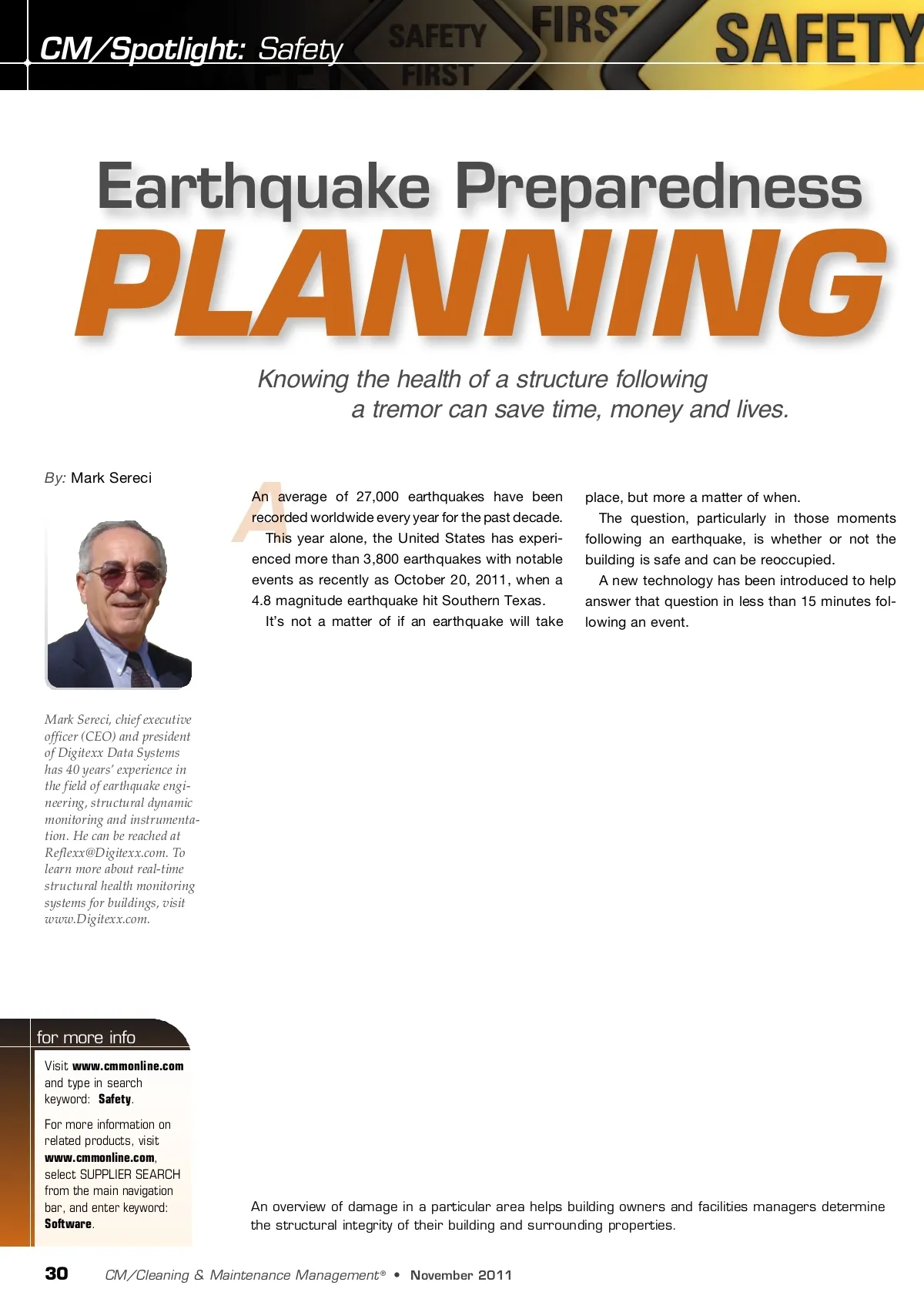
A detailed analysis of damage by floor can help decision makers better prepare for repairs. Dr. Farzad Naeim, president of the Los Angeles Tall Buildings Council and past president of the Earthquake Engineering Research Institute, explains that, while we often associate earthquakes with the visual spectacle of a fallen building, in reality, most buildings today remain standing due in great part to our increased understand-ing of seismic events, new building codes and the cooperation of architects, building owners and structural engineers. However, it is often difficult — if not impossible — to visually confirm the struc-tural integrity of a building following an earthquake, and it is equally challenging to achieve this assessment quickly. Typically, a qualified structural engineer is required to do modeling and conduct a visual examination prior to making an assessment. And, even then, the assessment can be wrong. As Dr. Mustafa Erdik, professor of earth-quake engineering and chairman of the Department of Earthquake Engineering at Bogazici University in Istanbul, stated in a recent New York Times report, “To say that a building is in bad condition is easy; to say that one is safe is hard.” ately benefits structural engineers, building owners and facility managers. “Imagine the value of knowing the actual health of a building just minutes after an earthquake event,” says Dr. Naeim. “A building emergency management team can determine on the spot whether to allow tenants back into a building or evacuate it. They can even receive detailed reporting on critical structural and non-structural components — like a heating, ventilation and air conditioning (HVAC) system or server system — and know what’s dam-aged as well as the estimated time and cost to repair. This technology closes the time gap so building management teams can react quickly to get their building oper-able again.” Additionally, the new technology is turn-key and available through a subscription model versus an upfront capital expense. “Our model is simple: Provide every-thing from the initial building evaluation and installation to the 24/7 reporting sys-tem and on-call structural engineering support,” states Angela Miller, Digitexx Data Systems director of marketing. “By providing the system through a month-Delivering Structural Integrity Reports Within Minutes A new smart system technology is provid-ing real-time monitoring, damage detec-tion and performance evaluation reporting that dramatically speeds up the damage detection and analysis time, enabling facil-ity and maintenance managers to make immediate decisions regarding occupancy and repairs. This technology, which can be manu-ally activated to generate a routine health assessment or automatically triggered by sensor threshold exceedance, combines real-time sensor data with sophisticated structural algorithms based on proven engineering methodologies such as FEMA-356, HAZUS-MH, ASCE-41 and ATC-58. As a result, in less than 15 minutes fol-lowing a triggered event, the system pro-duces detailed, actionable damage prob-ability report data in a format that immedi-With the assistance of software, an imminent collapse can be predicted, allowing building occupants to be evacuated to a safe area. ly subscription, building managers can avoid huge upfront capital investments and categorize the system as an operating expense, making additional safety mea-sures more affordable.” CM www.cmmonline.com 31
CMM – Archives Nov 2011: 31