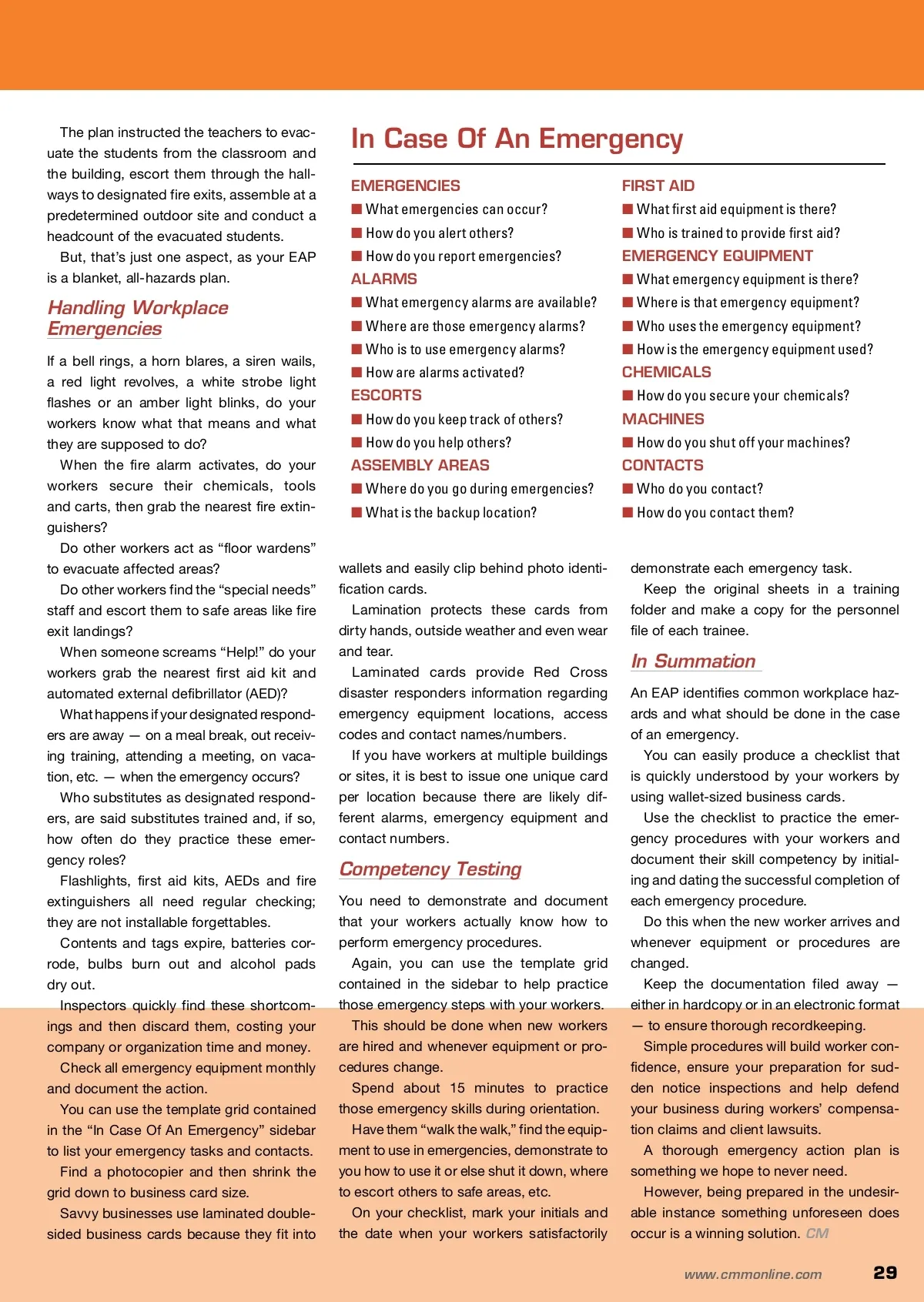
The plan instructed the teachers to evac-uate the students from the classroom and the building, escort them through the hall-ways to designated fire exits, assemble at a predetermined outdoor site and conduct a headcount of the evacuated students. But, that’s just one aspect, as your EAP is a blanket, all-hazards plan. In Case Of An Emergency EMERGENCIES ■ How do you alert others? ALARMS ■ What emergencies can occur? FIRST AID ■ What first aid equipment is there? EMERGENCY EQUIPMENT ■ Who is trained to provide first aid? ■ What emergency equipment is there? ■ How do you report emergencies? ■ What emergency alarms are available? ■ Where are those emergency alarms? ■ Who is to use emergency alarms? ■ How are alarms activated? ESCORTS Handling Workplace Emergencies If a bell rings, a horn blares, a siren wails, a red light revolves, a white strobe light flashes or an amber light blinks, do your workers know what that means and what they are supposed to do? When the fire alarm activates, do your workers secure their chemicals, tools and carts, then grab the nearest fire extin-guishers? Do other workers act as “floor wardens” to evacuate affected areas? Do other workers find the “special needs” staff and escort them to safe areas like fire exit landings? When someone screams “Help!” do your workers grab the nearest first aid kit and automated external defibrillator (AED)? What happens if your designated respond-ers are away — on a meal break, out receiv-ing training, attending a meeting, on vaca-tion, etc. — when the emergency occurs? Who substitutes as designated respond-ers, are said substitutes trained and, if so, how often do they practice these emer-gency roles? Flashlights, first aid kits, AEDs and fire extinguishers all need regular checking; they are not installable forgettables. Contents and tags expire, batteries cor-rode, bulbs burn out and alcohol pads dry out. Inspectors quickly find these shortcom-ings and then discard them, costing your company or organization time and money. Check all emergency equipment monthly and document the action. You can use the template grid contained in the “In Case Of An Emergency” sidebar to list your emergency tasks and contacts. Find a photocopier and then shrink the grid down to business card size. Savvy businesses use laminated double-sided business cards because they fit into ■ Where is that emergency equipment? ■ Who uses the emergency equipment? CHEMICALS MACHINES CONTACTS ■ How is the emergency equipment used? ■ How do you secure your chemicals? ■ How do you shut off your machines? ■ Who do you contact? ■ How do you keep track of others? ■ How do you help others? ASSEMBLY AREAS ■ What is the backup location? ■ Where do you go during emergencies? ■ How do you contact them? wallets and easily clip behind photo identi-fication cards. Lamination protects these cards from dirty hands, outside weather and even wear and tear. Laminated cards provide Red Cross disaster responders information regarding emergency equipment locations, access codes and contact names/numbers. If you have workers at multiple buildings or sites, it is best to issue one unique card per location because there are likely dif-ferent alarms, emergency equipment and contact numbers. demonstrate each emergency task. Keep the original sheets in a training folder and make a copy for the personnel file of each trainee. In Summation An EAP identifies common workplace haz-ards and what should be done in the case of an emergency. You can easily produce a checklist that is quickly understood by your workers by using wallet-sized business cards. Use the checklist to practice the emer-gency procedures with your workers and document their skill competency by initial-ing and dating the successful completion of each emergency procedure. Do this when the new worker arrives and whenever equipment or procedures are changed. Keep the documentation filed away — either in hardcopy or in an electronic format — to ensure thorough recordkeeping. Simple procedures will build worker con-fidence, ensure your preparation for sud-den notice inspections and help defend your business during workers’ compensa-tion claims and client lawsuits. A thorough emergency action plan is something we hope to never need. However, being prepared in the undesir-able instance something unforeseen does occur is a winning solution. CM www.cmmonline.com Competency Testing You need to demonstrate and document that your workers actually know how to perform emergency procedures. Again, you can use the template grid contained in the sidebar to help practice those emergency steps with your workers. This should be done when new workers are hired and whenever equipment or pro-cedures change. Spend about 15 minutes to practice those emergency skills during orientation. Have them “walk the walk,” find the equip-ment to use in emergencies, demonstrate to you how to use it or else shut it down, where to escort others to safe areas, etc. On your checklist, mark your initials and the date when your workers satisfactorily 29
CMM – Archives Nov 2011: 29