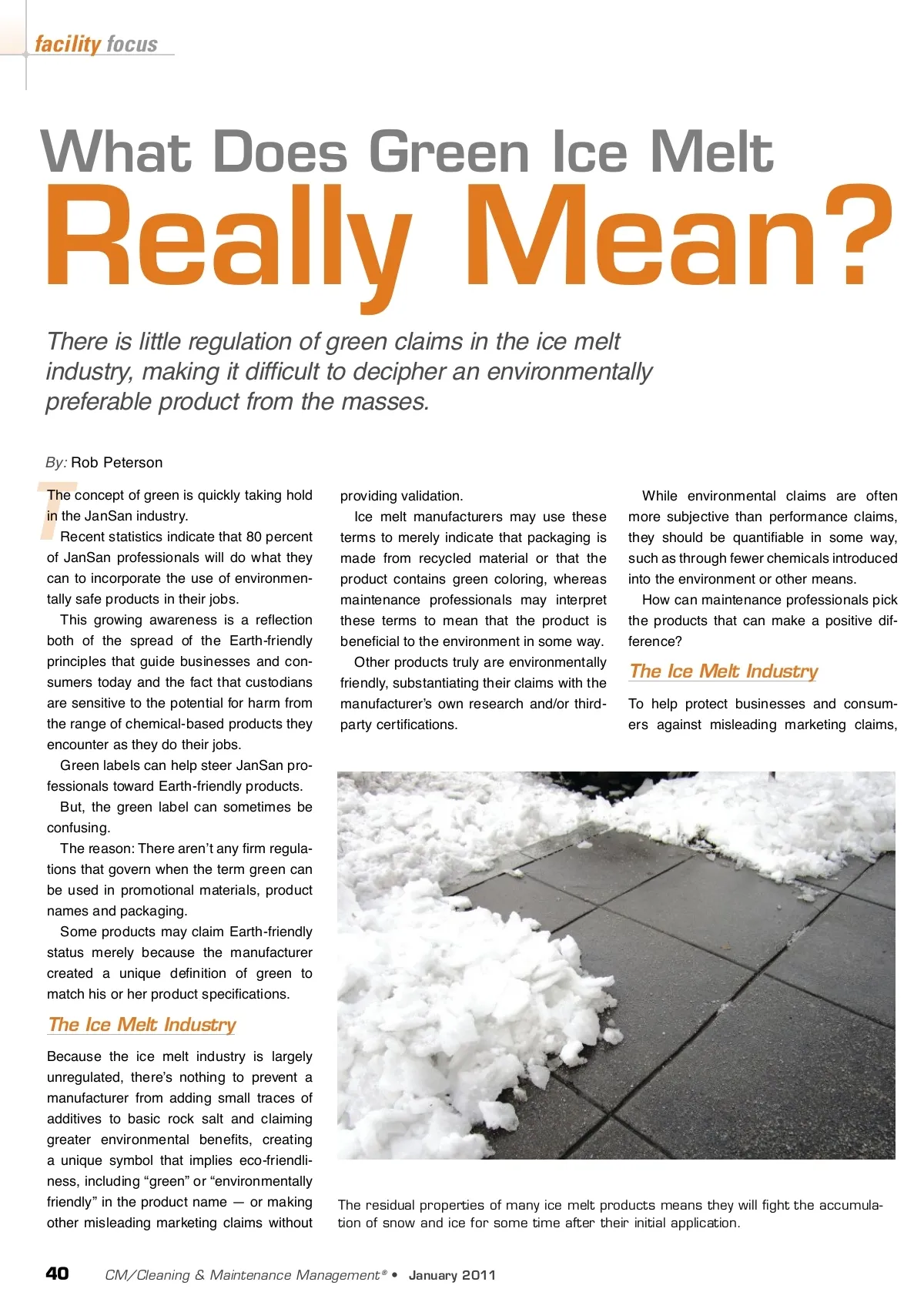
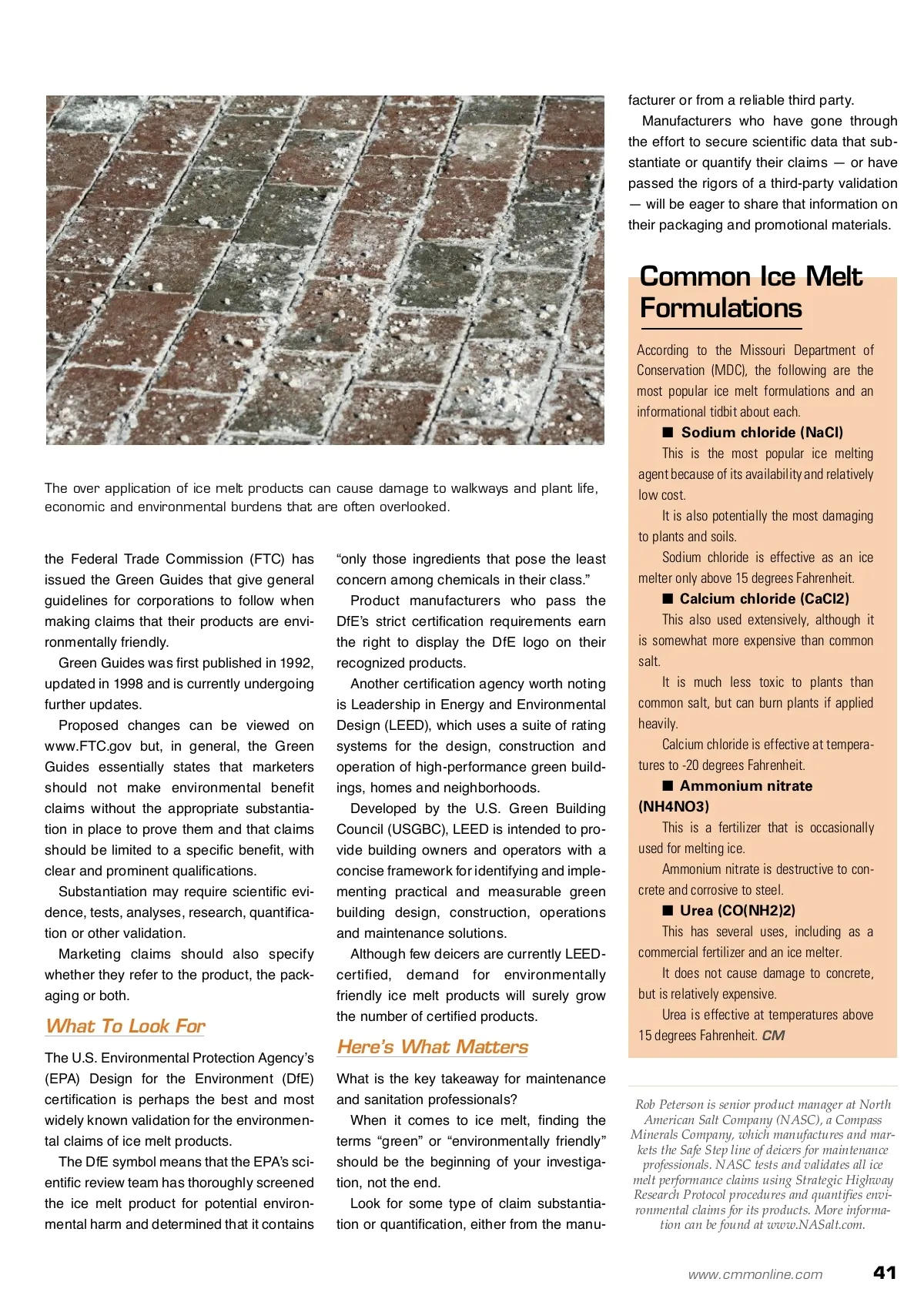
facturer or from a reliable third party. Manufacturers who have gone through the effort to secure scientific data that sub-stantiate or quantify their claims — or have passed the rigors of a third-party validation — will be eager to share that information on their packaging and promotional materials. Common Ice Melt Formulations According to the Missouri Department of Conservation (MDC), the following are the most popular ice melt formulations and an informational tidbit about each. ■ Sodium chloride (NaCl) This is the most popular ice melting agent because of its availability and relatively low cost. It is also potentially the most damaging to plants and soils. Sodium chloride is effective as an ice melter only above 15 degrees Fahrenheit. ■ Calcium chloride (CaCl2) This also used extensively, although it is somewhat more expensive than common salt. It is much less toxic to plants than common salt, but can burn plants if applied heavily. Calcium chloride is effective at tempera-tures to -20 degrees Fahrenheit. ■ Ammonium nitrate (NH4NO3) This is a fertilizer that is occasionally used for melting ice. Ammonium nitrate is destructive to con-crete and corrosive to steel. ■ Urea (CO(NH2)2) This has several uses, including as a commercial fertilizer and an ice melter. It does not cause damage to concrete, but is relatively expensive. Urea is effective at temperatures above 15 degrees Fahrenheit. CM The over application of ice melt products can cause damage to walkways and plant life, economic and environmental burdens that are often overlooked. the Federal Trade Commission (FTC) has issued the Green Guides that give general guidelines for corporations to follow when making claims that their products are envi-ronmentally friendly. Green Guides was first published in 1992, updated in 1998 and is currently undergoing further updates. Proposed changes can be viewed on www.FTC.gov but, in general, the Green Guides essentially states that marketers should not make environmental benefit claims without the appropriate substantia-tion in place to prove them and that claims should be limited to a specific benefit, with clear and prominent qualifications. Substantiation may require scientific evi-dence, tests, analyses, research, quantifica-tion or other validation. Marketing claims should also specify whether they refer to the product, the pack-aging or both. What To Look For The U.S. Environmental Protection Agency’s (EPA) Design for the Environment (DfE) certification is perhaps the best and most widely known validation for the environmen-tal claims of ice melt products. The DfE symbol means that the EPA’s sci-entific review team has thoroughly screened the ice melt product for potential environ-mental harm and determined that it contains “only those ingredients that pose the least concern among chemicals in their class.” Product manufacturers who pass the DfE’s strict certification requirements earn the right to display the DfE logo on their recognized products. Another certification agency worth noting is Leadership in Energy and Environmental Design (LEED), which uses a suite of rating systems for the design, construction and operation of high-performance green build-ings, homes and neighborhoods. Developed by the U.S. Green Building Council (USGBC), LEED is intended to pro-vide building owners and operators with a concise framework for identifying and imple-menting practical and measurable green building design, construction, operations and maintenance solutions. Although few deicers are currently LEED-certified, demand for environmentally friendly ice melt products will surely grow the number of certified products. Here’s What Matters What is the key takeaway for maintenance and sanitation professionals? When it comes to ice melt, finding the terms “green” or “environmentally friendly” should be the beginning of your investiga-tion, not the end. Look for some type of claim substantia-tion or quantification, either from the manu-Rob Peterson is senior product manager at North American Salt Company (NASC), a Compass Minerals Company, which manufactures and mar-kets the Safe Step line of deicers for maintenance professionals. NASC tests and validates all ice melt performance claims using Strategic Highway Research Protocol procedures and quantifies envi-ronmental claims for its products. More informa-tion can be found at www.NASalt.com. www.cmmonline.com 41
CMM – Archives Jan 2012: 41