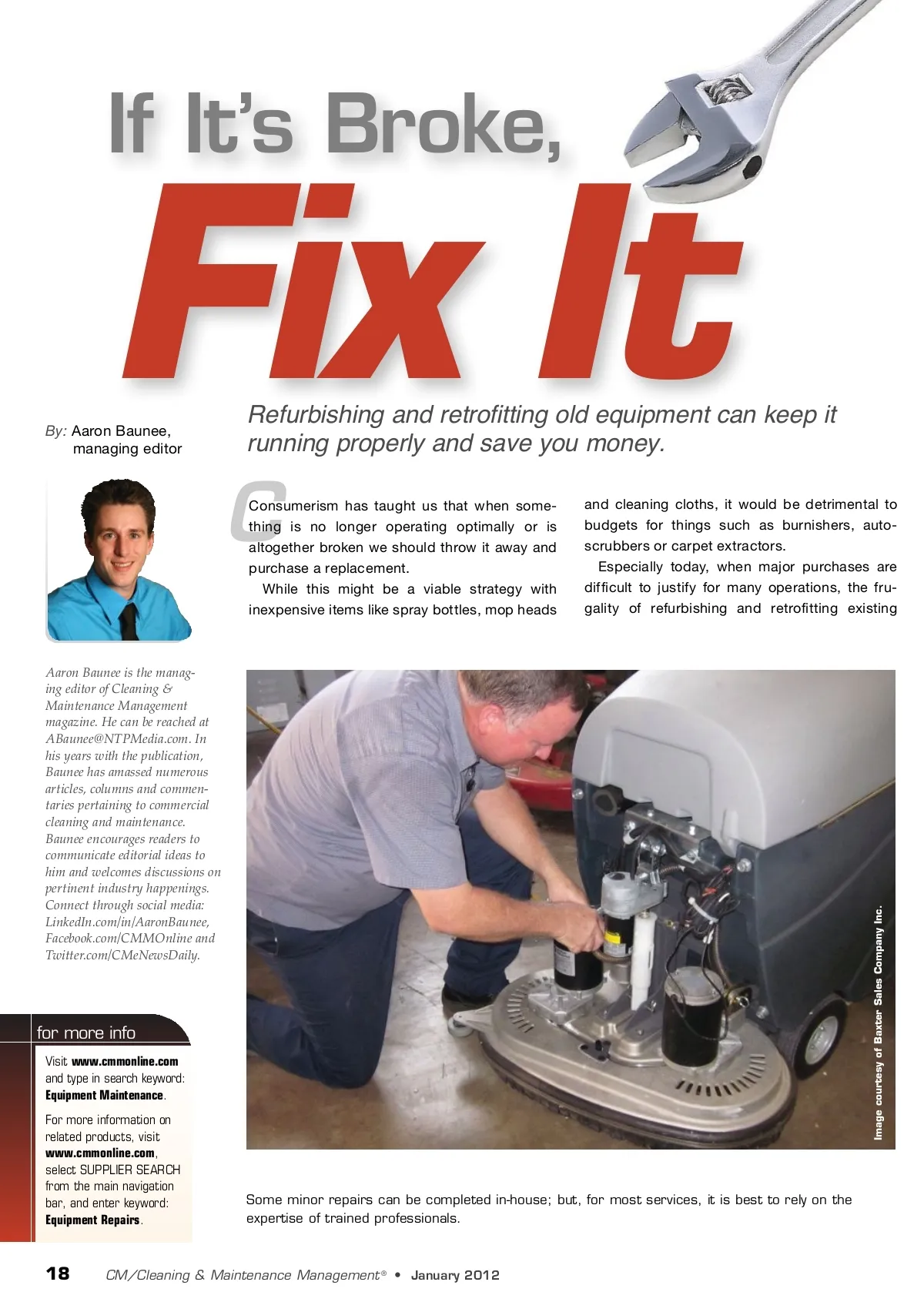
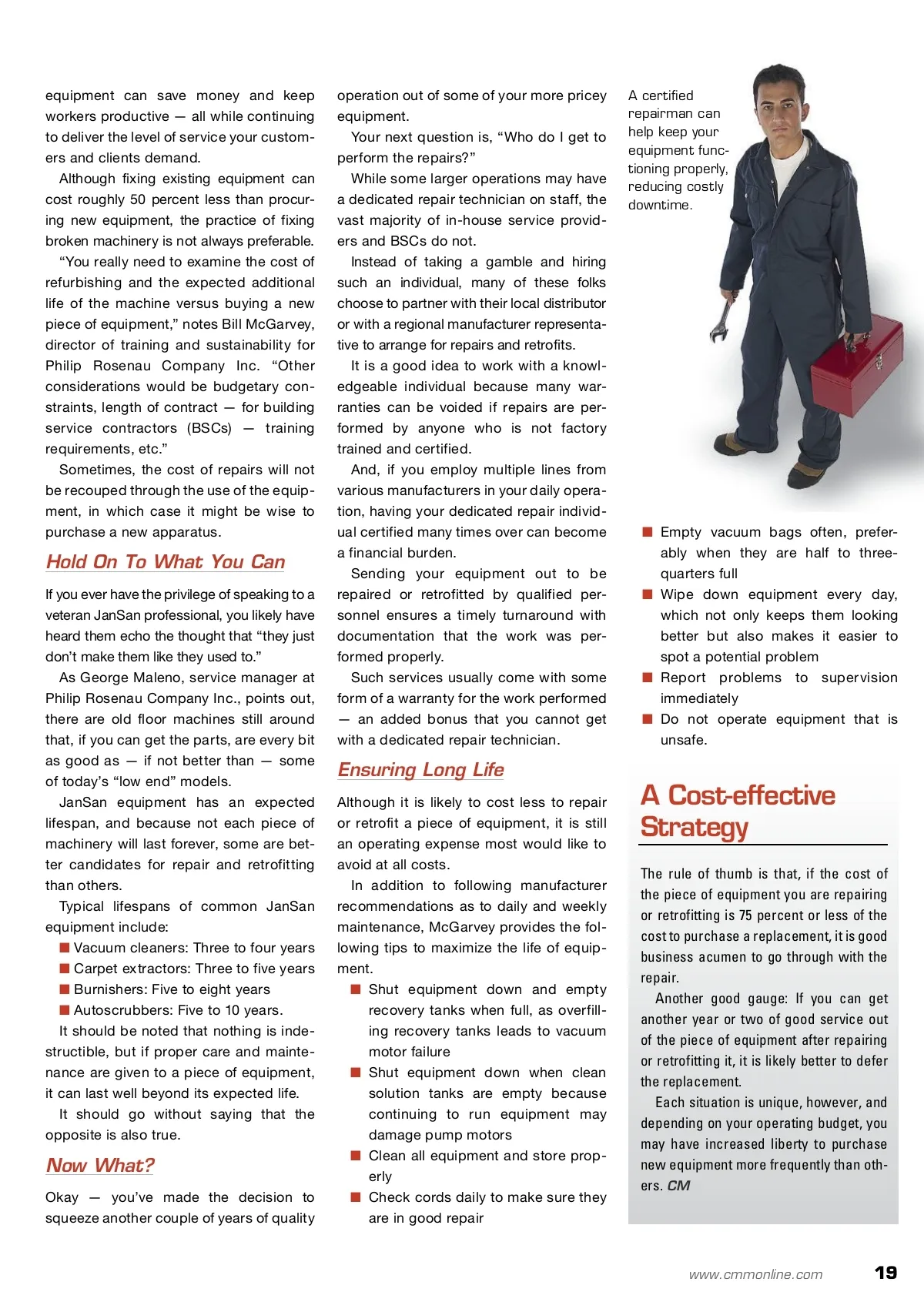
equipment can save money and keep workers productive — all while continuing to deliver the level of service your custom-ers and clients demand. Although fixing existing equipment can cost roughly 50 percent less than procur-ing new equipment, the practice of fixing broken machinery is not always preferable. “You really need to examine the cost of refurbishing and the expected additional life of the machine versus buying a new piece of equipment,” notes Bill McGarvey, director of training and sustainability for Philip Rosenau Company Inc. “Other considerations would be budgetary con-straints, length of contract — for building service contractors (BSCs) — training requirements, etc.” Sometimes, the cost of repairs will not be recouped through the use of the equip-ment, in which case it might be wise to purchase a new apparatus. Hold On To What You Can If you ever have the privilege of speaking to a veteran JanSan professional, you likely have heard them echo the thought that “they just don’t make them like they used to.” As George Maleno, service manager at Philip Rosenau Company Inc., points out, there are old floor machines still around that, if you can get the parts, are every bit as good as — if not better than — some of today’s “low end” models. JanSan equipment has an expected lifespan, and because not each piece of machinery will last forever, some are bet-ter candidates for repair and retrofitting than others. Typical lifespans of common JanSan equipment include: ■ Vacuum cleaners: Three to four years ■ Carpet extractors: Three to five years ■ Burnishers: Five to eight years ■ Autoscrubbers: Five to 10 years. It should be noted that nothing is inde-structible, but if proper care and mainte-nance are given to a piece of equipment, it can last well beyond its expected life. It should go without saying that the opposite is also true. operation out of some of your more pricey equipment. Your next question is, “Who do I get to perform the repairs?” While some larger operations may have a dedicated repair technician on staff, the vast majority of in-house service provid-ers and BSCs do not. Instead of taking a gamble and hiring such an individual, many of these folks choose to partner with their local distributor or with a regional manufacturer representa-tive to arrange for repairs and retrofits. It is a good idea to work with a knowl-edgeable individual because many war-ranties can be voided if repairs are per-formed by anyone who is not factory trained and certified. And, if you employ multiple lines from various manufacturers in your daily opera-tion, having your dedicated repair individ-ual certified many times over can become a financial burden. Sending your equipment out to be repaired or retrofitted by qualified per-sonnel ensures a timely turnaround with documentation that the work was per-formed properly. Such services usually come with some form of a warranty for the work performed — an added bonus that you cannot get with a dedicated repair technician. A certified repairman can help keep your equipment func-tioning properly, reducing costly downtime. ■ Empty vacuum bags often, prefer-ably when they are half to three-quarters full ■ Wipe down equipment every day, which not only keeps them looking better but also makes it easier to spot a potential problem ■ Report problems to supervision immediately ■ Do not operate equipment that is unsafe. Ensuring Long Life Although it is likely to cost less to repair or retrofit a piece of equipment, it is still an operating expense most would like to avoid at all costs. In addition to following manufacturer recommendations as to daily and weekly maintenance, McGarvey provides the fol-lowing tips to maximize the life of equip-ment. ■ Shut equipment down and empty recovery tanks when full, as overfill-ing recovery tanks leads to vacuum motor failure ■ Shut equipment down when clean solution tanks are empty because continuing to run equipment may damage pump motors ■ Clean all equipment and store prop-erly ■ Check cords daily to make sure they are in good repair A Cost-effective Strategy The rule of thumb is that, if the cost of the piece of equipment you are repairing or retrofitting is 75 percent or less of the cost to purchase a replacement, it is good business acumen to go through with the repair. Another good gauge: If you can get another year or two of good service out of the piece of equipment after repairing or retrofitting it, it is likely better to defer the replacement. Each situation is unique, however, and depending on your operating budget, you may have increased liberty to purchase new equipment more frequently than oth-ers. CM Now What? Okay — you’ve made the decision to squeeze another couple of years of quality www.cmmonline.com 19
CMM – Archives Jan 2012: 19