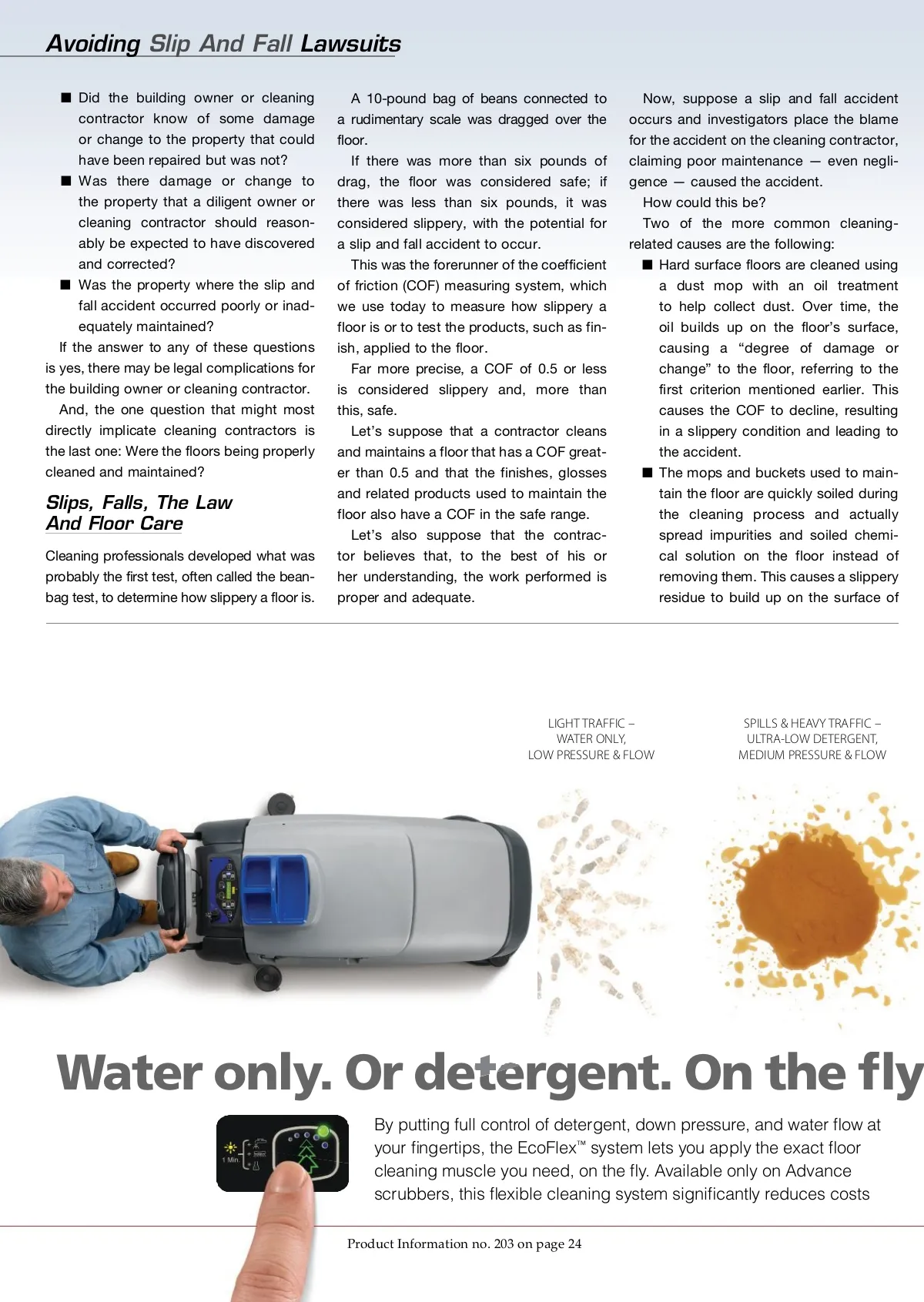
Avoiding Slip And Fall Lawsuits ■ Did the building owner or cleaning contractor know of some damage or change to the property that could have been repaired but was not? ■ Was there damage or change to the property that a diligent owner or cleaning contractor should reason-ably be expected to have discovered and corrected? ■ Was the property where the slip and fall accident occurred poorly or inad-equately maintained? If the answer to any of these questions is yes, there may be legal complications for the building owner or cleaning contractor. And, the one question that might most directly implicate cleaning contractors is the last one: Were the floors being properly cleaned and maintained? A 10-pound bag of beans connected to a rudimentary scale was dragged over the floor. If there was more than six pounds of drag, the floor was considered safe; if there was less than six pounds, it was considered slippery, with the potential for a slip and fall accident to occur. This was the forerunner of the coefficient of friction (COF) measuring system, which we use today to measure how slippery a floor is or to test the products, such as fin-ish, applied to the floor. Far more precise, a COF of 0.5 or less is considered slippery and, more than this, safe. Let’s suppose that a contractor cleans and maintains a floor that has a COF great-er than 0.5 and that the finishes, glosses and related products used to maintain the floor also have a COF in the safe range. Let’s also suppose that the contrac-tor believes that, to the best of his or her understanding, the work performed is proper and adequate. Now, suppose a slip and fall accident occurs and investigators place the blame for the accident on the cleaning contractor, claiming poor maintenance — even negli-gence — caused the accident. How could this be? Two of the more common cleaning-related causes are the following: ■ Hard surface floors are cleaned using a dust mop with an oil treatment to help collect dust. Over time, the oil builds up on the floor’s surface, causing a “degree of damage or change” to the floor, referring to the first criterion mentioned earlier. This causes the COF to decline, resulting in a slippery condition and leading to the accident. ■ The mops and buckets used to main-tain the floor are quickly soiled during the cleaning process and actually spread impurities and soiled chemi-cal solution on the floor instead of removing them. This causes a slippery residue to build up on the surface of Slips, Falls, The Law And Floor Care Cleaning professionals developed what was probably the first test, often called the bean-bag test, to determine how slippery a floor is. LIGHT TRAFFIC – WATER ONLY, LOW PRESSURE & FLOW SPILLS & HEAVY TRAFFIC – ULTRA-LOW DETERGENT, MEDIUM PRESSURE & FLOW Water only. Or detergent. On the fl y By putting full control of detergent, down pressure, and water fl ow at your fi ngertips, the EcoFlex ™ system lets you apply the exact fl oor cleaning muscle you need, on the fl y. Available only on Advance scrubbers, this fl exible cleaning system signifi cantly reduces costs Product Information no. 203 on page 24
CMM – Archives Jan 2012: 16