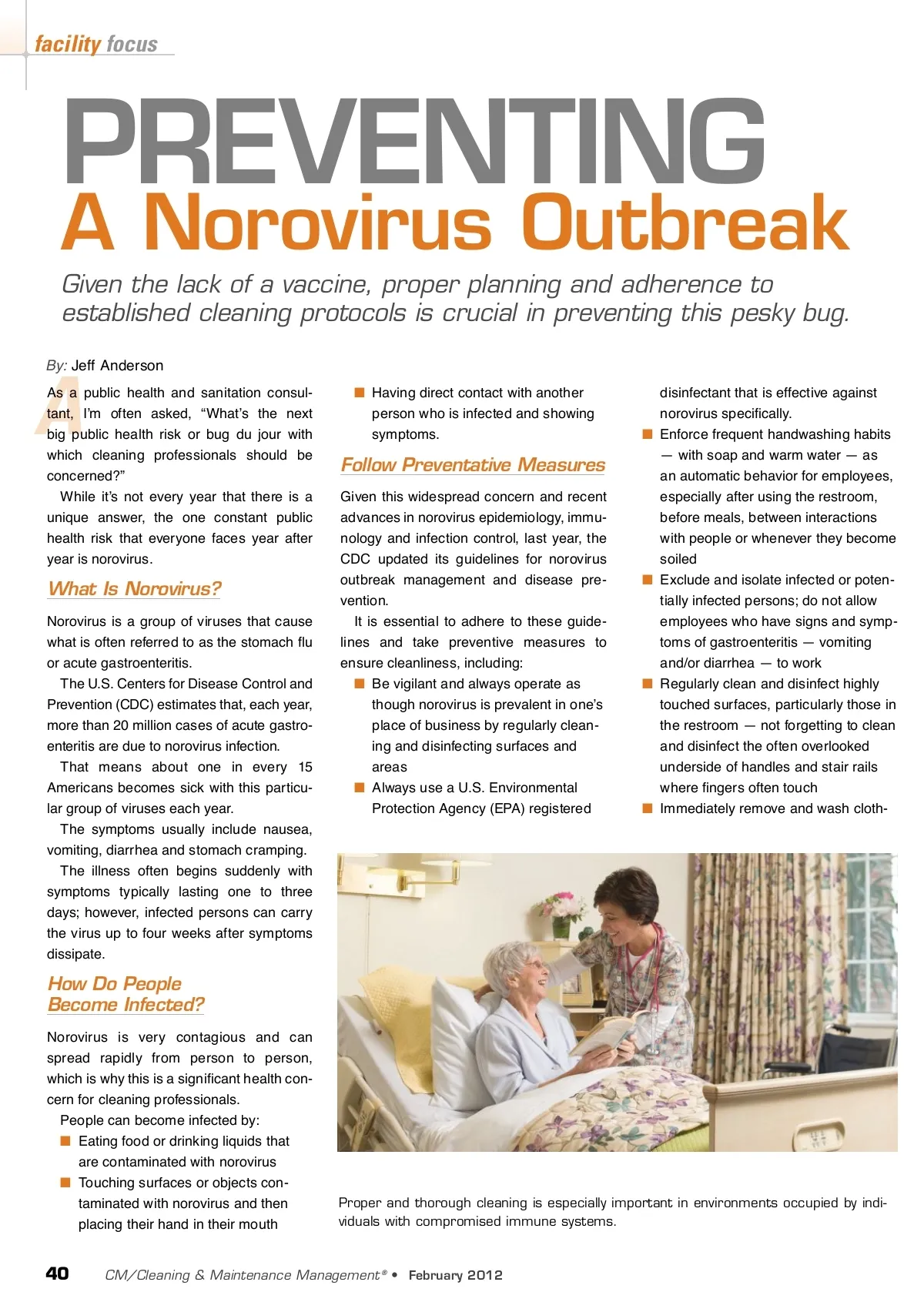
facility focus PREVENTING By: Jeff Anderson ANorovirusOutbreak Given the lack of a vaccine, proper planning and adherence to established cleaning protocols is crucial in preventing this pesky bug. A As a public health and sanitation consul-tant, I’m often asked, “What’s the next big public health risk or bug du jour with which cleaning professionals should be concerned?” While it’s not every year that there is a unique answer, the one constant public health risk that everyone faces year after year is norovirus. ■ Having direct contact with another person who is infected and showing symptoms. ■ Follow Preventative Measures Given this widespread concern and recent advances in norovirus epidemiology, immu-nology and infection control, last year, the CDC updated its guidelines for norovirus outbreak management and disease pre-vention. It is essential to adhere to these guide-lines and take preventive measures to ensure cleanliness, including: ■ Be vigilant and always operate as though norovirus is prevalent in one’s place of business by regularly clean-ing and disinfecting surfaces and areas ■ Always use a U.S. Environmental Protection Agency (EPA) registered What Is Norovirus? Norovirus is a group of viruses that cause what is often referred to as the stomach flu or acute gastroenteritis. The U.S. Centers for Disease Control and Prevention (CDC) estimates that, each year, more than 20 million cases of acute gastro-enteritis are due to norovirus infection. That means about one in every 15 Americans becomes sick with this particu-lar group of viruses each year. The symptoms usually include nausea, vomiting, diarrhea and stomach cramping. The illness often begins suddenly with symptoms typically lasting one to three days; however, infected persons can carry the virus up to four weeks after symptoms dissipate. ■ ■ ■ disinfectant that is effective against norovirus specifically. Enforce frequent handwashing habits — with soap and warm water — as an automatic behavior for employees, especially after using the restroom, before meals, between interactions with people or whenever they become soiled Exclude and isolate infected or poten-tially infected persons; do not allow employees who have signs and symp-toms of gastroenteritis — vomiting and/or diarrhea — to work Regularly clean and disinfect highly touched surfaces, particularly those in the restroom — not forgetting to clean and disinfect the often overlooked underside of handles and stair rails where fingers often touch Immediately remove and wash cloth-How Do People Become Infected? Norovirus is very contagious and can spread rapidly from person to person, which is why this is a significant health con-cern for cleaning professionals. People can become infected by: ■ Eating food or drinking liquids that are contaminated with norovirus ■ Touching surfaces or objects con-taminated with norovirus and then placing their hand in their mouth Proper and thorough cleaning is especially important in environments occupied by indi-viduals with compromised immune systems. 40 CM/Cleaning & Maintenance Management ® • February2012
CMM – Archives Feb 2012: 40