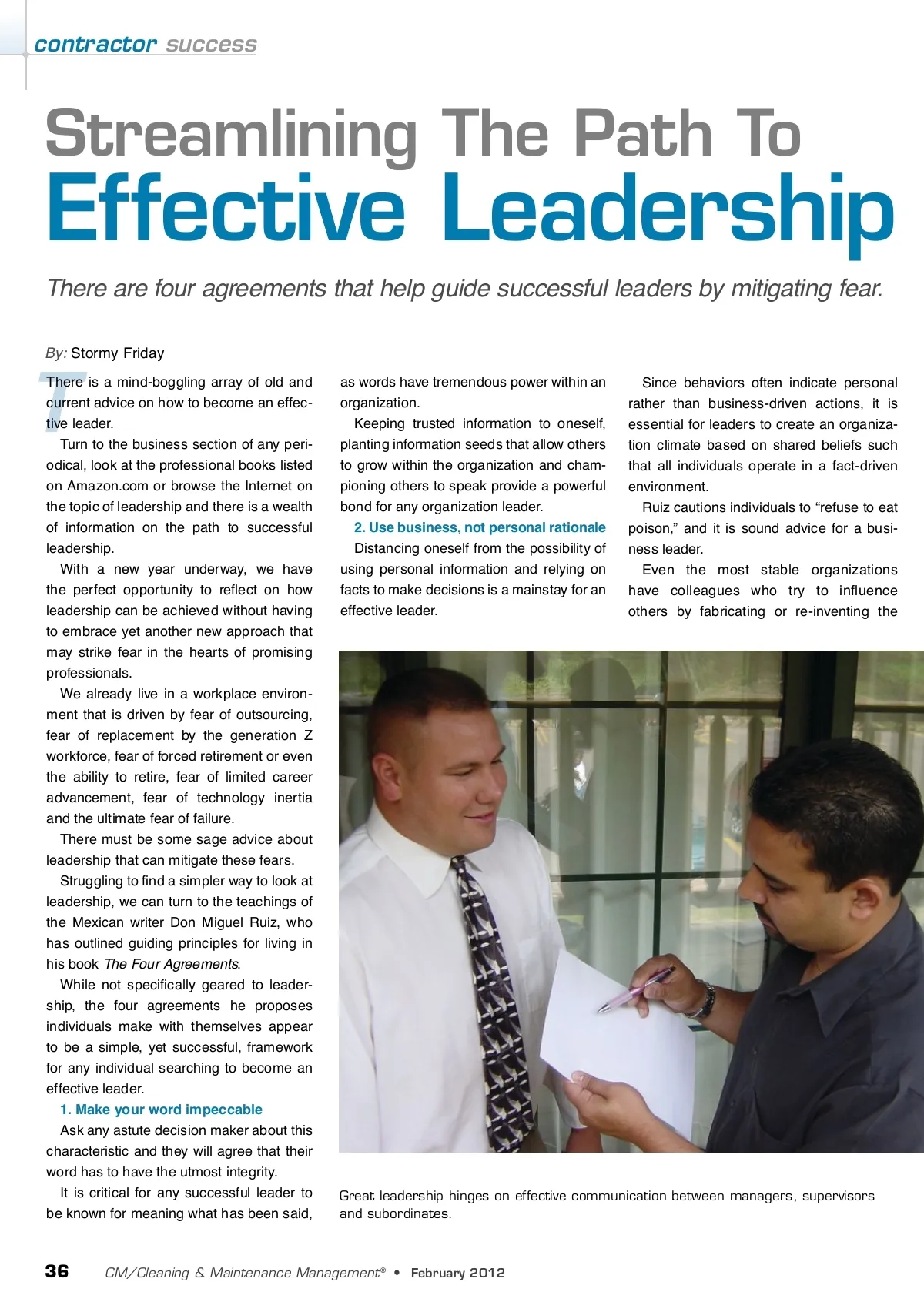
contractor success Streamlining The Path To Effective Leadership There are four agreements that help guide successful leaders by mitigating fear. By: Stormy Friday T There is a mind-boggling array of old and current advice on how to become an effec-tive leader. Turn to the business section of any peri-odical, look at the professional books listed on Amazon.com or browse the Internet on the topic of leadership and there is a wealth of information on the path to successful leadership. With a new year underway, we have the perfect opportunity to reflect on how leadership can be achieved without having to embrace yet another new approach that may strike fear in the hearts of promising professionals. We already live in a workplace environ-ment that is driven by fear of outsourcing, fear of replacement by the generation Z workforce, fear of forced retirement or even the ability to retire, fear of limited career advancement, fear of technology inertia and the ultimate fear of failure. There must be some sage advice about leadership that can mitigate these fears. Struggling to find a simpler way to look at leadership, we can turn to the teachings of the Mexican writer Don Miguel Ruiz, who has outlined guiding principles for living in his book The Four Agreements . While not specifically geared to leader-ship, the four agreements he proposes individuals make with themselves appear to be a simple, yet successful, framework for any individual searching to become an effective leader. 1. Make your word impeccable Ask any astute decision maker about this characteristic and they will agree that their word has to have the utmost integrity. It is critical for any successful leader to be known for meaning what has been said, as words have tremendous power within an organization. Keeping trusted information to oneself, planting information seeds that allow others to grow within the organization and cham-pioning others to speak provide a powerful bond for any organization leader. 2. Use business, not personal rationale Distancing oneself from the possibility of using personal information and relying on facts to make decisions is a mainstay for an effective leader. Since behaviors often indicate personal rather than business-driven actions, it is essential for leaders to create an organiza-tion climate based on shared beliefs such that all individuals operate in a fact-driven environment. Ruiz cautions individuals to “refuse to eat poison,” and it is sound advice for a busi-ness leader. Even the most stable organizations have colleagues who try to influence others by fabricating or re-inventing the Great leadership hinges on effective communication between managers, supervisors and subordinates. 36 CM/Cleaning & Maintenance Management ® • February 2012
CMM – Archives Feb 2012: 36