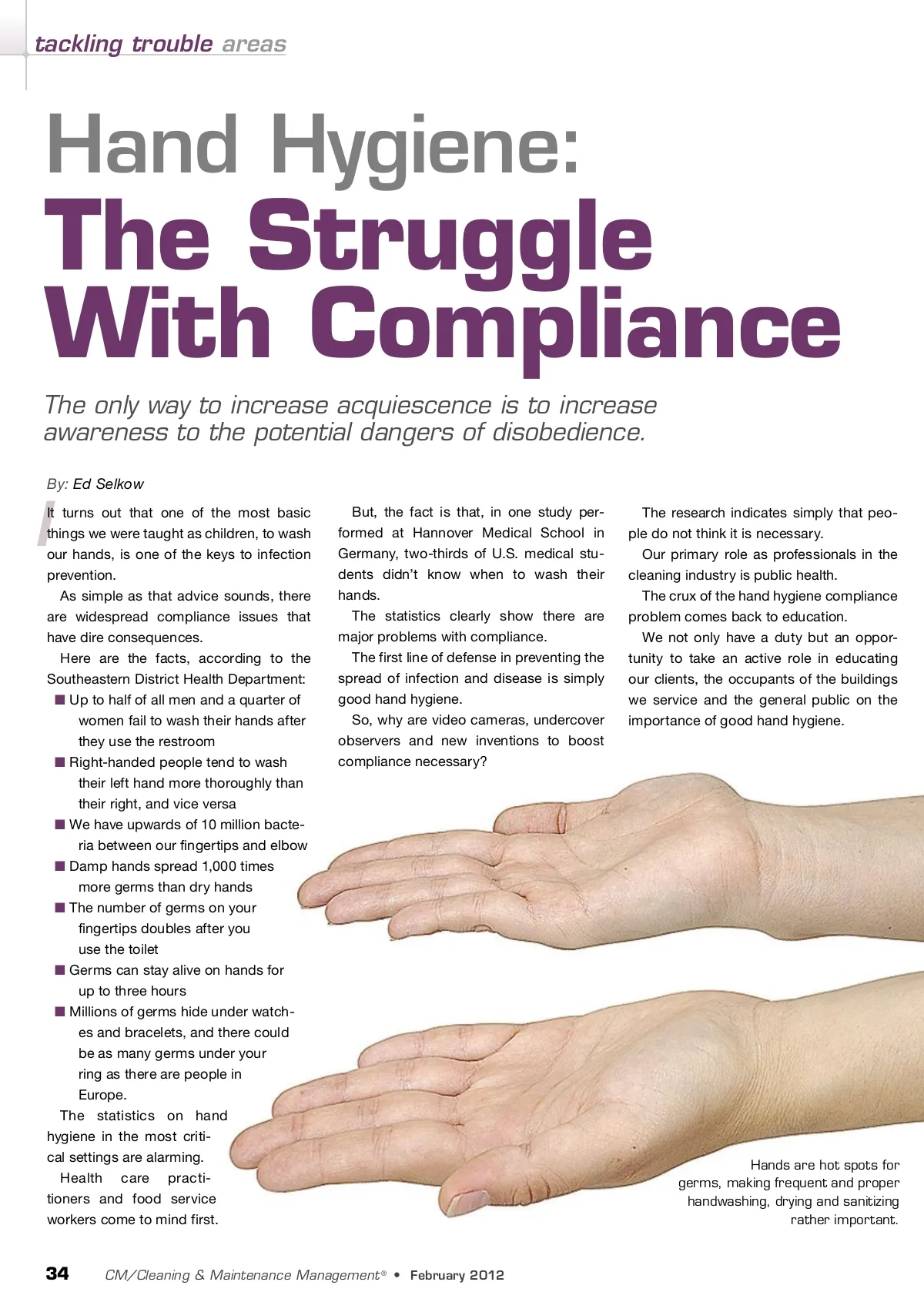
tackling trouble areas Hand Hygiene: The Struggle With Compliance The only way to increase acquiescence is to increase awareness to the potential dangers of disobedience. By: Ed Selkow I It turns out that one of the most basic things we were taught as children, to wash our hands, is one of the keys to infection prevention. As simple as that advice sounds, there are widespread compliance issues that have dire consequences. Here are the facts, according to the Southeastern District Health Department: ■ Up to half of all men and a quarter of women fail to wash their hands after they use the restroom ■ Right-handed people tend to wash their left hand more thoroughly than their right, and vice versa ■ We have upwards of 10 million bacte-ria between our fingertips and elbow ■ Damp hands spread 1,000 times more germs than dry hands ■ The number of germs on your fingertips doubles after you use the toilet ■ Germs can stay alive on hands for up to three hours ■ Millions of germs hide under watch-es and bracelets, and there could be as many germs under your ring as there are people in Europe. The statistics on hand hygiene in the most criti-cal settings are alarming. Health care practi-tioners and food service workers come to mind first. But, the fact is that, in one study per-formed at Hannover Medical School in Germany, two-thirds of U.S. medical stu-dents didn’t know when to wash their hands. The statistics clearly show there are major problems with compliance. The first line of defense in preventing the spread of infection and disease is simply good hand hygiene. So, why are video cameras, undercover observers and new inventions to boost compliance necessary? The research indicates simply that peo-ple do not think it is necessary. Our primary role as professionals in the cleaning industry is public health. The crux of the hand hygiene compliance problem comes back to education. We not only have a duty but an oppor-tunity to take an active role in educating our clients, the occupants of the buildings we service and the general public on the importance of good hand hygiene. Hands are hot spots for germs, making frequent and proper handwashing, drying and sanitizing rather important. 34 CM/Cleaning & Maintenance Management ® • February 2012
CMM – Archives Feb 2012: 34