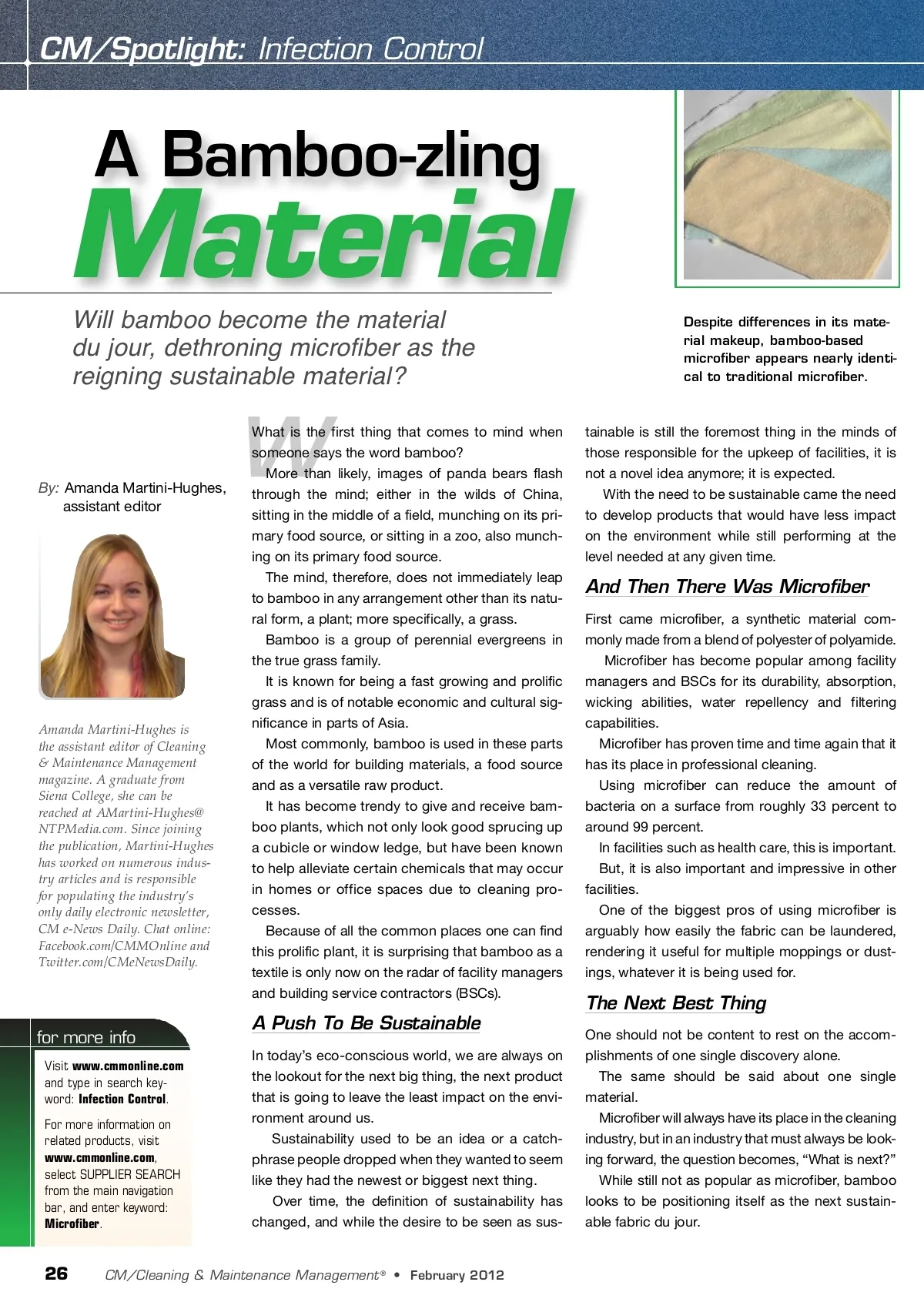
CM/Spotlight: Infection Control Material Will bamboo become the material du jour, dethroning microfiber as the reigning sustainable material? Despite differences in its mate-rial makeup, bamboo-based microfiber appears nearly identi-cal to traditional microfiber. A Bamboo-zling By: Amanda Martini-Hughes, assistant editor W Amanda Martini-Hughes is the assistant editor of Cleaning & Maintenance Management magazine. A graduate from Siena College, she can be reached at AMartini-Hughes@ NTPMedia.com. Since joining the publication, Martini-Hughes has worked on numerous indus-try articles and is responsible for populating the industry’s only daily electronic newsletter, CM e-News Daily. Chat online: Facebook.com/CMMOnline and Twitter.com/CMeNewsDaily. What is the first thing that comes to mind when someone says the word bamboo? More than likely, images of panda bears flash through the mind; either in the wilds of China, sitting in the middle of a field, munching on its pri-mary food source, or sitting in a zoo, also munch-ing on its primary food source. The mind, therefore, does not immediately leap to bamboo in any arrangement other than its natu-ral form, a plant; more specifically, a grass. Bamboo is a group of perennial evergreens in the true grass family. It is known for being a fast growing and prolific grass and is of notable economic and cultural sig-nificance in parts of Asia. Most commonly, bamboo is used in these parts of the world for building materials, a food source and as a versatile raw product. It has become trendy to give and receive bam-boo plants, which not only look good sprucing up a cubicle or window ledge, but have been known to help alleviate certain chemicals that may occur in homes or office spaces due to cleaning pro-cesses. Because of all the common places one can find this prolific plant, it is surprising that bamboo as a textile is only now on the radar of facility managers and building service contractors (BSCs). tainable is still the foremost thing in the minds of those responsible for the upkeep of facilities, it is not a novel idea anymore; it is expected. With the need to be sustainable came the need to develop products that would have less impact on the environment while still performing at the level needed at any given time. And Then There Was Microfiber First came microfiber, a synthetic material com-monly made from a blend of polyester of polyamide. Microfiber has become popular among facility managers and BSCs for its durability, absorption, wicking abilities, water repellency and filtering capabilities. Microfiber has proven time and time again that it has its place in professional cleaning. Using microfiber can reduce the amount of bacteria on a surface from roughly 33 percent to around 99 percent. In facilities such as health care, this is important. But, it is also important and impressive in other facilities. One of the biggest pros of using microfiber is arguably how easily the fabric can be laundered, rendering it useful for multiple moppings or dust-ings, whatever it is being used for. The Next Best Thing One should not be content to rest on the accom-plishments of one single discovery alone. The same should be said about one single material. Microfiber will always have its place in the cleaning industry, but in an industry that must always be look-ing forward, the question becomes, “What is next?” While still not as popular as microfiber, bamboo looks to be positioning itself as the next sustain-able fabric du jour. A Push To Be Sustainable for more info Visit www.cmmonline.com and type in search key-word: Infection Control . For more information on related products, visit www.cmmonline.com , select SUPPLIER SEARCH from the main navigation bar, and enter keyword: Microfiber . In today’s eco-conscious world, we are always on the lookout for the next big thing, the next product that is going to leave the least impact on the envi-ronment around us. Sustainability used to be an idea or a catch-phrase people dropped when they wanted to seem like they had the newest or biggest next thing. Over time, the definition of sustainability has changed, and while the desire to be seen as sus-26 CM/Cleaning & Maintenance Management ® • February 2012
CMM – Archives Feb 2012: 26