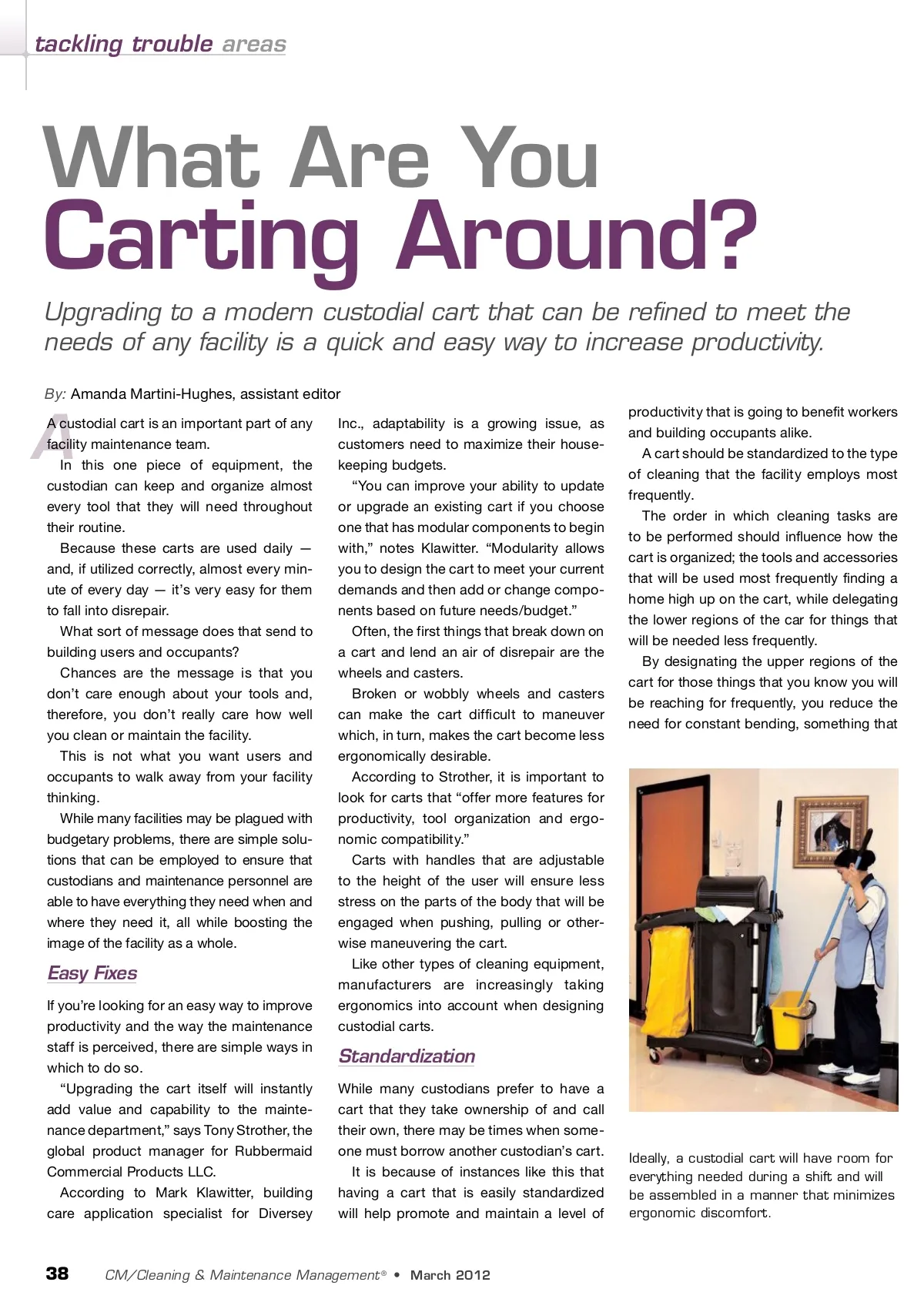
tackling trouble areas What Are You By: Amanda Martini-Hughes, assistant editor Carting Around? Upgrading to a modern custodial cart that can be refined to meet the needs of any facility is a quick and easy way to increase productivity. A A custodial cart is an important part of any facility maintenance team. In this one piece of equipment, the custodian can keep and organize almost every tool that they will need throughout their routine. Because these carts are used daily — and, if utilized correctly, almost every min-ute of every day — it’s very easy for them to fall into disrepair. What sort of message does that send to building users and occupants? Chances are the message is that you don’t care enough about your tools and, therefore, you don’t really care how well you clean or maintain the facility. This is not what you want users and occupants to walk away from your facility thinking. While many facilities may be plagued with budgetary problems, there are simple solu-tions that can be employed to ensure that custodians and maintenance personnel are able to have everything they need when and where they need it, all while boosting the image of the facility as a whole. Easy Fixes If you’re looking for an easy way to improve productivity and the way the maintenance staff is perceived, there are simple ways in which to do so. “Upgrading the cart itself will instantly add value and capability to the mainte-nance department,” says Tony Strother, the global product manager for Rubbermaid Commercial Products LLC. According to Mark Klawitter, building care application specialist for Diversey Inc., adaptability is a growing issue, as customers need to maximize their house-keeping budgets. “You can improve your ability to update or upgrade an existing cart if you choose one that has modular components to begin with,” notes Klawitter. “Modularity allows you to design the cart to meet your current demands and then add or change compo-nents based on future needs/budget.” Often, the first things that break down on a cart and lend an air of disrepair are the wheels and casters. Broken or wobbly wheels and casters can make the cart difficult to maneuver which, in turn, makes the cart become less ergonomically desirable. According to Strother, it is important to look for carts that “offer more features for productivity, tool organization and ergo-nomic compatibility.” Carts with handles that are adjustable to the height of the user will ensure less stress on the parts of the body that will be engaged when pushing, pulling or other-wise maneuvering the cart. Like other types of cleaning equipment, manufacturers are increasingly taking ergonomics into account when designing custodial carts. productivity that is going to benefit workers and building occupants alike. A cart should be standardized to the type of cleaning that the facility employs most frequently. The order in which cleaning tasks are to be performed should influence how the cart is organized; the tools and accessories that will be used most frequently finding a home high up on the cart, while delegating the lower regions of the car for things that will be needed less frequently. By designating the upper regions of the cart for those things that you know you will be reaching for frequently, you reduce the need for constant bending, something that Standardization While many custodians prefer to have a cart that they take ownership of and call their own, there may be times when some-one must borrow another custodian’s cart. It is because of instances like this that having a cart that is easily standardized will help promote and maintain a level of Ideally, a custodial cart will have room for everything needed during a shift and will be assembled in a manner that minimizes ergonomic discomfort. 38 CM/Cleaning & Maintenance Management ® • March 2012
CMM – Archives Mar 2012: 38