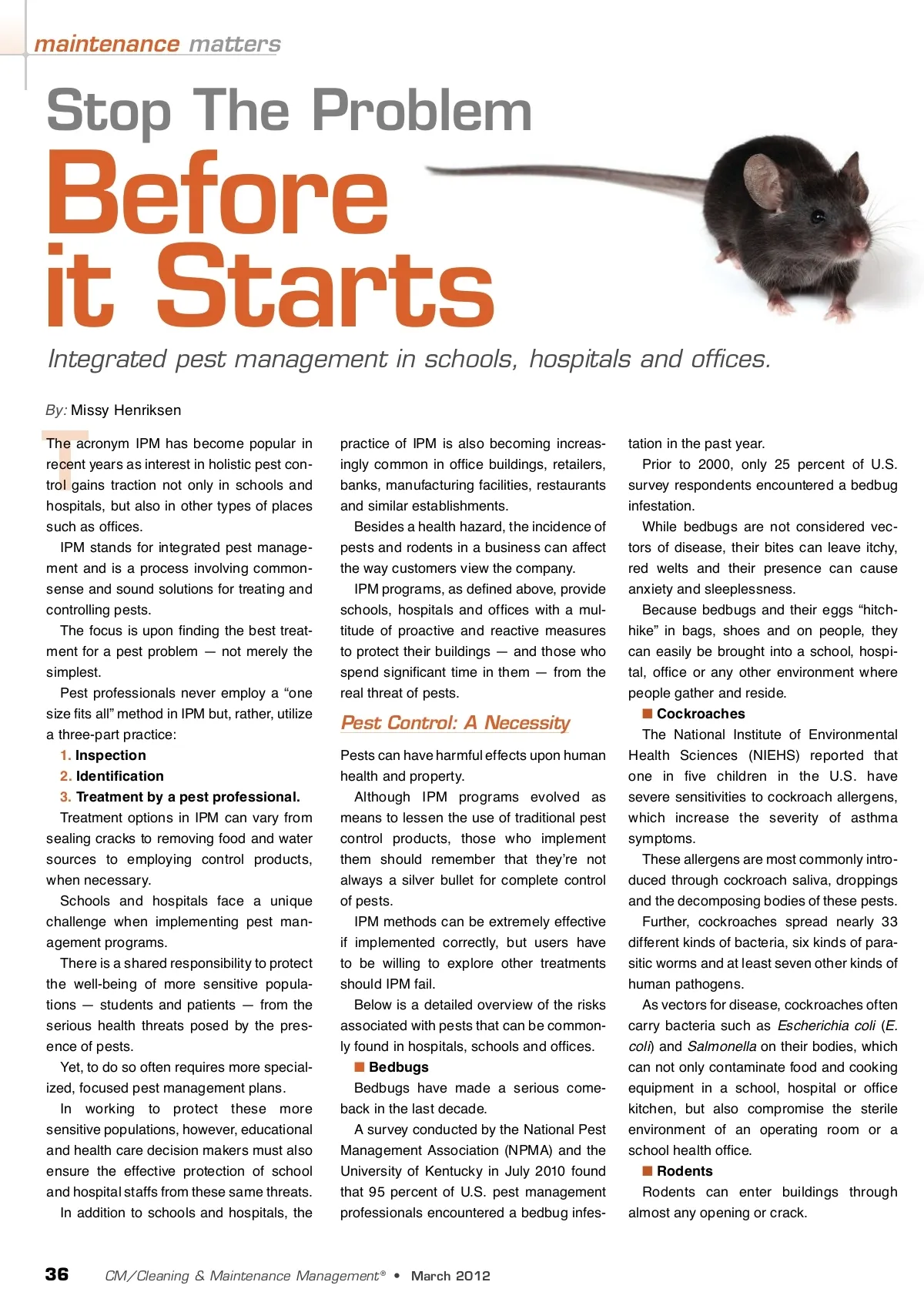
maintenance matters Stop The Problem Before it Starts By: Missy Henriksen Integrated pest management in schools, hospitals and offices. T The acronym IPM has become popular in recent years as interest in holistic pest con-trol gains traction not only in schools and hospitals, but also in other types of places such as offices. IPM stands for integrated pest manage-ment and is a process involving common-sense and sound solutions for treating and controlling pests. The focus is upon finding the best treat-ment for a pest problem — not merely the simplest. Pest professionals never employ a “one size fits all” method in IPM but, rather, utilize a three-part practice: 1. Inspection 2. Identification 3. Treatment by a pest professional. Treatment options in IPM can vary from sealing cracks to removing food and water sources to employing control products, when necessary. Schools and hospitals face a unique challenge when implementing pest man-agement programs. There is a shared responsibility to protect the well-being of more sensitive popula-tions — students and patients — from the serious health threats posed by the pres-ence of pests. Yet, to do so often requires more special-ized, focused pest management plans. In working to protect these more sensitive populations, however, educational and health care decision makers must also ensure the effective protection of school and hospital staffs from these same threats. In addition to schools and hospitals, the practice of IPM is also becoming increas-ingly common in office buildings, retailers, banks, manufacturing facilities, restaurants and similar establishments. Besides a health hazard, the incidence of pests and rodents in a business can affect the way customers view the company. IPM programs, as defined above, provide schools, hospitals and offices with a mul-titude of proactive and reactive measures to protect their buildings — and those who spend significant time in them — from the real threat of pests. Pest Control: A Necessity Pests can have harmful effects upon human health and property. Although IPM programs evolved as means to lessen the use of traditional pest control products, those who implement them should remember that they’re not always a silver bullet for complete control of pests. IPM methods can be extremely effective if implemented correctly, but users have to be willing to explore other treatments should IPM fail. Below is a detailed overview of the risks associated with pests that can be common-ly found in hospitals, schools and offices. ■ Bedbugs Bedbugs have made a serious come-back in the last decade. A survey conducted by the National Pest Management Association (NPMA) and the University of Kentucky in July 2010 found that 95 percent of U.S. pest management professionals encountered a bedbug infes-tation in the past year. Prior to 2000, only 25 percent of U.S. survey respondents encountered a bedbug infestation. While bedbugs are not considered vec-tors of disease, their bites can leave itchy, red welts and their presence can cause anxiety and sleeplessness. Because bedbugs and their eggs “hitch-hike” in bags, shoes and on people, they can easily be brought into a school, hospi-tal, office or any other environment where people gather and reside. ■ Cockroaches The National Institute of Environmental Health Sciences (NIEHS) reported that one in five children in the U.S. have severe sensitivities to cockroach allergens, which increase the severity of asthma symptoms. These allergens are most commonly intro-duced through cockroach saliva, droppings and the decomposing bodies of these pests. Further, cockroaches spread nearly 33 different kinds of bacteria, six kinds of para-sitic worms and at least seven other kinds of human pathogens. As vectors for disease, cockroaches often carry bacteria such as Escherichia coli ( E. coli ) and Salmonella on their bodies, which can not only contaminate food and cooking equipment in a school, hospital or office kitchen, but also compromise the sterile environment of an operating room or a school health office. ■ Rodents Rodents can enter buildings through almost any opening or crack. 36 CM/Cleaning & Maintenance Management ® • March 2012
CMM – Archives Mar 2012: 36