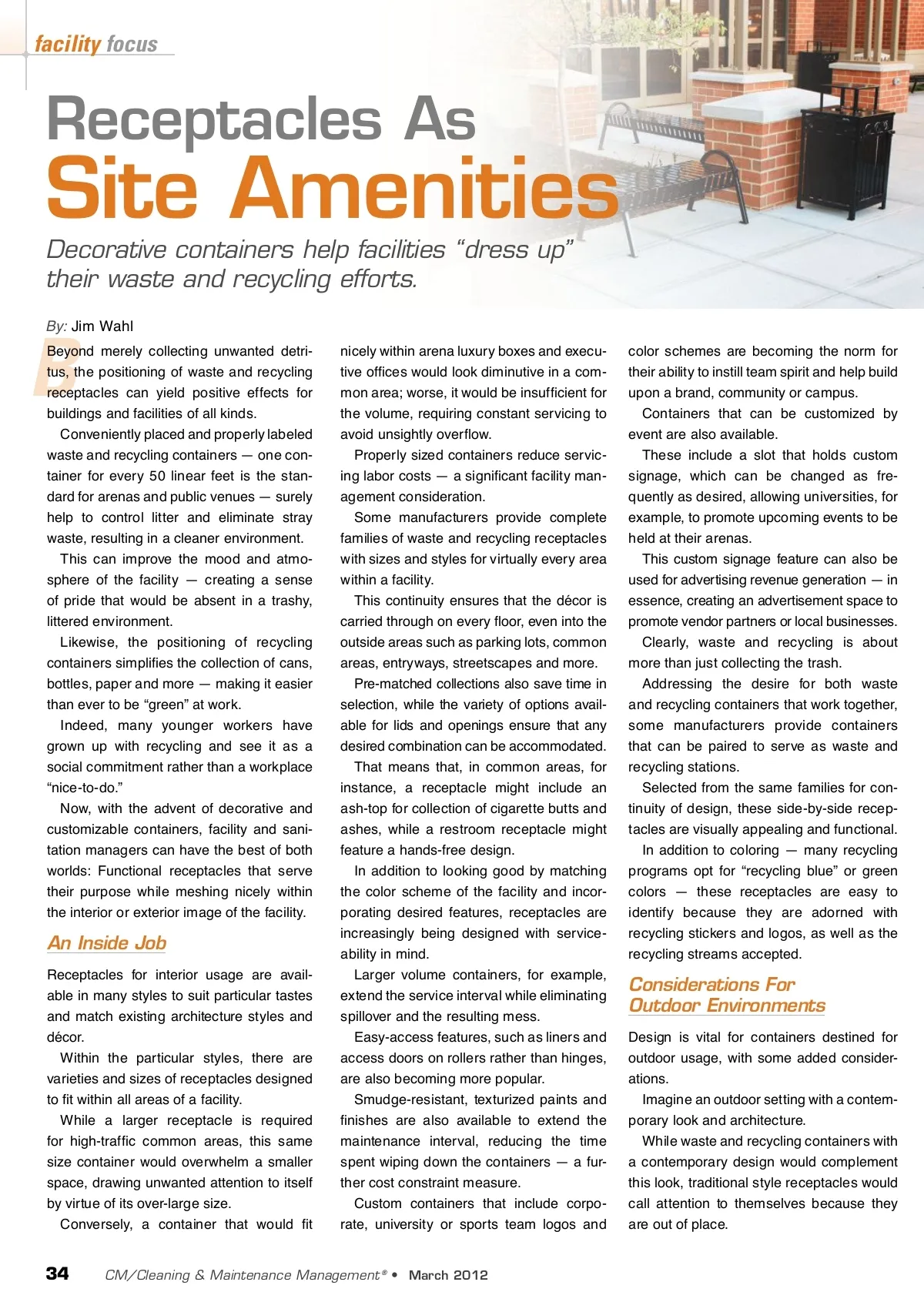
facility focus ReceptaclesAs SiteAmenities Decorative containers help facilities “dress up” their waste and recycling efforts. By: Jim Wahl B Beyond merely collecting unwanted detri-tus, the positioning of waste and recycling receptacles can yield positive effects for buildings and facilities of all kinds. Conveniently placed and properly labeled waste and recycling containers — one con-tainer for every 50 linear feet is the stan-dard for arenas and public venues — surely help to control litter and eliminate stray waste, resulting in a cleaner environment. This can improve the mood and atmo-sphere of the facility — creating a sense of pride that would be absent in a trashy, littered environment. Likewise, the positioning of recycling containers simplifies the collection of cans, bottles, paper and more — making it easier than ever to be “green” at work. Indeed, many younger workers have grown up with recycling and see it as a social commitment rather than a workplace “nice-to-do.” Now, with the advent of decorative and customizable containers, facility and sani-tation managers can have the best of both worlds: Functional receptacles that serve their purpose while meshing nicely within the interior or exterior image of the facility. An Inside Job Receptacles for interior usage are avail-able in many styles to suit particular tastes and match existing architecture styles and décor. Within the particular styles, there are varieties and sizes of receptacles designed to fit within all areas of a facility. While a larger receptacle is required for high-traffic common areas, this same size container would overwhelm a smaller space, drawing unwanted attention to itself by virtue of its over-large size. Conversely, a container that would fit nicely within arena luxury boxes and execu-tive offices would look diminutive in a com-mon area; worse, it would be insufficient for the volume, requiring constant servicing to avoid unsightly overflow. Properly sized containers reduce servic-ing labor costs — a significant facility man-agement consideration. Some manufacturers provide complete families of waste and recycling receptacles with sizes and styles for virtually every area within a facility. This continuity ensures that the décor is carried through on every floor, even into the outside areas such as parking lots, common areas, entryways, streetscapes and more. Pre-matched collections also save time in selection, while the variety of options avail-able for lids and openings ensure that any desired combination can be accommodated. That means that, in common areas, for instance, a receptacle might include an ash-top for collection of cigarette butts and ashes, while a restroom receptacle might feature a hands-free design. In addition to looking good by matching the color scheme of the facility and incor-porating desired features, receptacles are increasingly being designed with service-ability in mind. Larger volume containers, for example, extend the service interval while eliminating spillover and the resulting mess. Easy-access features, such as liners and access doors on rollers rather than hinges, are also becoming more popular. Smudge-resistant, texturized paints and finishes are also available to extend the maintenance interval, reducing the time spent wiping down the containers — a fur-ther cost constraint measure. Custom containers that include corpo-rate, university or sports team logos and color schemes are becoming the norm for their ability to instill team spirit and help build upon a brand, community or campus. Containers that can be customized by event are also available. These include a slot that holds custom signage, which can be changed as fre-quently as desired, allowing universities, for example, to promote upcoming events to be held at their arenas. This custom signage feature can also be used for advertising revenue generation — in essence, creating an advertisement space to promote vendor partners or local businesses. Clearly, waste and recycling is about more than just collecting the trash. Addressing the desire for both waste and recycling containers that work together, some manufacturers provide containers that can be paired to serve as waste and recycling stations. Selected from the same families for con-tinuity of design, these side-by-side recep-tacles are visually appealing and functional. In addition to coloring — many recycling programs opt for “recycling blue” or green colors — these receptacles are easy to identify because they are adorned with recycling stickers and logos, as well as the recycling streams accepted. Considerations For Outdoor Environments Design is vital for containers destined for outdoor usage, with some added consider-ations. Imagine an outdoor setting with a contem-porary look and architecture. While waste and recycling containers with a contemporary design would complement this look, traditional style receptacles would call attention to themselves because they are out of place. 34 CM/Cleaning & Maintenance Management ® • March2012
CMM – Archives Mar 2012: 34