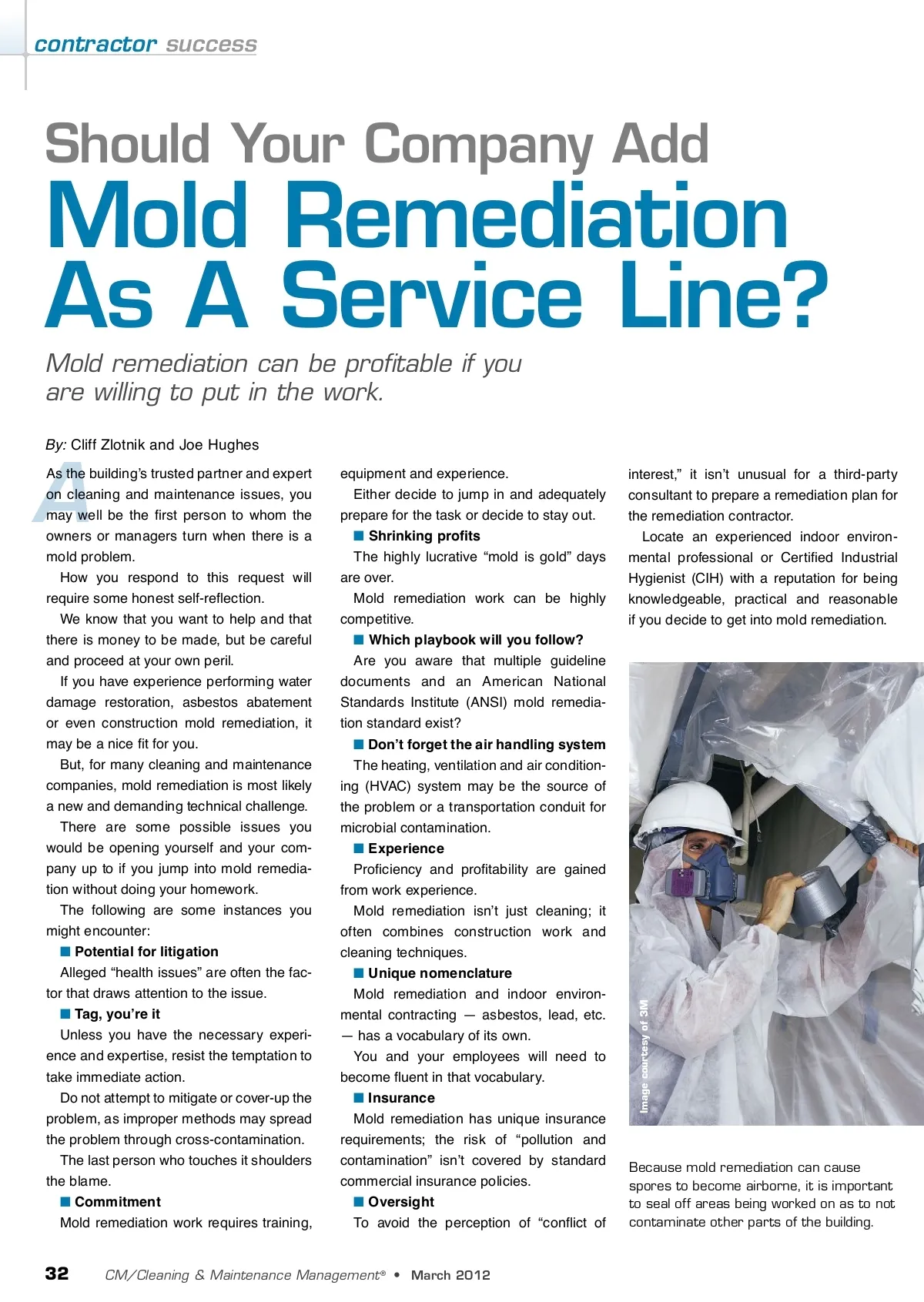
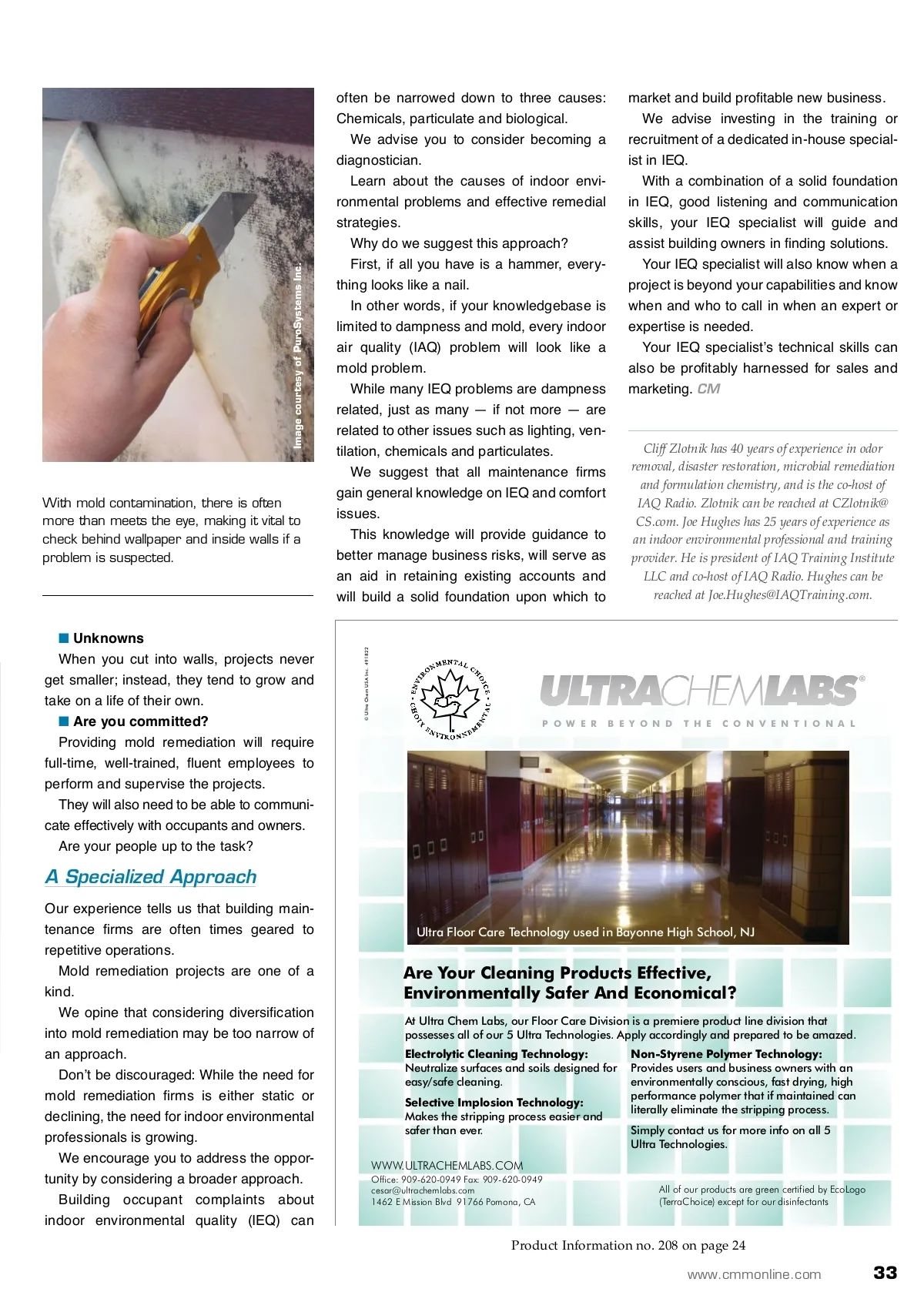
contractor success Should Your Company Add Mold Remediation As A Service Line? Mold remediation can be profitable if you are willing to put in the work. By: Cliff Zlotnik and Joe Hughes A As the building’s trusted partner and expert on cleaning and maintenance issues, you may well be the first person to whom the owners or managers turn when there is a mold problem. How you respond to this request will require some honest self-reflection. We know that you want to help and that there is money to be made, but be careful and proceed at your own peril. If you have experience performing water damage restoration, asbestos abatement or even construction mold remediation, it may be a nice fit for you. But, for many cleaning and maintenance companies, mold remediation is most likely a new and demanding technical challenge. There are some possible issues you would be opening yourself and your com-pany up to if you jump into mold remedia-tion without doing your homework. The following are some instances you might encounter: ■ Potential for litigation Alleged “health issues” are often the fac-tor that draws attention to the issue. ■ Tag, you’re it Unless you have the necessary experi-ence and expertise, resist the temptation to take immediate action. Do not attempt to mitigate or cover-up the problem, as improper methods may spread the problem through cross-contamination. The last person who touches it shoulders the blame. ■ Commitment Mold remediation work requires training, equipment and experience. Either decide to jump in and adequately prepare for the task or decide to stay out. ■ Shrinking profits The highly lucrative “mold is gold” days are over. Mold remediation work can be highly competitive. ■ Which playbook will you follow? Are you aware that multiple guideline documents and an American National Standards Institute (ANSI) mold remedia-tion standard exist? ■ Don’t forget the air handling system The heating, ventilation and air condition-ing (HVAC) system may be the source of the problem or a transportation conduit for microbial contamination. ■ Experience Proficiency and profitability are gained from work experience. Mold remediation isn’t just cleaning; it often combines construction work and cleaning techniques. ■ Unique nomenclature Mold remediation and indoor environ-mental contracting — asbestos, lead, etc. — has a vocabulary of its own. You and your employees will need to become fluent in that vocabulary. ■ Insurance Mold remediation has unique insurance requirements; the risk of “pollution and contamination” isn’t covered by standard commercial insurance policies. ■ Oversight To avoid the perception of “conflict of interest,” it isn’t unusual for a third-party consultant to prepare a remediation plan for the remediation contractor. Locate an experienced indoor environ-mental professional or Certified Industrial Hygienist (CIH) with a reputation for being knowledgeable, practical and reasonable if you decide to get into mold remediation. Because mold remediation can cause spores to become airborne, it is important to seal off areas being worked on as to not contaminate other parts of the building. 32 CM/Cleaning & Maintenance Management ® • March 2012 Image courtesy of 3M
CMM – Archives Mar 2012: 32