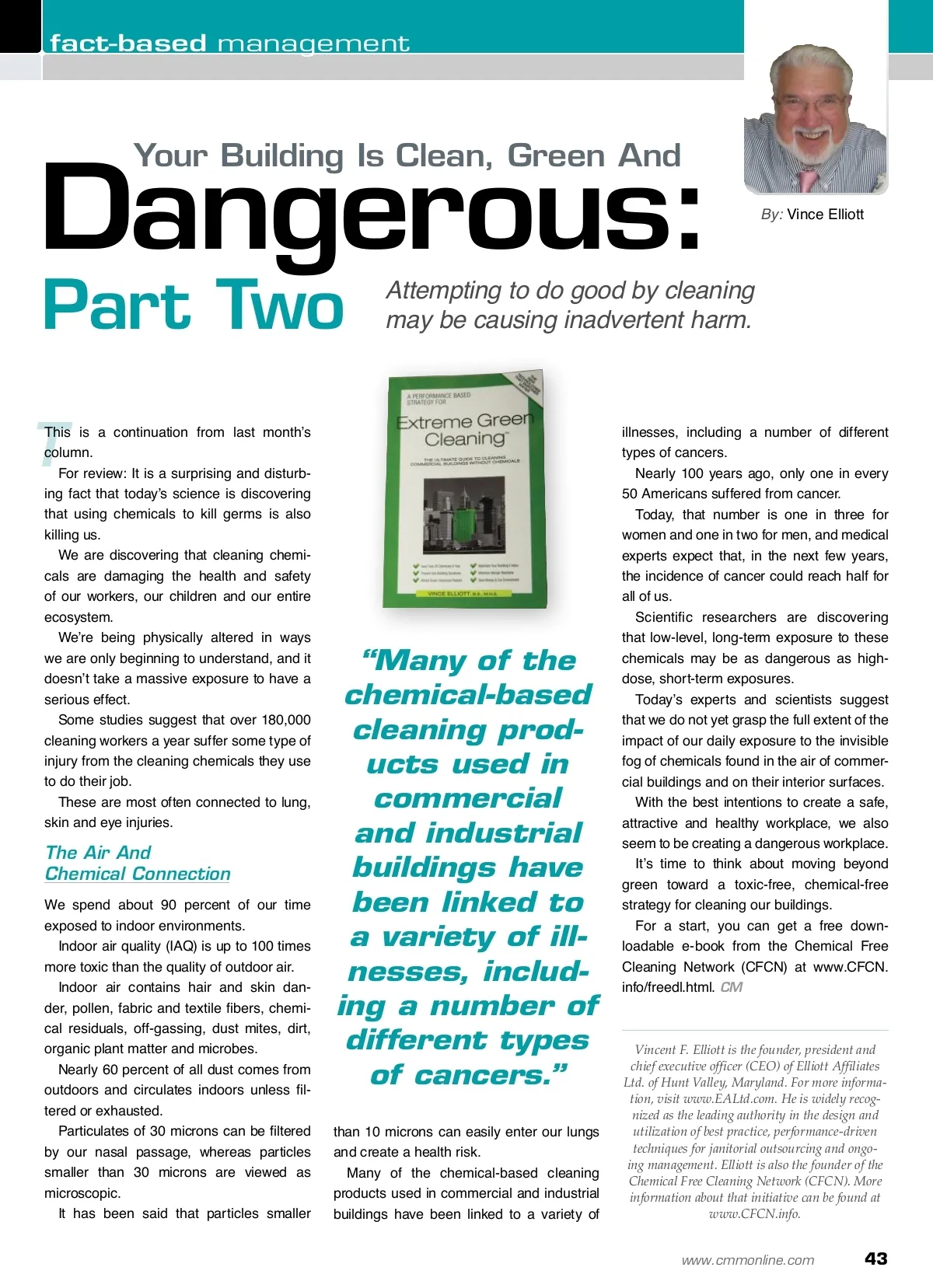
fact-based management Dangerous: Part Two T This is a continuation from last month’s column. For review: It is a surprising and disturb-ing fact that today’s science is discovering that using chemicals to kill germs is also killing us. We are discovering that cleaning chemi-cals are damaging the health and safety of our workers, our children and our entire ecosystem. We’re being physically altered in ways we are only beginning to understand, and it doesn’t take a massive exposure to have a serious effect. Some studies suggest that over 180,000 cleaning workers a year suffer some type of injury from the cleaning chemicals they use to do their job. These are most often connected to lung, skin and eye injuries. Your Building Is Clean, Green And By: Vince Elliott Attempting to do good by cleaning may be causing inadvertent harm. The Air And Chemical Connection We spend about 90 percent of our time exposed to indoor environments. Indoor air quality (IAQ) is up to 100 times more toxic than the quality of outdoor air. Indoor air contains hair and skin dan-der, pollen, fabric and textile fibers, chemi-cal residuals, off-gassing, dust mites, dirt, organic plant matter and microbes. Nearly 60 percent of all dust comes from outdoors and circulates indoors unless fil-tered or exhausted. Particulates of 30 microns can be filtered by our nasal passage, whereas particles smaller than 30 microns are viewed as microscopic. It has been said that particles smaller “Many of the chemical-based cleaning prod-ucts used in commercial and industrial buildings have been linked to a variety of ill-nesses, includ-ing a number of different types of cancers.” than 10 microns can easily enter our lungs and create a health risk. Many of the chemical-based cleaning products used in commercial and industrial buildings have been linked to a variety of illnesses, including a number of different types of cancers. Nearly 100 years ago, only one in every 50 Americans suffered from cancer. Today, that number is one in three for women and one in two for men, and medical experts expect that, in the next few years, the incidence of cancer could reach half for all of us. Scientific researchers are discovering that low-level, long-term exposure to these chemicals may be as dangerous as high-dose, short-term exposures. Today’s experts and scientists suggest that we do not yet grasp the full extent of the impact of our daily exposure to the invisible fog of chemicals found in the air of commer-cial buildings and on their interior surfaces. With the best intentions to create a safe, attractive and healthy workplace, we also seem to be creating a dangerous workplace. It’s time to think about moving beyond green toward a toxic-free, chemical-free strategy for cleaning our buildings. For a start, you can get a free down-loadable e-book from the Chemical Free Cleaning Network (CFCN) at www.CFCN. info/freedl.html. CM Vincent F. Elliott is the founder, president and chief executive officer (CEO) of Elliott Affiliates Ltd. of Hunt Valley, Maryland. For more informa-tion, visit www.EALtd.com. He is widely recog-nized as the leading authority in the design and utilization of best practice, performance-driven techniques for janitorial outsourcing and ongo-ing management. Elliott is also the founder of the Chemical Free Cleaning Network (CFCN). More information about that initiative can be found at www.CFCN.info. www.cmmonline.com 43
CMM – Archives Apr 2012: 43