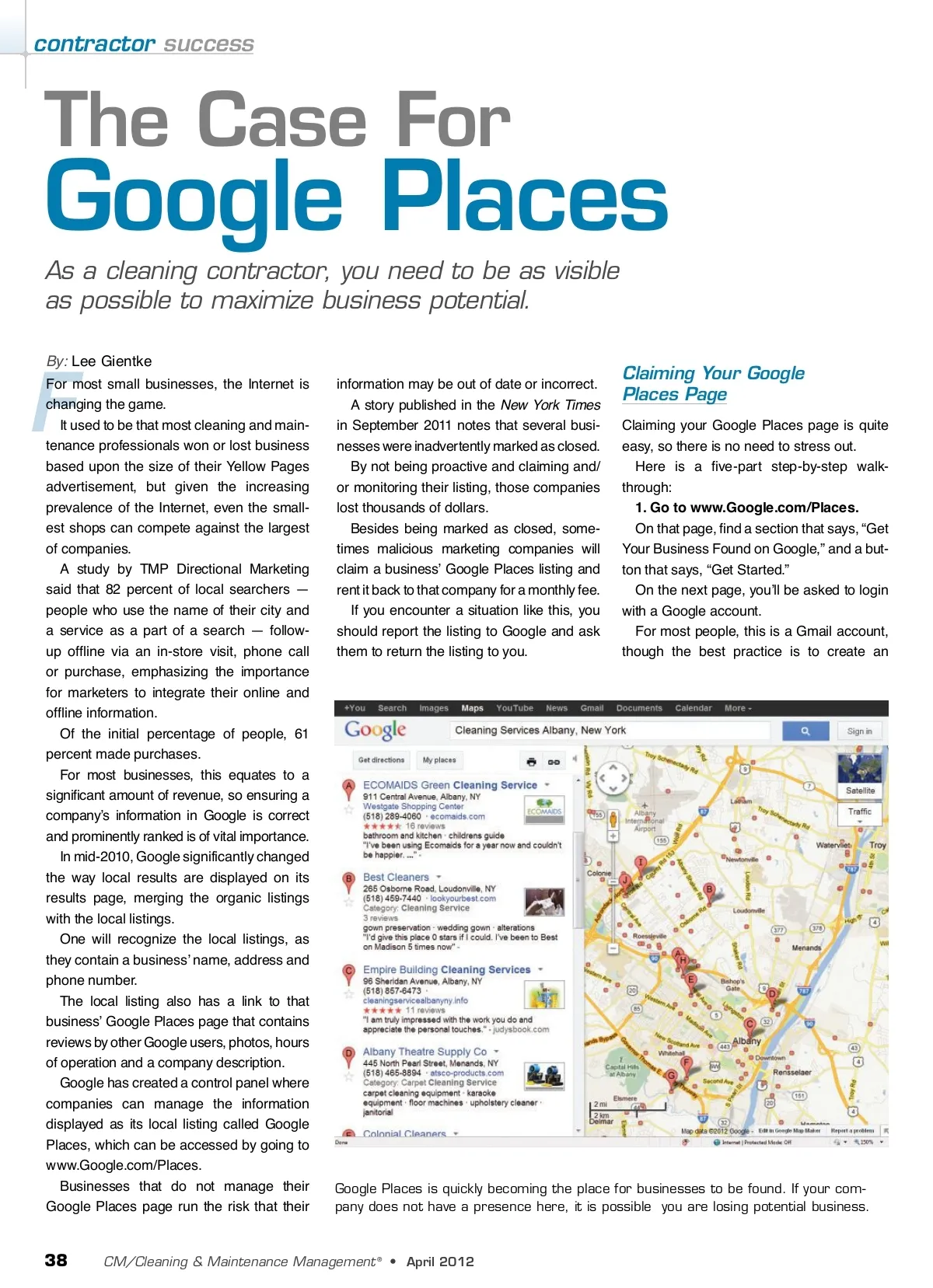
contractor success The Case For Google Places As a cleaning contractor, you need to be as visible as possible to maximize business potential. By: Lee Gientke F For most small businesses, the Internet is changing the game. It used to be that most cleaning and main-tenance professionals won or lost business based upon the size of their Yellow Pages advertisement, but given the increasing prevalence of the Internet, even the small-est shops can compete against the largest of companies. A study by TMP Directional Marketing said that 82 percent of local searchers — people who use the name of their city and a service as a part of a search — follow-up offline via an in-store visit, phone call or purchase, emphasizing the importance for marketers to integrate their online and offline information. Of the initial percentage of people, 61 percent made purchases. For most businesses, this equates to a significant amount of revenue, so ensuring a company’s information in Google is correct and prominently ranked is of vital importance. In mid-2010, Google significantly changed the way local results are displayed on its results page, merging the organic listings with the local listings. One will recognize the local listings, as they contain a business’ name, address and phone number. The local listing also has a link to that business’ Google Places page that contains reviews by other Google users, photos, hours of operation and a company description. Google has created a control panel where companies can manage the information displayed as its local listing called Google Places, which can be accessed by going to www.Google.com/Places. Businesses that do not manage their Google Places page run the risk that their information may be out of date or incorrect. A story published in the New York Times in September 2011 notes that several busi-nesses were inadvertently marked as closed. By not being proactive and claiming and/ or monitoring their listing, those companies lost thousands of dollars. Besides being marked as closed, some-times malicious marketing companies will claim a business’ Google Places listing and rent it back to that company for a monthly fee. If you encounter a situation like this, you should report the listing to Google and ask them to return the listing to you. Claiming Your Google Places Page Claiming your Google Places page is quite easy, so there is no need to stress out. Here is a five-part step-by-step walk-through: 1. Go to www.Google.com/Places. On that page, find a section that says, “Get Your Business Found on Google,” and a but-ton that says, “Get Started.” On the next page, you’ll be asked to login with a Google account. For most people, this is a Gmail account, though the best practice is to create an Google Places is quickly becoming the place for businesses to be found. If your com-pany does not have a presence here, it is possible you are losing potential business. 38 CM/Cleaning & Maintenance Management ® • April 2012
CMM – Archives Apr 2012: 38