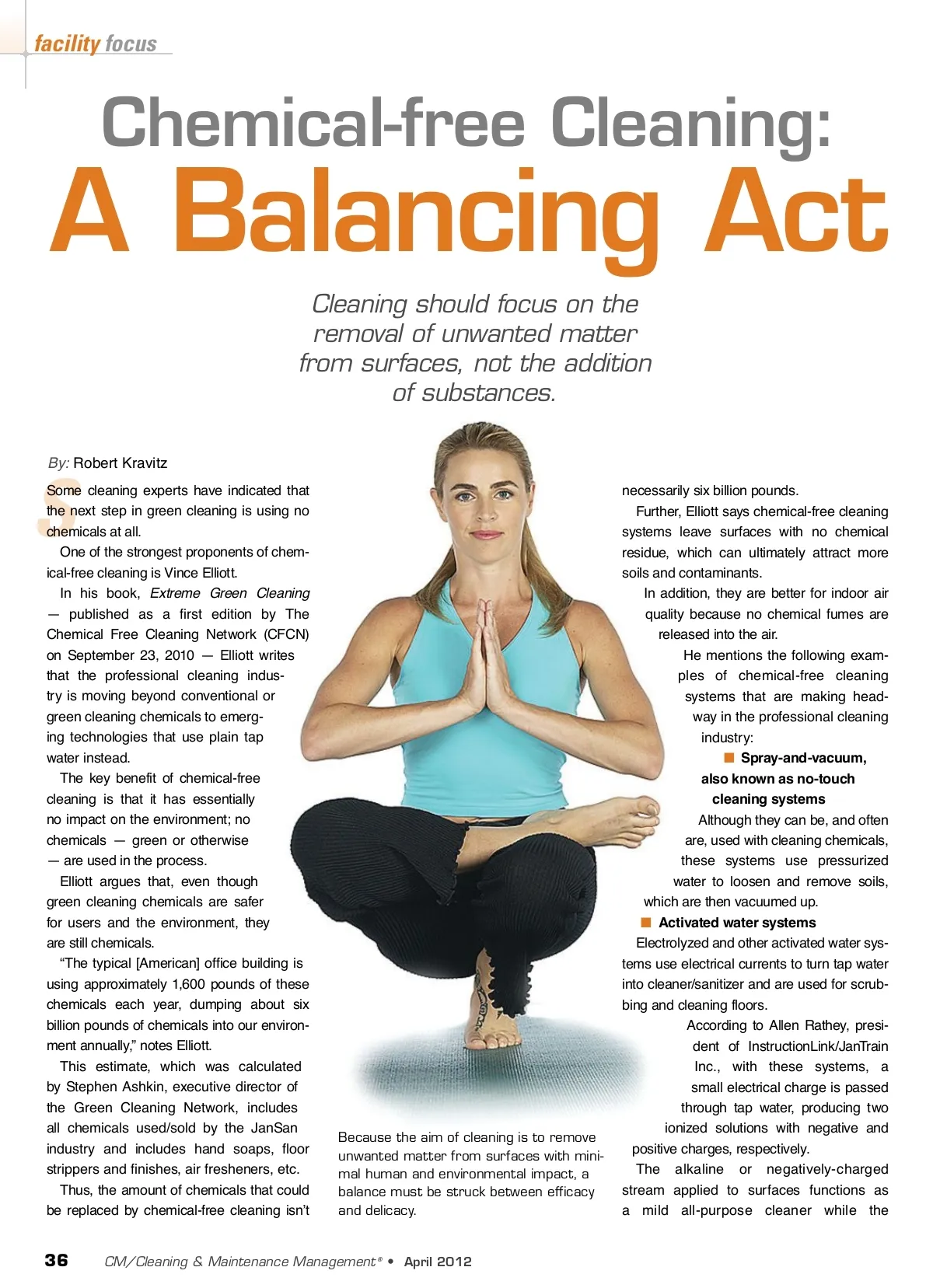
facility focus ABalancingAct Cleaning should focus on the removal of unwanted matter from surfaces, not the addition of substances. By: Robert Kravitz Chemical-freeCleaning: S Some cleaning experts have indicated that the next step in green cleaning is using no chemicals at all. One of the strongest proponents of chem-ical-free cleaning is Vince Elliott. In his book, Extreme Green Cleaning — published as a first edition by The Chemical Free Cleaning Network (CFCN) on September 23, 2010 — Elliott writes that the professional cleaning indus-try is moving beyond conventional or green cleaning chemicals to emerg-ing technologies that use plain tap water instead. The key benefit of chemical-free cleaning is that it has essentially no impact on the environment; no chemicals — green or otherwise — are used in the process. Elliott argues that, even though green cleaning chemicals are safer for users and the environment, they are still chemicals. “The typical [American] office building is using approximately 1,600 pounds of these chemicals each year, dumping about six billion pounds of chemicals into our environ-ment annually,” notes Elliott. This estimate, which was calculated by Stephen Ashkin, executive director of the Green Cleaning Network, includes all chemicals used/sold by the JanSan industry and includes hand soaps, floor strippers and finishes, air fresheners, etc. Thus, the amount of chemicals that could be replaced by chemical-free cleaning isn’t Because the aim of cleaning is to remove unwanted matter from surfaces with mini-mal human and environmental impact, a balance must be struck between efficacy and delicacy. necessarily six billion pounds. Further, Elliott says chemical-free cleaning systems leave surfaces with no chemical residue, which can ultimately attract more soils and contaminants. In addition, they are better for indoor air quality because no chemical fumes are released into the air. He mentions the following exam-ples of chemical-free cleaning systems that are making head-way in the professional cleaning industry: ■ Spray-and-vacuum, also known as no-touch cleaning systems Although they can be, and often are, used with cleaning chemicals, these systems use pressurized water to loosen and remove soils, which are then vacuumed up. ■ Activated water systems Electrolyzed and other activated water sys-tems use electrical currents to turn tap water into cleaner/sanitizer and are used for scrub-bing and cleaning floors. According to Allen Rathey, presi-dent of InstructionLink/JanTrain Inc., with these systems, a small electrical charge is passed through tap water, producing two ionized solutions with negative and positive charges, respectively. The alkaline or negatively-charged stream applied to surfaces functions as a mild all-purpose cleaner while the 36 CM/Cleaning & Maintenance Management ® • April2012
CMM – Archives Apr 2012: 36