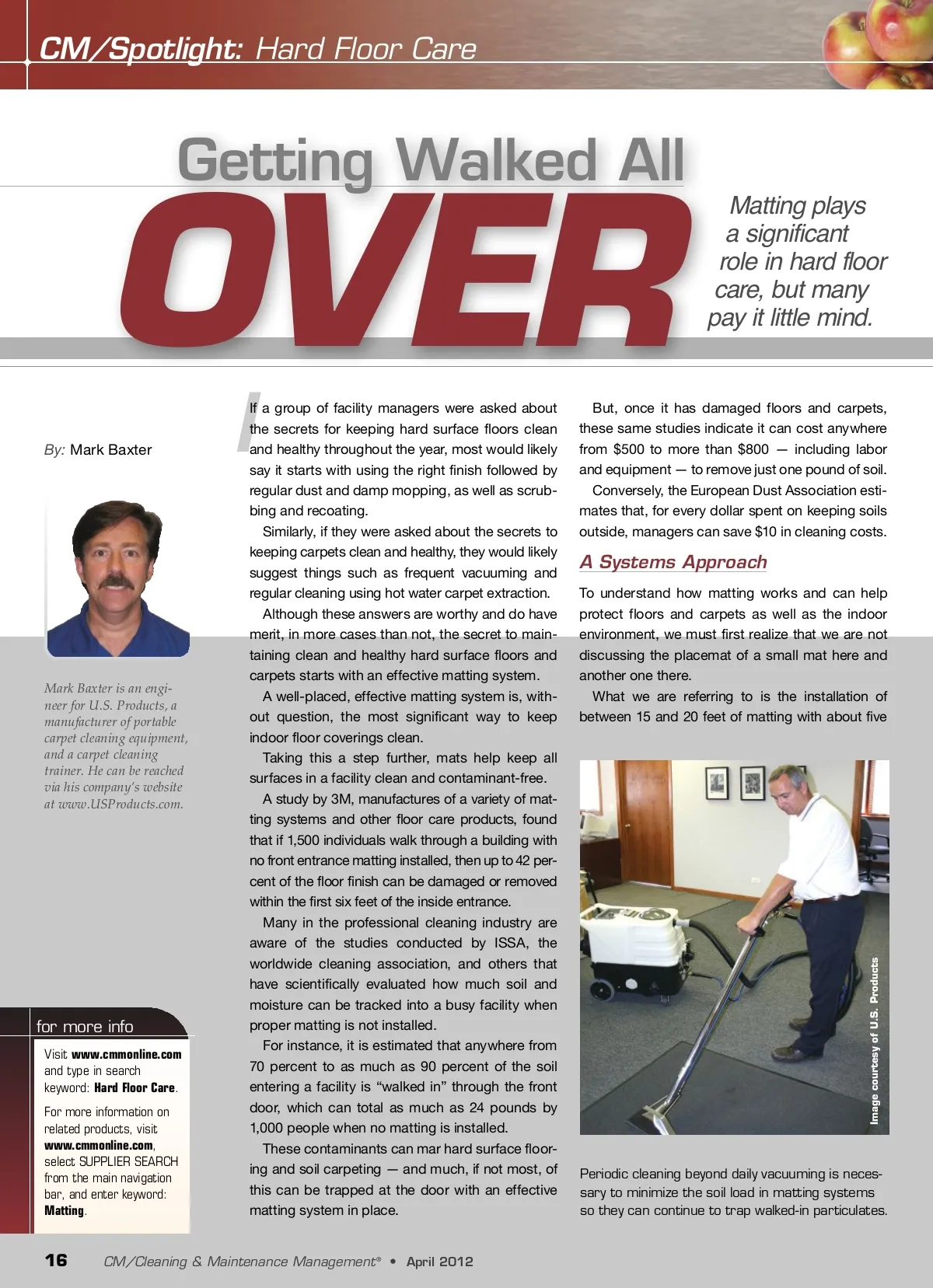
CM/Spotlight: Hard Floor Care OVER By: Mark Baxter Getting Walked All Matting plays a significant role in hard floor care, but many pay it little mind. I Mark Baxter is an engi-neer for U.S. Products, a manufacturer of portable carpet cleaning equipment, and a carpet cleaning trainer. He can be reached via his company’s website at www.USProducts.com. for more info Visit www.cmmonline.com and type in search keyword: Hard Floor Care . For more information on related products, visit www.cmmonline.com , select SUPPLIER SEARCH from the main navigation bar, and enter keyword: Matting . If a group of facility managers were asked about the secrets for keeping hard surface floors clean and healthy throughout the year, most would likely say it starts with using the right finish followed by regular dust and damp mopping, as well as scrub-bing and recoating. Similarly, if they were asked about the secrets to keeping carpets clean and healthy, they would likely suggest things such as frequent vacuuming and regular cleaning using hot water carpet extraction. Although these answers are worthy and do have merit, in more cases than not, the secret to main-taining clean and healthy hard surface floors and carpets starts with an effective matting system. A well-placed, effective matting system is, with-out question, the most significant way to keep indoor floor coverings clean. Taking this a step further, mats help keep all surfaces in a facility clean and contaminant-free. A study by 3M, manufactures of a variety of mat-ting systems and other floor care products, found that if 1,500 individuals walk through a building with no front entrance matting installed, then up to 42 per-cent of the floor finish can be damaged or removed within the first six feet of the inside entrance. Many in the professional cleaning industry are aware of the studies conducted by ISSA, the worldwide cleaning association, and others that have scientifically evaluated how much soil and moisture can be tracked into a busy facility when proper matting is not installed. For instance, it is estimated that anywhere from 70 percent to as much as 90 percent of the soil entering a facility is “walked in” through the front door, which can total as much as 24 pounds by 1,000 people when no matting is installed. These contaminants can mar hard surface floor-ing and soil carpeting — and much, if not most, of this can be trapped at the door with an effective matting system in place. But, once it has damaged floors and carpets, these same studies indicate it can cost anywhere from $500 to more than $800 — including labor and equipment — to remove just one pound of soil. Conversely, the European Dust Association esti-mates that, for every dollar spent on keeping soils outside, managers can save $10 in cleaning costs. A Systems Approach To understand how matting works and can help protect floors and carpets as well as the indoor environment, we must first realize that we are not discussing the placemat of a small mat here and another one there. What we are referring to is the installation of between 15 and 20 feet of matting with about five Periodic cleaning beyond daily vacuuming is neces-sary to minimize the soil load in matting systems so they can continue to trap walked-in particulates. 16 CM/Cleaning & Maintenance Management ® • April 2012 Image courtesy of U.S. Products
CMM – Archives Apr 2012: 16