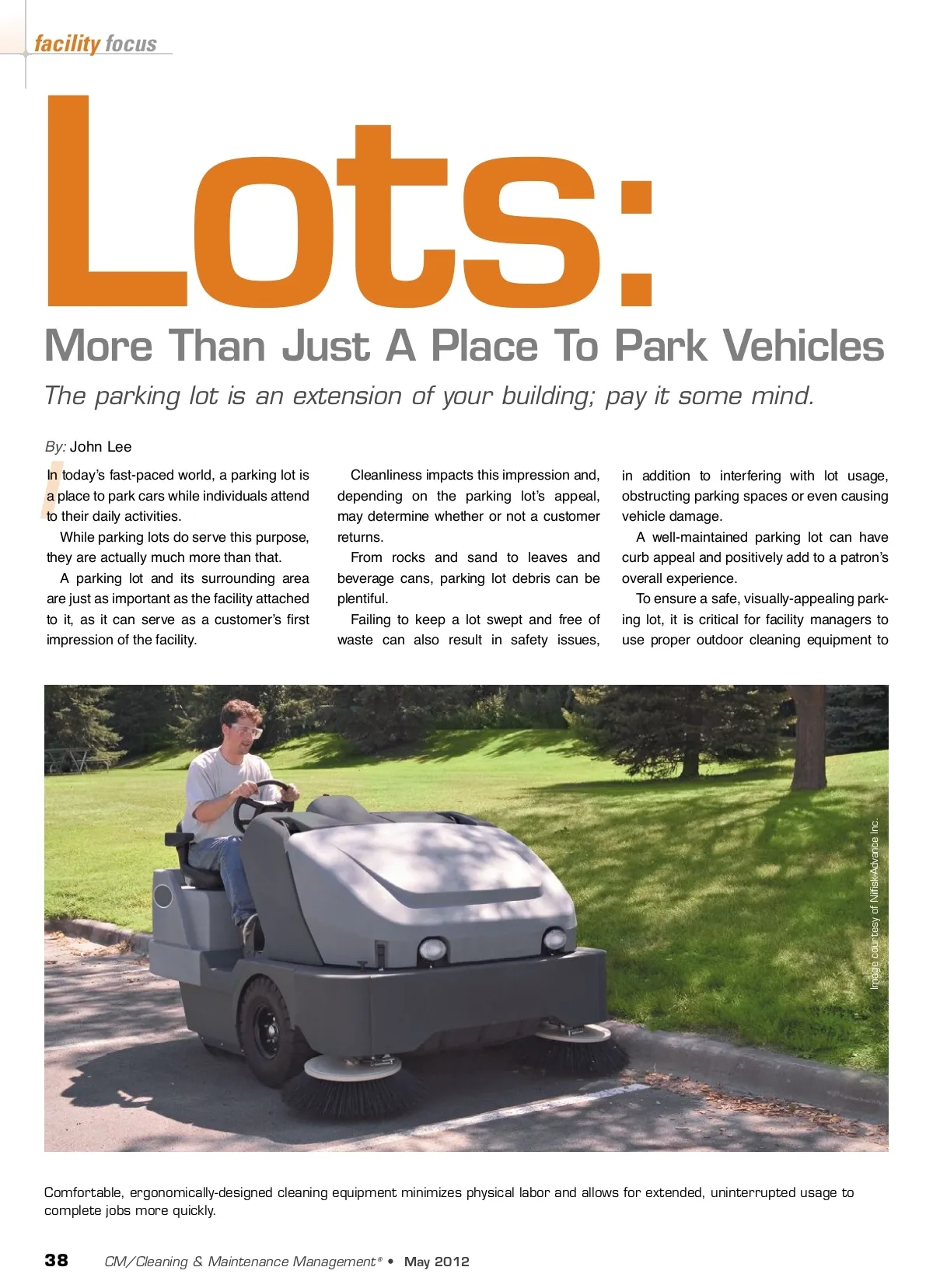
collect fine particles and litter alike — leav-ing a clean parking lot to welcome facility patrons. Outdoor Cleaning Equipment When selecting outdoor cleaning equip-ment, it is important to consider the scope and cleaning requirements of the parking lot. It is also crucial to assess labor needs, equipment performance and desired results in terms of sustainability, safety, durability and effectiveness. When conducting this assessment, there are a variety of outdoor surface cleaners available from which to choose. Depending on the parking lot, operators can choose to employ any of the following cleaning machines: ■ Handheld pressure washers With adjustable pressure sprays, these pressure washers reach deep into surface crevices, where traditional cleaning equip-ment may not. For example, handheld machines are opti-mal for curbs and tight parking lot corners. Their compact sizes make them simple to use and easy to store. ■ Outdoor power sweeping Ride-on power sweeping machines offer wide broom capacities and dust-controlled operation to ensure effective debris pickup. With their comfortable, ergonomically-designed operator compartment, these machines minimize physical labor. ■ High-pressure operator driven These large, operator-driven cleaning machines provide deep cleaning capabili-ties, allowing users to remove dirt, tire marks and painted lines without surface damage. With high-pressure performance, these machines provide increased productivity by reducing time spent cleaning. tion, which may have significant health effects on those who are exposed to it. To prevent this, some of today’s advanced outdoor surface equipment use a recovery and recycling system that works to scour away dirt, tire marks and petroleum depos-its, while eliminating discharge into the envi-ronment or damage to the cleaned surface. Virtually all water is reclaimed and con-taminants are filtered out, allowing for the re-use of the reclaimed water for extended cleaning cycles. This self-contained system delivers a sus-tainable outdoor surface cleaning solution by minimizing water usage and eliminating chemical use and water runoff, while aid-ing U.S. Environmental Protection Agency (EPA) compliance. It is also crucial to sweep and wash park-ing surfaces periodically to remove dust, oil, grease, dirt and de-icing chemicals that can be tracked inside the building. Fluids from vehicles, such as grease, oil and antifreeze, can collect in parking spaces, which present surface damage, environmental concerns and slip and fall hazards for patrons. A parking lot is not just another place to park a car, but an extension of a building and also a customer’s first impression. With the right outdoor surface cleaning equipment, facility managers can keep their parking lots safe, clean and readily acces-sible. John Lee is the industrial vertical marketing manager for Nilfisk-Advance Inc. For more infor-mation about the many tools and equipment solu-tions Nilfisk-Advance can offer, including parking lot sweeping and cleaning products, visit www.Advance-US.com. Durable, Comfortable Design Many outdoor surface cleaners feature a design that not only ensures operator safe-ty, but also provide enhanced comfort to minimize labor efforts. Other machines incorporate one-touch functions for easy control and operation. Additional comfort features to look for include an adjustable suspension seat with lower back support, oversize tires for a smooth ride and an all-weather cab — complete with air conditioning, heat and defroster to make operators comfortable and productive regardless of weather conditions. Lastly, whether or not the machine con-tains an all-weather cab, it is imperative that the driver has a clear line of sight to ensure the highest level of safety. How Does A Recovery And Recycle System Work? An example of how a recovery and recy-cling system type of system functions is as follows: A machine operating with a closed-loop cleaning, recovery and recycling system features a cleaning head with turbine blades that rotate at high speed to create a vortex of air and water equiva-lent to a Category-4 hurricane. Continuous movement keeps water from pooling and allows incoming high-pressure water to directly contact the surface for maximum cleaning power. Wastewater scrubs away dirt as it is pulled over the surface to complement the pressurized water and deeply clean in a single pass. The rotational movement of the turbine blades creates lift that reclaims water, which is pumped back to the trailer — without a vacuum system. A multi-stage filtration system helps to minimize water usage and extend the cleaning cycle by removing dirt and con-taminants, converting reclaimed water into reusable clean water. CM The Bottom Line In addition to presenting a well-kept public image and ensuring patron safety, regular surface cleaning of parking lots can help increase the overall longevity of the lot — minimizing costs associated with resurfacing. Depending on the size of the parking lot, resurfacing it can result in thousands of dollars spent, in addition to the extensive amount of time and labor required to com-plete the project. It is important to remove trash from park-ing surfaces consistently to eliminate debris that can hold moisture and de-icing salts in contact with concrete. After time, these will eventually ruin the parking lot surface. Sustainable, Deep-cleaning Performance Even when cleaning outdoors, facility man-agers should consider the environmental impacts that cleaning equipment may have. Most surface cleaning methods rely on abrasive action, chemicals or merely smear the contaminated residue and cleaning water from one area to another. Not only is this inefficient, but it can also potentially cause ground water contamina-www.cmmonline.com 39
CMM – Archives May 2012: 39