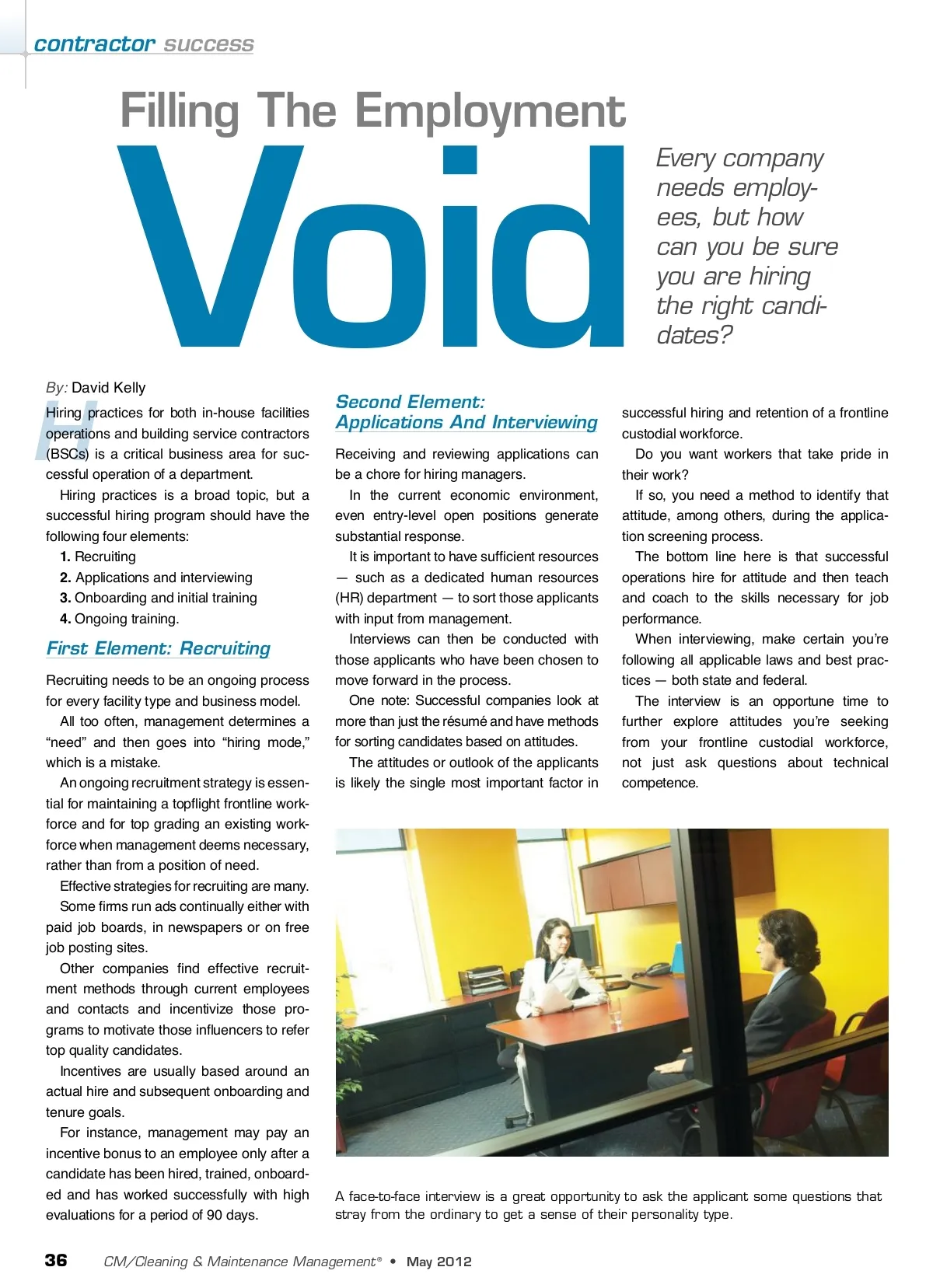
According to HR firm Scheig Associates, a three-part test will be a good indicator for desired behaviors and the willingness of the applicant to happily perform specific duties. Mark Tinney, president of Scheig Associates, says, “Interviews fall prey to that autopilot nodding syndrome: ‘Oh yes, I’ll do that. I love doing that. I love vomit, and I’ll clean it up until the cows come home.’” Many interviewees express these types of responses, but will they perform well if hired? Instead of a typical interview format, Scheig has developed testing to evaluate technical proficiencies, willingness to per-form tasks, behavioral ratings based upon other top-performing custodial workers and multiple choice situational questions. All of these help ascertain if the applicant has the desired attitudes to perform the job duties at a high level. This method can be a good motivator for new employees, as they quickly see their pro-ficiency in the subject matter increase, which is reflected in their scores and evaluations. Initial training should not attempt to cover every possible topic or cross training on vari-ous positions. Keep the training simple and streamlined for early success with your new hires. Fourth Element: Ongoing Training Once your new hire has completed the initial training and orientation, it is important to offer ongoing training. Areas for ongoing training should be those critical to the success of both the employee and the employer. Safety training, simple equipment pre-ventative maintenance, equipment repair protocols, information routing, planning, checklists and reporting are all segments for possible ongoing training. Basically, a successful custodial operation should constantly train on material important to their success and that of the employee. Cross training for other positions can be introduced as your new employees become a bit more seasoned and show a high level of proficiency. Management can set performance bench-marks for determining when to begin cross training for added responsibility and greater compensation. Share those benchmarks with the employ-ees to motivate them to the levels you desire they achieve. Hiring practices by in-house custodial operations and BSCs that incorporate these principals will lead to better decisions in hir-ing, more effective interviewing, onboarding and training. But, more importantly, best practices in hiring will help reduce turnover and improve the atmosphere and motivation levels among your frontline custodial staffs. CM David Kelly, a Leadership in Energy and Environmental Design (LEED) Green Associate, is the regional director for Jani-King of Baltimore. For more information, visit www.JaniKing.com/ Baltimore. Kelly may be contacted at [email protected]. Third Element: Onboarding And Initial Training Once the ideal future employee is identified and the offer is made/accepted, manage-ment must have in place a plan for orienta-tion and training. New employee orientation should be geared towards introducing the new hire to the policies and procedures of the firm, but also to the culture and mission. It is important to know you’re required to clock in and clock out each day, but it is equally vital to stress the company-specific culture, mission and goals. Orientation should also address any spe-cific benefits and incentive programs. Plant the seed early that top performance is rewarded and what those rewards entail. At the minimum, initial training should consist of safety training — the use of personal protective equipment (PPE), U.S. Occupational Safety and Health Administration’s (OSHA) Bloodborne Pathogen (BBP) Standard and Hazard Communication Standard (HCS), etc. — and site-specific and duty-specific training. All training may be conducted in a class-room setting or on the worksite as applicable to the specific training. Employees should sign acknowledgement of training and supervisors and trainers should evaluate proficiency in key areas. One strategy involves a pre-training evalu-ation, followed by another evaluation on the subject matter after training. POWER BEYOND THE CONVENTIONAL Product Information no. 205 on page 24 www.cmmonline.com 37
CMM – Archives May 2012: 37