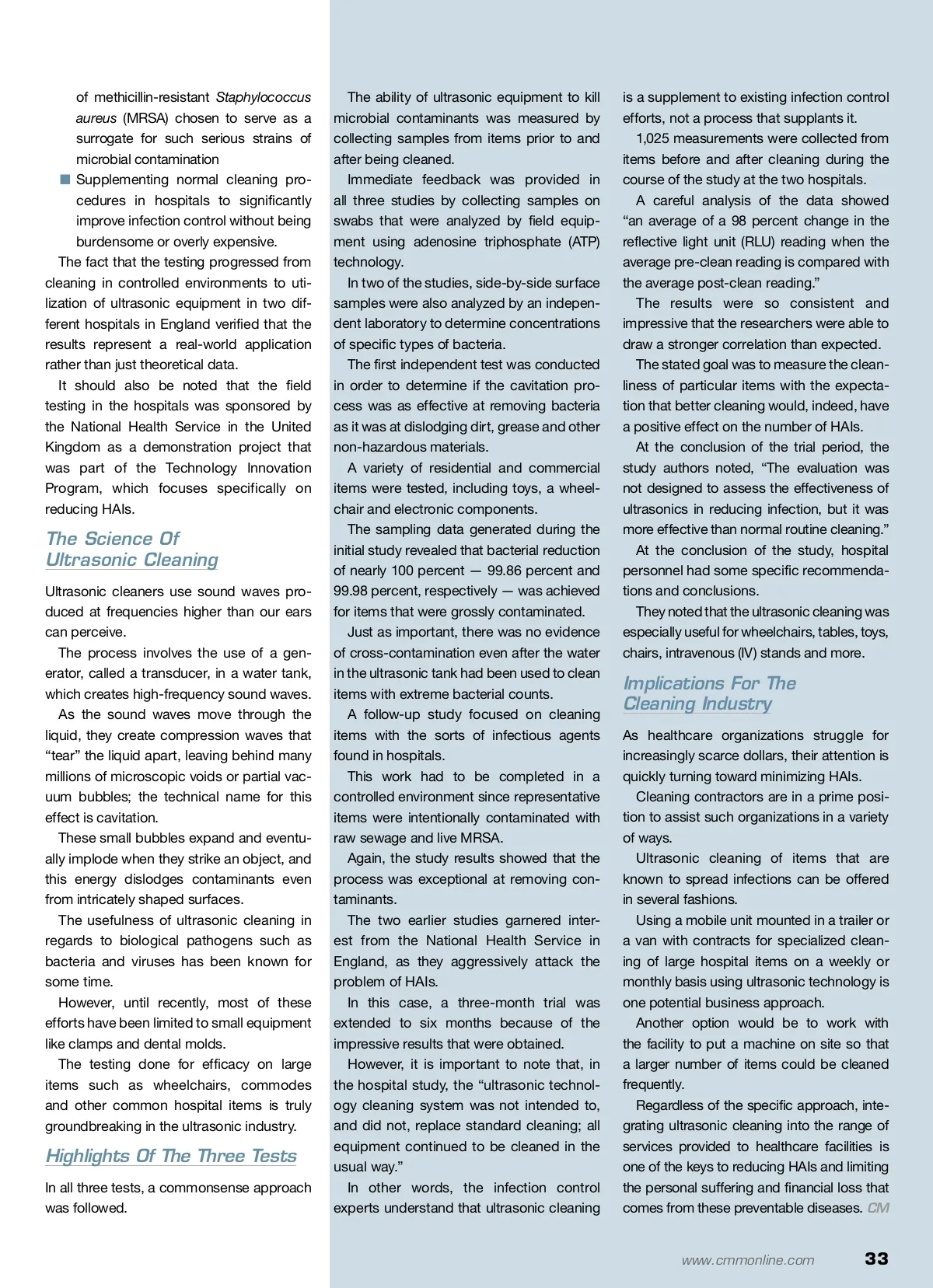
of methicillin-resistant Staphylococcus aureus (MRSA) chosen to serve as a surrogate for such serious strains of microbial contamination ■ Supplementing normal cleaning pro-cedures in hospitals to significantly improve infection control without being burdensome or overly expensive. The fact that the testing progressed from cleaning in controlled environments to uti-lization of ultrasonic equipment in two dif-ferent hospitals in England verified that the results represent a real-world application rather than just theoretical data. It should also be noted that the field testing in the hospitals was sponsored by the National Health Service in the United Kingdom as a demonstration project that was part of the Technology Innovation Program, which focuses specifically on reducing HAIs. The Science Of Ultrasonic Cleaning Ultrasonic cleaners use sound waves pro-duced at frequencies higher than our ears can perceive. The process involves the use of a gen-erator, called a transducer, in a water tank, which creates high-frequency sound waves. As the sound waves move through the liquid, they create compression waves that “tear” the liquid apart, leaving behind many millions of microscopic voids or partial vac-uum bubbles; the technical name for this effect is cavitation. These small bubbles expand and eventu-ally implode when they strike an object, and this energy dislodges contaminants even from intricately shaped surfaces. The usefulness of ultrasonic cleaning in regards to biological pathogens such as bacteria and viruses has been known for some time. However, until recently, most of these efforts have been limited to small equipment like clamps and dental molds. The testing done for efficacy on large items such as wheelchairs, commodes and other common hospital items is truly groundbreaking in the ultrasonic industry. Highlights Of The Three Tests In all three tests, a commonsense approach was followed. The ability of ultrasonic equipment to kill microbial contaminants was measured by collecting samples from items prior to and after being cleaned. Immediate feedback was provided in all three studies by collecting samples on swabs that were analyzed by field equip-ment using adenosine triphosphate (ATP) technology. In two of the studies, side-by-side surface samples were also analyzed by an indepen-dent laboratory to determine concentrations of specific types of bacteria. The first independent test was conducted in order to determine if the cavitation pro-cess was as effective at removing bacteria as it was at dislodging dirt, grease and other non-hazardous materials. A variety of residential and commercial items were tested, including toys, a wheel-chair and electronic components. The sampling data generated during the initial study revealed that bacterial reduction of nearly 100 percent — 99.86 percent and 99.98 percent, respectively — was achieved for items that were grossly contaminated. Just as important, there was no evidence of cross-contamination even after the water in the ultrasonic tank had been used to clean items with extreme bacterial counts. A follow-up study focused on cleaning items with the sorts of infectious agents found in hospitals. This work had to be completed in a controlled environment since representative items were intentionally contaminated with raw sewage and live MRSA. Again, the study results showed that the process was exceptional at removing con-taminants. The two earlier studies garnered inter-est from the National Health Service in England, as they aggressively attack the problem of HAIs. In this case, a three-month trial was extended to six months because of the impressive results that were obtained. However, it is important to note that, in the hospital study, the “ultrasonic technol-ogy cleaning system was not intended to, and did not, replace standard cleaning; all equipment continued to be cleaned in the usual way.” In other words, the infection control experts understand that ultrasonic cleaning is a supplement to existing infection control efforts, not a process that supplants it. 1,025 measurements were collected from items before and after cleaning during the course of the study at the two hospitals. A careful analysis of the data showed “an average of a 98 percent change in the reflective light unit (RLU) reading when the average pre-clean reading is compared with the average post-clean reading.” The results were so consistent and impressive that the researchers were able to draw a stronger correlation than expected. The stated goal was to measure the clean-liness of particular items with the expecta-tion that better cleaning would, indeed, have a positive effect on the number of HAIs. At the conclusion of the trial period, the study authors noted, “The evaluation was not designed to assess the effectiveness of ultrasonics in reducing infection, but it was more effective than normal routine cleaning.” At the conclusion of the study, hospital personnel had some specific recommenda-tions and conclusions. They noted that the ultrasonic cleaning was especially useful for wheelchairs, tables, toys, chairs, intravenous (IV) stands and more. Implications For The Cleaning Industry As healthcare organizations struggle for increasingly scarce dollars, their attention is quickly turning toward minimizing HAIs. Cleaning contractors are in a prime posi-tion to assist such organizations in a variety of ways. Ultrasonic cleaning of items that are known to spread infections can be offered in several fashions. Using a mobile unit mounted in a trailer or a van with contracts for specialized clean-ing of large hospital items on a weekly or monthly basis using ultrasonic technology is one potential business approach. Another option would be to work with the facility to put a machine on site so that a larger number of items could be cleaned frequently. Regardless of the specific approach, inte-grating ultrasonic cleaning into the range of services provided to healthcare facilities is one of the keys to reducing HAIs and limiting the personal suffering and financial loss that comes from these preventable diseases. CM www.cmmonline.com 33
CMM – Archives May 2012: 33