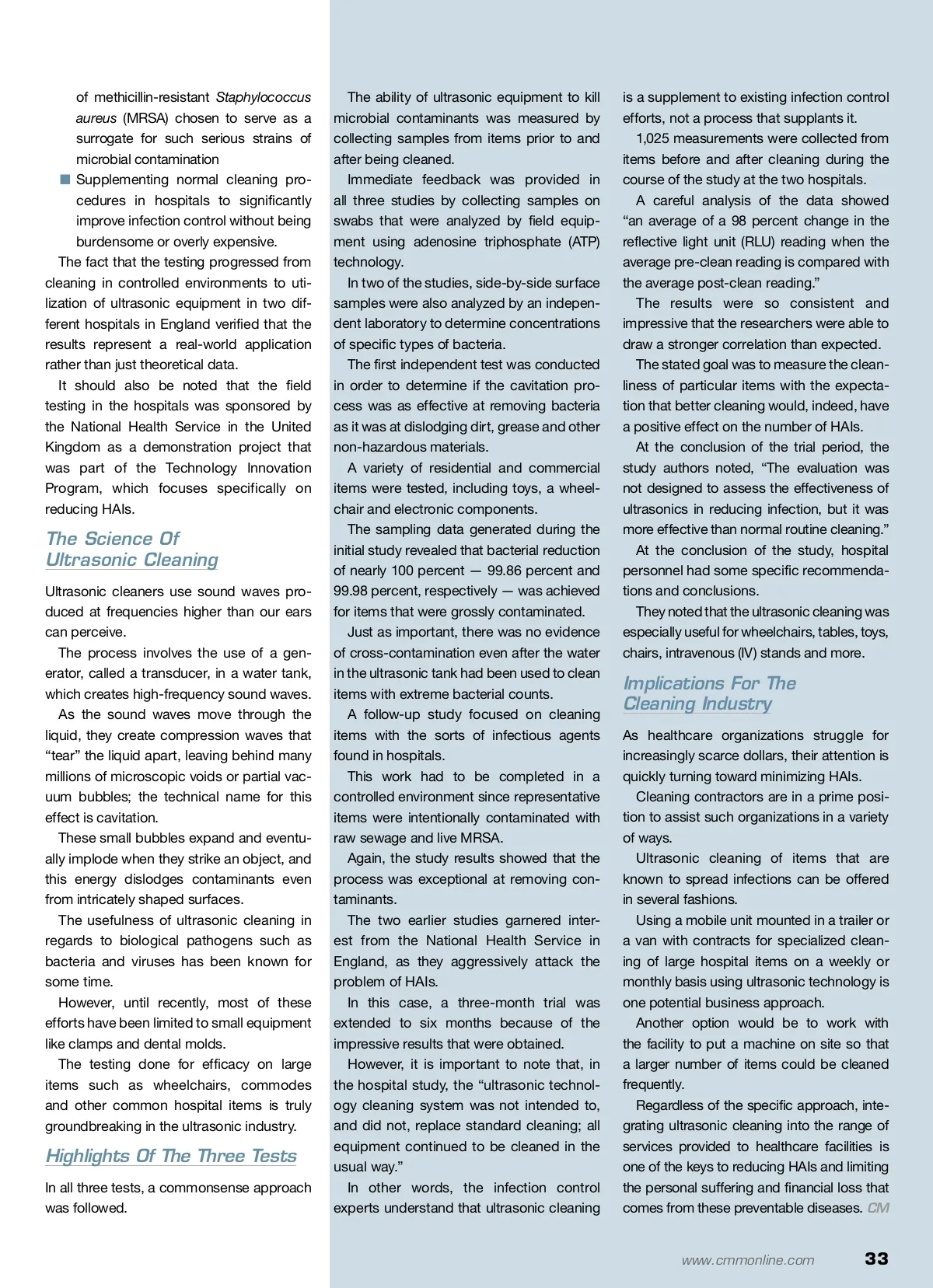
Cleaner Ultrasonic cleaning can achieve high levels of cleanliness through physical means rather than chemical processes. By: Michael Pinto The Silent H Michael Pinto, Certified Safety Professional (CSP), Certified Mold Professional (CMP), is chief executive officer (CEO) of Wonder Makers Environmental Inc. He focuses on commonsense practices that work when health professionals are faced with threats from swine or avian flu, MRSA outbreaks, norovirus exposures and nosocomial infec-tion problems in healthcare facilities. Pinto is the author of over 150 published articles and several books, includ-ing Fungal Contamination: A Comprehensive Guide for Remediation. Pinto can be reached at (269) 382-4154 or [email protected]. for more info Visit www.cmmonline.com and type in search keyword: Infection Control . For more information on related products, visit www.cmmonline.com , select SUPPLIER SEARCH from the main navigation bar, and enter keyword: Ultrasonic . Healthcare facilities are caught in a vice of which the two jaws are a growing awareness of the detrimen-tal effects of healthcare acquired infections (HAI) and shrinking resources to address the problem. Fortunately, professional cleaning organizations are in a position to help. Anyone providing services to the healthcare industry should be shocked by some of the latest facts and figures. A January 2012 report from the Healthcare Cost and Utilization Project noted that the rate of infections from the particularly serious bacteria Clostridium difficile ( C. diff ) doubled from 2001 to 2005. By 2009, there were 336,600 hospitalizations that involved this bacteria, which is nearly 1 per-cent of all hospital stays. One strain of C. diff developed antibiotic resis-tance and then evolved into a form with greater toxicity. Most importantly, the study noted that, on aver-age, over 80 patients die every day from this deadly microbe. Shockingly, the experts are in near universal agreement that infection rates in hospitals from C. diff could be driven down toward zero through a proper program of handwashing and surface cleaning. This is where cleaning professionals can step in to reduce the tragedy of illness and death from HAIs and save facilities millions of dollars in treatment costs — expenses that are now often not reimburs-able through Medicaid and Medicare because they are considered to be preventable incidents. Fortunately, there is an option that has been proven to dramatically enhance normal cleaning procedures in healthcare facilities: Ultrasonics. Ultrasonic cleaning kills bacteria and other pathogens through physical means rather than by a chemical reaction, eliminating the need for harsh compounds and the possibility of instigating resis-tant organisms. After more than two years of testing in both the United States and Great Britain, the results showed conclusively that ultrasonic cleaning equipment was capable of removing bacterial contamination from items typically used in both institutional and residential settings. Over the course of three carefully controlled studies, it was discovered that ultrasonic machines were effective in: ■ Removing both gross contamination and microscopic bacterial pathogens that are found on items after they have been involved in a black water loss ■ Destroying bacteria that pose the greatest concern to health professionals, with a strain Hidden surfaces like the bottom of a stand that holds intravenous bags rarely, if ever, get cleaned during normal janitorial procedures. 32 CM/Cleaning & Maintenance Management ® • May 2012 Image courtesy of Wonder Makers Environmental Inc.
CMM – Archives May 2012: 32