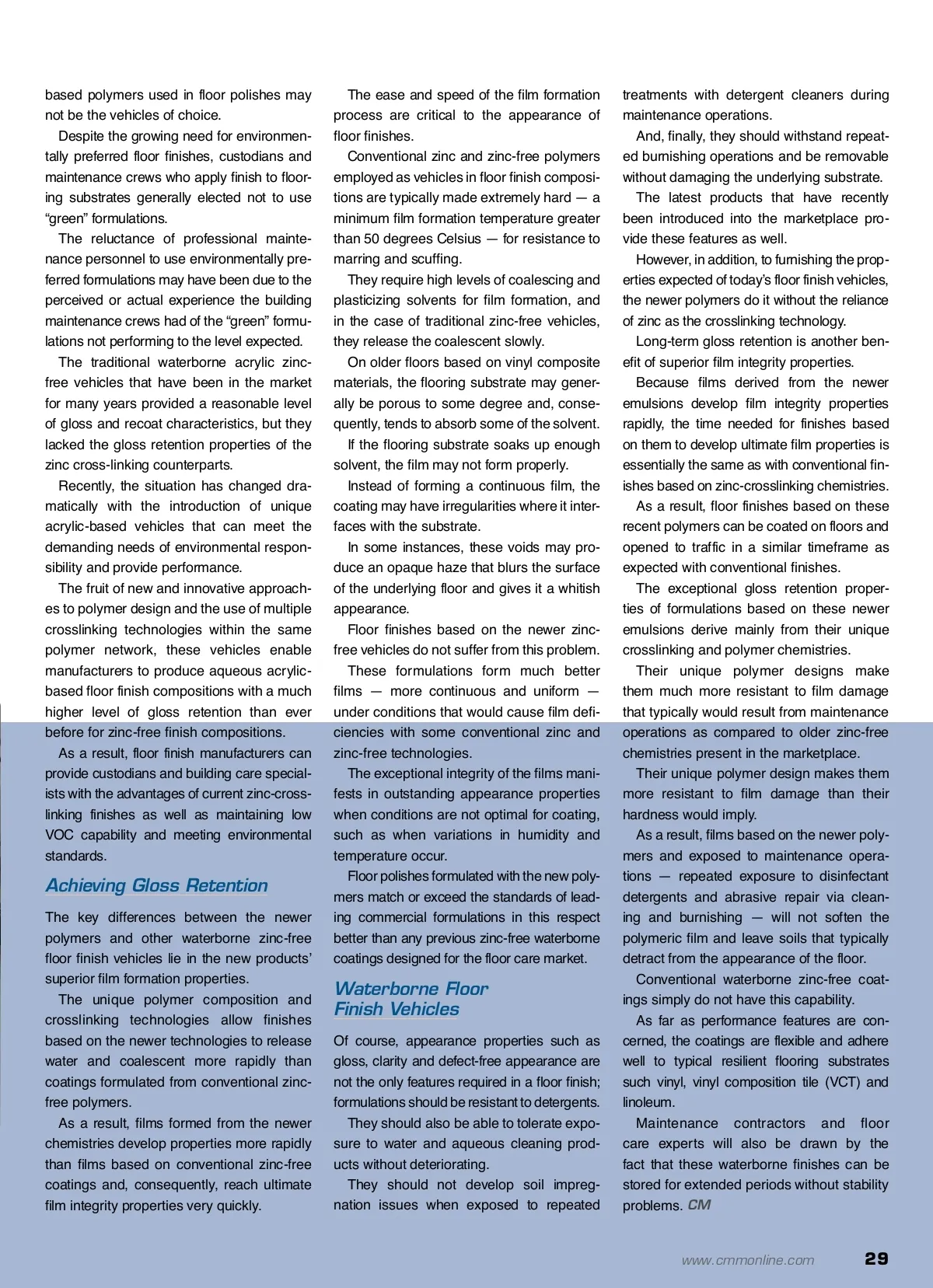
Marrying Durability And Environmental Preferability Recent innovations have introduced remarkable new polymers for floor finishes. Finishes based on the newer polymers can be applied in marginal application conditions without encountering the same recoat issues that may be present with conventional coatings. In addition to gloss retention characteristics and tolerance to marginal application conditions, the newer polymers based on multiple crosslink-ing technologies incorporated into single polymer matrices furnish low odor, an excellent balance of detergent resistance and removability and respond to all types of maintenance conditions. Formulations based on these polymers combine low volatile organic compound (VOC) content with other desirable environmental benefits to pro-duce important performance properties, including high gloss, resistance to harsh cleaners, excellent removability and, most importantly, durability. The polymeric vehicles employed in floor finish coatings must provide a remarkably diverse set of performance properties. The list of these expected attributes includes an attractive appearance, protective durability, water and detergent resistance and ease of removability. However, these properties represent only a start-ing point. The formulation that will be used to coat floors demands other features from the coating vehicle. Floor polishes are applied in some instances to a vinyl-based substrate that is categorized as being resilient. Consequently, the vehicle must supply flexibility and adhesion so the coating will not be damaged when the floor is exposed to normal pedestrian traffic and floor maintenance. The polymer must also impart significant mea-sures of aqueous resistance and toughness so the coating can endure repeated cleanings and other assaults that normally occur during the life of the coating. F By: Theodore Tysak, Ph.D. Over the last several decades, waterborne acrylic polymers based on zinc-crosslinked acrylic emul-sions have made significant inroads in floor care coating markets. Offering exceptional recoat characteristics, resis-tance to marring, scuffing and black heel marking, zinc-crosslinked acrylic-based emulsion polymers have been employed successfully to meet the var-ied needs of the floor care market. With the advent of “green cleaning” and eco-labeling becoming more prevalent in the build-ing maintenance industry, zinc containing acrylic-Dr. Theodore Tysak is a technology manager for the floor and surface care business at the Dow Chemical Company. For more information concerning this article, Tysak may be reached at [email protected]. for more info Visit www.cmmonline.com and type in search keyword: Hard Floor Care . For more information on related products, visit www.cmmonline.com , select SUPPLIER SEARCH from the main navigation bar, and enter keyword: Floor Finish . Today’s floor finishes have polymers that are bet-ter able to withstand repeated burnishings with-out discoloration or other degradation. 28 CM/Cleaning & Maintenance Management ® • May 2012 Image courtesy of Windsor Industries
CMM – Archives May 2012: 28