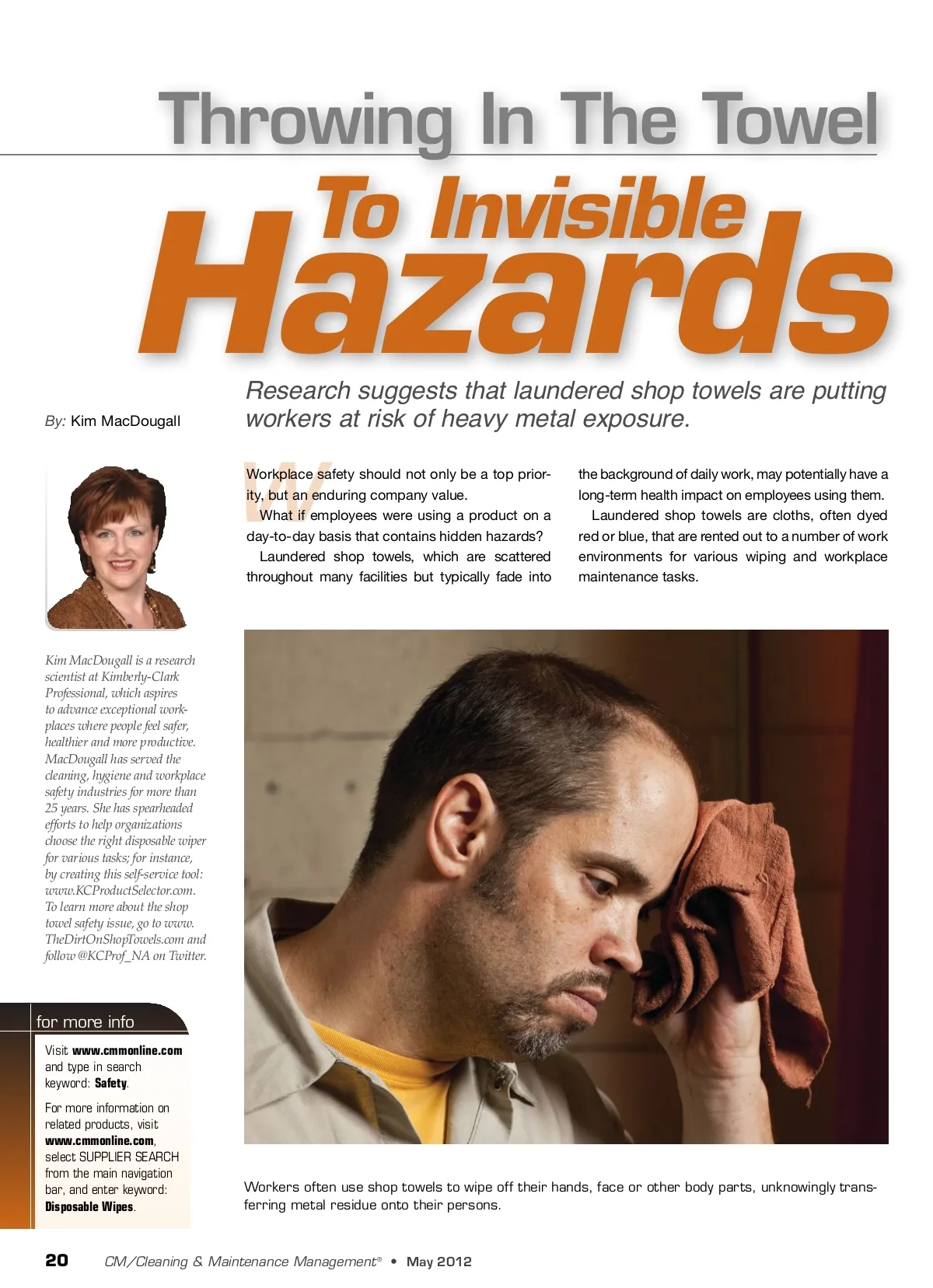
These towels are delivered “clean” to the worksite. After use, the shop towels are collected from different types of facilities, potentially washed together and delivered to other facilities. Unable to see any hazards on the towels, workers assume they are clean and con-tinue using them, often barehanded and without precautions. The Challenge: Potential Workplace Hazards Even though laundered shop towels are expected to be clean, nothing could be further from the truth. Recent research by Gradient, a leading environmental consulting firm, shows that shop towels contain high metal contamina-tion levels after laundering. In fact, at least 18 different types of heavy metal residue were found on 100 percent of the laundered shop towels tested. For the workers handling these towels, this might even pose a long-term health risk. The research was recently presented at the 2012 Society of Toxicology Annual Meeting. In the industrial environment, metal con-tamination is often thought of as an air-borne, respiratory hazard. However, metals can also represent an ingestion risk. The Gradient study establishes that metal residue on “clean” laundered shop towels can transfer to hands during use, then to the face and mouth where they can become an ingestion hazard. Many exposure models have explained the ease of transfer from hand to mouth; this is recognized by multiple federal agencies such as the U.S. Environmental Protection Agency (EPA). Given that an average person touches their face up to 16 times per hour, this expo-sure pathway’s importance becomes clear. The problem is, workers cannot see, smell or feel heavy metal contaminants on shop towels, so they may ultimately ingest the toxic metal residue from hand-to-mouth movements without knowing it. This is a significant issue, as chronic metal exposure, at sufficient doses, could result in various negative health effects including cancer and reproductive problems. Gradient research compared predicted metal exposure from shop towels against federal and state health-based toxicity limits. The firm conducted this analysis after 26 U.S. and Canadian companies submit-ted laundered shop towel samples to an independent lab, which tested them for 29 metals including antimony, beryl-lium, cadmium, cobalt, copper, iron, lead, molybdenum and nickel, as well as oil and grease. When comparing metal exposure from laundered shop towels against well-known regulatory benchmarks, the findings were alarming: ■ Permissible exposure limits from drinking water Metal exposure from using laundered shop towels may exceed the permissible levels allowed in drinking water as set by the EPA in the Safe Water Drinking Act. According to Gradient’s latest research, workers who use the typical amount of shop towels may be exposed to metals such as lead, chromium, cadmium and antimony at levels exceeding those allowed by the maximum contaminant levels (MCLs) or action levels (AL) for drinking water. For instance, the daily intake of lead from shop towels may be up to 21 times higher than the intake associated with the lead action level. ■ Health-based toxicology limits Several agencies like the EPA and the Agency for Toxic Substances and Disease Registry (ATSDR) set health-based toxicol-ogy guidelines for metal exposure. Predicted exposures among laundered shop towel users may be up to hundreds of times more than health-based toxicity cri-terion for metals like lead, cadmium, cobalt, beryllium and copper. To complement these findings, it was important to ask workers directly about their perspectives on shop towel risks and safety. We commissioned Harris Interactive to conduct an online survey asking workers specific questions about their awareness of heavy metals in shop towels. The results were clear: 78 percent believed laundered shop towels should be banned if they are not 100 percent free of hazardous materials. Additionally, more than nine in 10 work-ers would take greater safety precautions if they knew the risks. The survey found that many workers are unknowingly putting themselves at risk. Most surprisingly, 54 percent said their coworkers take the shop towels home, and 18 percent have used them for personal hygiene or first aid. Seeking A Healthier, More Effective Alternative It is time to replace laundered shop towels. Pound for pound, disposables have the potential to absorb more than rental shop towels and provide softness while main-taining strength and durability. Disposable material advances can help these wipers do the job of multiple shop towels. But, most importantly, disposable wip-ers provide a safe and clean alternative to laundered shop towels. When workers must handle shop tow-els, they have the right to know about the unnecessary and potentially serious health risks they are being exposed to on a daily basis in order to take precautions, such as: ■ Do not wipe your hands, face or mouth with laundered shop towels; to avoid skin contact, gloves are recommended ■ Always thoroughly wash your hands with soap and water and dry with a clean paper towel before eating or touching your eyes or mouth ■ Wash your hands and face before leav-ing work to avoid the potential of taking heavy metal residues home to your family ■ Do not take home laundered shop towels or wash them along with your clothes at home. The industry must fully address staff expectations for safe workplace products. When laundered shop towels are deliv-ered as clean, they should, in fact, be clean. Workers today experience an unnec-essary exposure to toxic metal residues from regular shop towel use — this is unac-ceptable. Metal exposure is cumulative and may have long-term health consequences. We must protect workers from this poten-tially dangerous, hidden workplace hazard. The best way to do that is to throw in the towel on dirty shop towels. CM www.cmmonline.com 21
CMM – Archives May 2012: 21