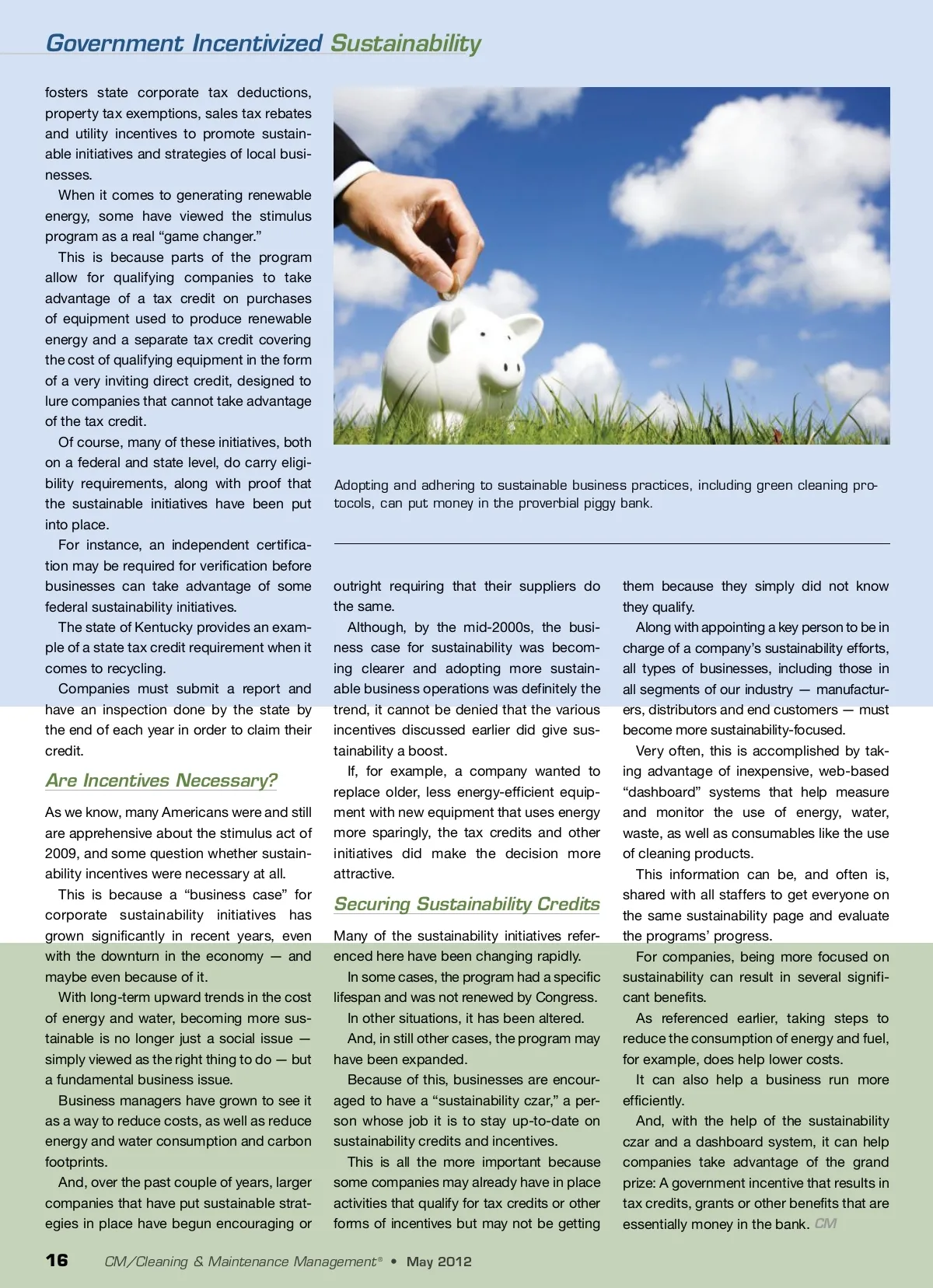
Government Incentivized Sustainability fosters state corporate tax deductions, property tax exemptions, sales tax rebates and utility incentives to promote sustain-able initiatives and strategies of local busi-nesses. When it comes to generating renewable energy, some have viewed the stimulus program as a real “game changer.” This is because parts of the program allow for qualifying companies to take advantage of a tax credit on purchases of equipment used to produce renewable energy and a separate tax credit covering the cost of qualifying equipment in the form of a very inviting direct credit, designed to lure companies that cannot take advantage of the tax credit. Of course, many of these initiatives, both on a federal and state level, do carry eligi-bility requirements, along with proof that the sustainable initiatives have been put into place. For instance, an independent certifica-tion may be required for verification before businesses can take advantage of some federal sustainability initiatives. The state of Kentucky provides an exam-ple of a state tax credit requirement when it comes to recycling. Companies must submit a report and have an inspection done by the state by the end of each year in order to claim their credit. Adopting and adhering to sustainable business practices, including green cleaning pro-tocols, can put money in the proverbial piggy bank. Are Incentives Necessary? As we know, many Americans were and still are apprehensive about the stimulus act of 2009, and some question whether sustain-ability incentives were necessary at all. This is because a “business case” for corporate sustainability initiatives has grown significantly in recent years, even with the downturn in the economy — and maybe even because of it. With long-term upward trends in the cost of energy and water, becoming more sus-tainable is no longer just a social issue — simply viewed as the right thing to do — but a fundamental business issue. Business managers have grown to see it as a way to reduce costs, as well as reduce energy and water consumption and carbon footprints. And, over the past couple of years, larger companies that have put sustainable strat-egies in place have begun encouraging or outright requiring that their suppliers do the same. Although, by the mid-2000s, the busi-ness case for sustainability was becom-ing clearer and adopting more sustain-able business operations was definitely the trend, it cannot be denied that the various incentives discussed earlier did give sus-tainability a boost. If, for example, a company wanted to replace older, less energy-efficient equip-ment with new equipment that uses energy more sparingly, the tax credits and other initiatives did make the decision more attractive. Securing Sustainability Credits Many of the sustainability initiatives refer-enced here have been changing rapidly. In some cases, the program had a specific lifespan and was not renewed by Congress. In other situations, it has been altered. And, in still other cases, the program may have been expanded. Because of this, businesses are encour-aged to have a “sustainability czar,” a per-son whose job it is to stay up-to-date on sustainability credits and incentives. This is all the more important because some companies may already have in place activities that qualify for tax credits or other forms of incentives but may not be getting them because they simply did not know they qualify. Along with appointing a key person to be in charge of a company’s sustainability efforts, all types of businesses, including those in all segments of our industry — manufactur-ers, distributors and end customers — must become more sustainability-focused. Very often, this is accomplished by tak-ing advantage of inexpensive, web-based “dashboard” systems that help measure and monitor the use of energy, water, waste, as well as consumables like the use of cleaning products. This information can be, and often is, shared with all staffers to get everyone on the same sustainability page and evaluate the programs’ progress. For companies, being more focused on sustainability can result in several signifi-cant benefits. As referenced earlier, taking steps to reduce the consumption of energy and fuel, for example, does help lower costs. It can also help a business run more efficiently. And, with the help of the sustainability czar and a dashboard system, it can help companies take advantage of the grand prize: A government incentive that results in tax credits, grants or other benefits that are essentially money in the bank. CM 16 CM/Cleaning & Maintenance Management ® • May 2012
CMM – Archives May 2012: 16