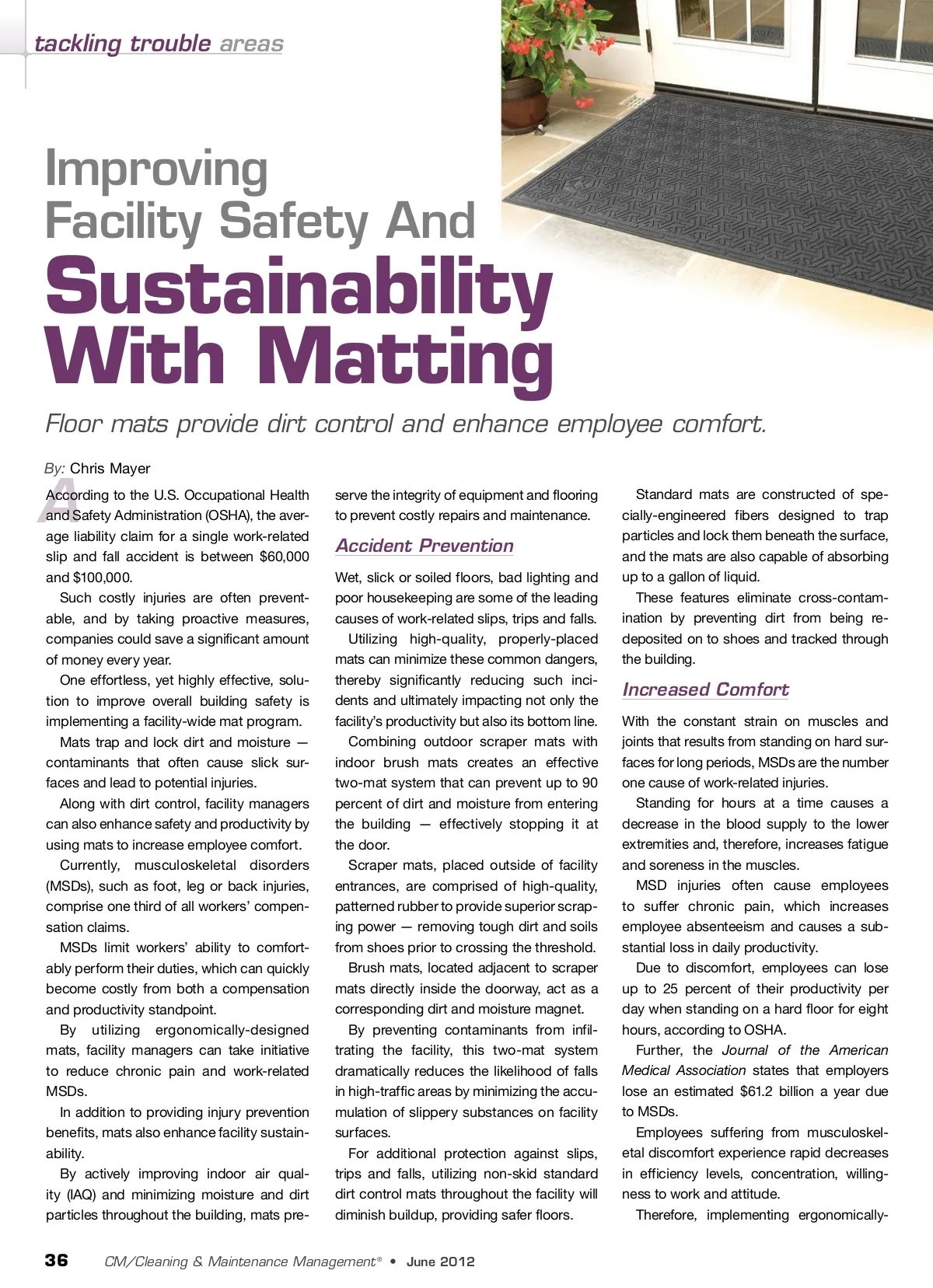
tackling trouble areas Improving Facility Safety And Sustainability With Matting Floor mats provide dirt control and enhance employee comfort. By: Chris Mayer A According to the U.S. Occupational Health and Safety Administration (OSHA), the aver-age liability claim for a single work-related slip and fall accident is between $60,000 and $100,000. Such costly injuries are often prevent-able, and by taking proactive measures, companies could save a significant amount of money every year. One effortless, yet highly effective, solu-tion to improve overall building safety is implementing a facility-wide mat program. Mats trap and lock dirt and moisture — contaminants that often cause slick sur-faces and lead to potential injuries. Along with dirt control, facility managers can also enhance safety and productivity by using mats to increase employee comfort. Currently, musculoskeletal disorders (MSDs), such as foot, leg or back injuries, comprise one third of all workers’ compen-sation claims. MSDs limit workers’ ability to comfort-ably perform their duties, which can quickly become costly from both a compensation and productivity standpoint. By utilizing ergonomically-designed mats, facility managers can take initiative to reduce chronic pain and work-related MSDs. In addition to providing injury prevention benefits, mats also enhance facility sustain-ability. By actively improving indoor air qual-ity (IAQ) and minimizing moisture and dirt particles throughout the building, mats pre-serve the integrity of equipment and flooring to prevent costly repairs and maintenance. Accident Prevention Wet, slick or soiled floors, bad lighting and poor housekeeping are some of the leading causes of work-related slips, trips and falls. Utilizing high-quality, properly-placed mats can minimize these common dangers, thereby significantly reducing such inci-dents and ultimately impacting not only the facility’s productivity but also its bottom line. Combining outdoor scraper mats with indoor brush mats creates an effective two-mat system that can prevent up to 90 percent of dirt and moisture from entering the building — effectively stopping it at the door. Scraper mats, placed outside of facility entrances, are comprised of high-quality, patterned rubber to provide superior scrap-ing power — removing tough dirt and soils from shoes prior to crossing the threshold. Brush mats, located adjacent to scraper mats directly inside the doorway, act as a corresponding dirt and moisture magnet. By preventing contaminants from infil-trating the facility, this two-mat system dramatically reduces the likelihood of falls in high-traffic areas by minimizing the accu-mulation of slippery substances on facility surfaces. For additional protection against slips, trips and falls, utilizing non-skid standard dirt control mats throughout the facility will diminish buildup, providing safer floors. Standard mats are constructed of spe-cially-engineered fibers designed to trap particles and lock them beneath the surface, and the mats are also capable of absorbing up to a gallon of liquid. These features eliminate cross-contam-ination by preventing dirt from being re-deposited on to shoes and tracked through the building. Increased Comfort With the constant strain on muscles and joints that results from standing on hard sur-faces for long periods, MSDs are the number one cause of work-related injuries. Standing for hours at a time causes a decrease in the blood supply to the lower extremities and, therefore, increases fatigue and soreness in the muscles. MSD injuries often cause employees to suffer chronic pain, which increases employee absenteeism and causes a sub-stantial loss in daily productivity. Due to discomfort, employees can lose up to 25 percent of their productivity per day when standing on a hard floor for eight hours, according to OSHA. Further, the Journal of the American Medical Association states that employers lose an estimated $61.2 billion a year due to MSDs. Employees suffering from musculoskel-etal discomfort experience rapid decreases in efficiency levels, concentration, willing-ness to work and attitude. Therefore, implementing ergonomically-36 CM/Cleaning & Maintenance Management ® • June 2012
CMM – Archives June 2012: 36