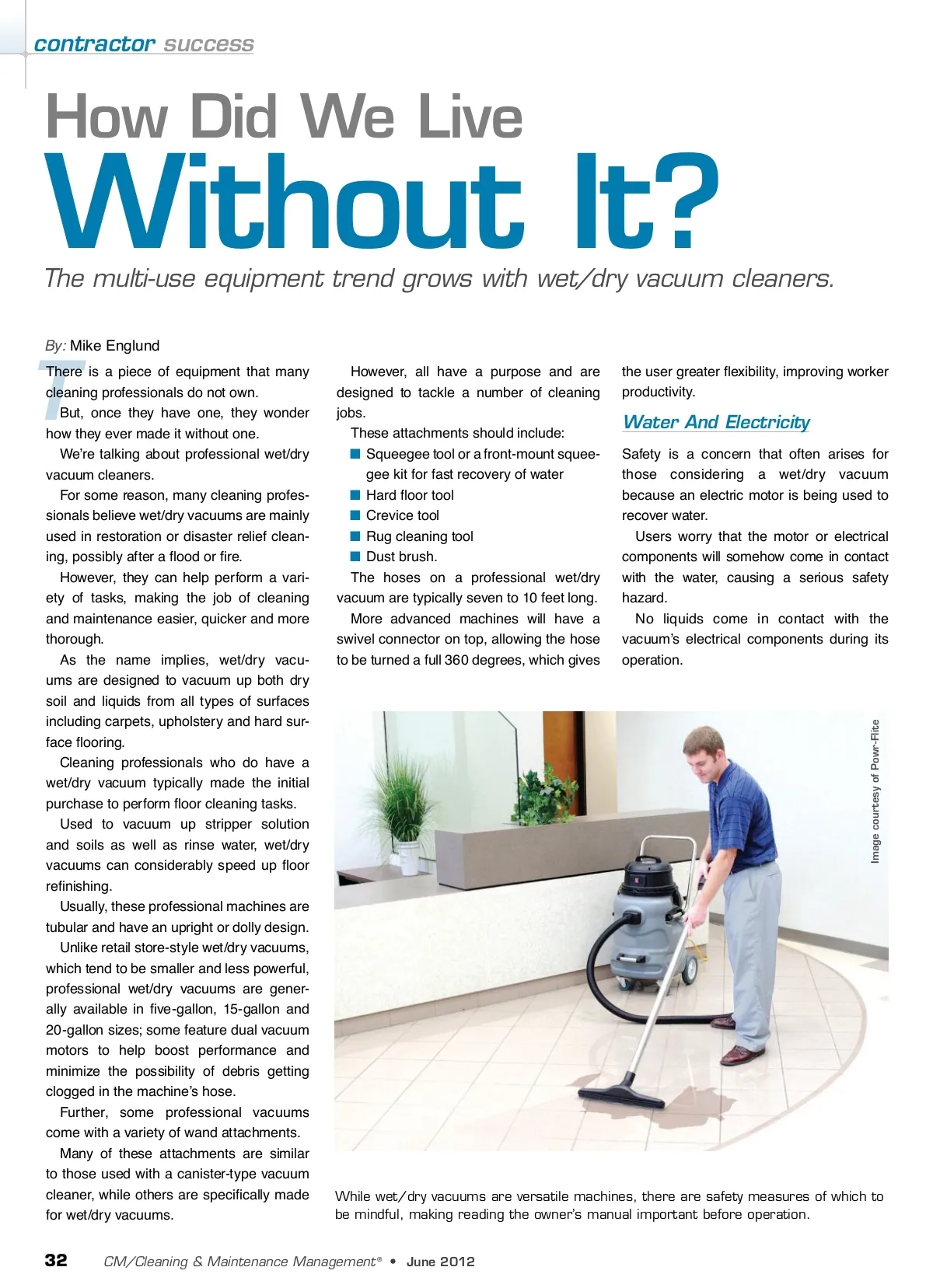
contractor success How Did We Live The multi-use equipment trend grows with wet/dry vacuum cleaners. By: Mike Englund Without It? There is a piece of equipment that many cleaning professionals do not own. But, once they have one, they wonder how they ever made it without one. We’re talking about professional wet/dry vacuum cleaners. For some reason, many cleaning profes-sionals believe wet/dry vacuums are mainly used in restoration or disaster relief clean-ing, possibly after a flood or fire. However, they can help perform a vari-ety of tasks, making the job of cleaning and maintenance easier, quicker and more thorough. As the name implies, wet/dry vacu-ums are designed to vacuum up both dry soil and liquids from all types of surfaces including carpets, upholstery and hard sur-face flooring. Cleaning professionals who do have a wet/dry vacuum typically made the initial purchase to perform floor cleaning tasks. Used to vacuum up stripper solution and soils as well as rinse water, wet/dry vacuums can considerably speed up floor refinishing. Usually, these professional machines are tubular and have an upright or dolly design. Unlike retail store-style wet/dry vacuums, which tend to be smaller and less powerful, professional wet/dry vacuums are gener-ally available in five-gallon, 15-gallon and 20-gallon sizes; some feature dual vacuum motors to help boost performance and minimize the possibility of debris getting clogged in the machine’s hose. Further, some professional vacuums come with a variety of wand attachments. Many of these attachments are similar to those used with a canister-type vacuum cleaner, while others are specifically made for wet/dry vacuums. However, all have a purpose and are designed to tackle a number of cleaning jobs. These attachments should include: ■ Squeegee tool or a front-mount squee-gee kit for fast recovery of water ■ Hard floor tool ■ Crevice tool ■ Rug cleaning tool ■ Dust brush. The hoses on a professional wet/dry vacuum are typically seven to 10 feet long. More advanced machines will have a swivel connector on top, allowing the hose to be turned a full 360 degrees, which gives T the user greater flexibility, improving worker productivity. Water And Electricity Safety is a concern that often arises for those considering a wet/dry vacuum because an electric motor is being used to recover water. Users worry that the motor or electrical components will somehow come in contact with the water, causing a serious safety hazard. No liquids come in contact with the vacuum’s electrical components during its operation. While wet/dry vacuums are versatile machines, there are safety measures of which to be mindful, making reading the owner’s manual important before operation. 32 CM/Cleaning & Maintenance Management ® • June 2012 Image courtesy of Powr-Flite
CMM – Archives June 2012: 32