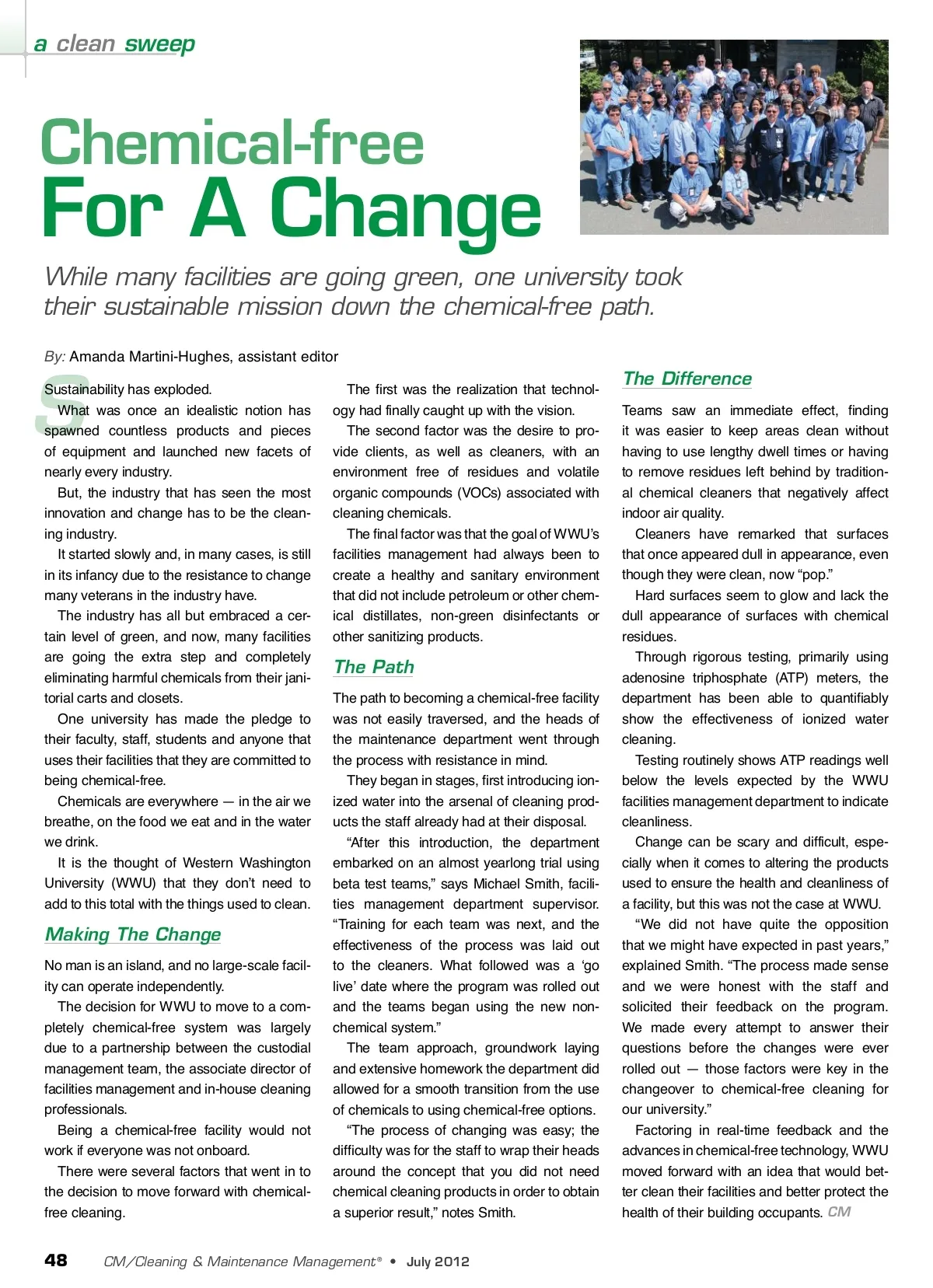
a clean sweep Chemical-free For A Change While many facilities are going green, one university took their sustainable mission down the chemical-free path. By: Amanda Martini-Hughes, assistant editor S Sustainability has exploded. What was once an idealistic notion has spawned countless products and pieces of equipment and launched new facets of nearly every industry. But, the industry that has seen the most innovation and change has to be the clean-ing industry. It started slowly and, in many cases, is still in its infancy due to the resistance to change many veterans in the industry have. The industry has all but embraced a cer-tain level of green, and now, many facilities are going the extra step and completely eliminating harmful chemicals from their jani-torial carts and closets. One university has made the pledge to their faculty, staff, students and anyone that uses their facilities that they are committed to being chemical-free. Chemicals are everywhere — in the air we breathe, on the food we eat and in the water we drink. It is the thought of Western Washington University (WWU) that they don’t need to add to this total with the things used to clean. The first was the realization that technol-ogy had finally caught up with the vision. The second factor was the desire to pro-vide clients, as well as cleaners, with an environment free of residues and volatile organic compounds (VOCs) associated with cleaning chemicals. The final factor was that the goal of WWU’s facilities management had always been to create a healthy and sanitary environment that did not include petroleum or other chem-ical distillates, non-green disinfectants or other sanitizing products. The Difference Teams saw an immediate effect, finding it was easier to keep areas clean without having to use lengthy dwell times or having to remove residues left behind by tradition-al chemical cleaners that negatively affect indoor air quality. Cleaners have remarked that surfaces that once appeared dull in appearance, even though they were clean, now “pop.” Hard surfaces seem to glow and lack the dull appearance of surfaces with chemical residues. Through rigorous testing, primarily using adenosine triphosphate (ATP) meters, the department has been able to quantifiably show the effectiveness of ionized water cleaning. Testing routinely shows ATP readings well below the levels expected by the WWU facilities management department to indicate cleanliness. Change can be scary and difficult, espe-cially when it comes to altering the products used to ensure the health and cleanliness of a facility, but this was not the case at WWU. “We did not have quite the opposition that we might have expected in past years,” explained Smith. “The process made sense and we were honest with the staff and solicited their feedback on the program. We made every attempt to answer their questions before the changes were ever rolled out — those factors were key in the changeover to chemical-free cleaning for our university.” Factoring in real-time feedback and the advances in chemical-free technology, WWU moved forward with an idea that would bet-ter clean their facilities and better protect the health of their building occupants. CM The Path The path to becoming a chemical-free facility was not easily traversed, and the heads of the maintenance department went through the process with resistance in mind. They began in stages, first introducing ion-ized water into the arsenal of cleaning prod-ucts the staff already had at their disposal. “After this introduction, the department embarked on an almost yearlong trial using beta test teams,” says Michael Smith, facili-ties management department supervisor. “Training for each team was next, and the effectiveness of the process was laid out to the cleaners. What followed was a ‘go live’ date where the program was rolled out and the teams began using the new non-chemical system.” The team approach, groundwork laying and extensive homework the department did allowed for a smooth transition from the use of chemicals to using chemical-free options. “The process of changing was easy; the difficulty was for the staff to wrap their heads around the concept that you did not need chemical cleaning products in order to obtain a superior result,” notes Smith. Making The Change No man is an island, and no large-scale facil-ity can operate independently. The decision for WWU to move to a com-pletely chemical-free system was largely due to a partnership between the custodial management team, the associate director of facilities management and in-house cleaning professionals. Being a chemical-free facility would not work if everyone was not onboard. There were several factors that went in to the decision to move forward with chemical-free cleaning. 48 CM/Cleaning & Maintenance Management ® • July 2012
CMM – Archives July2012: 48