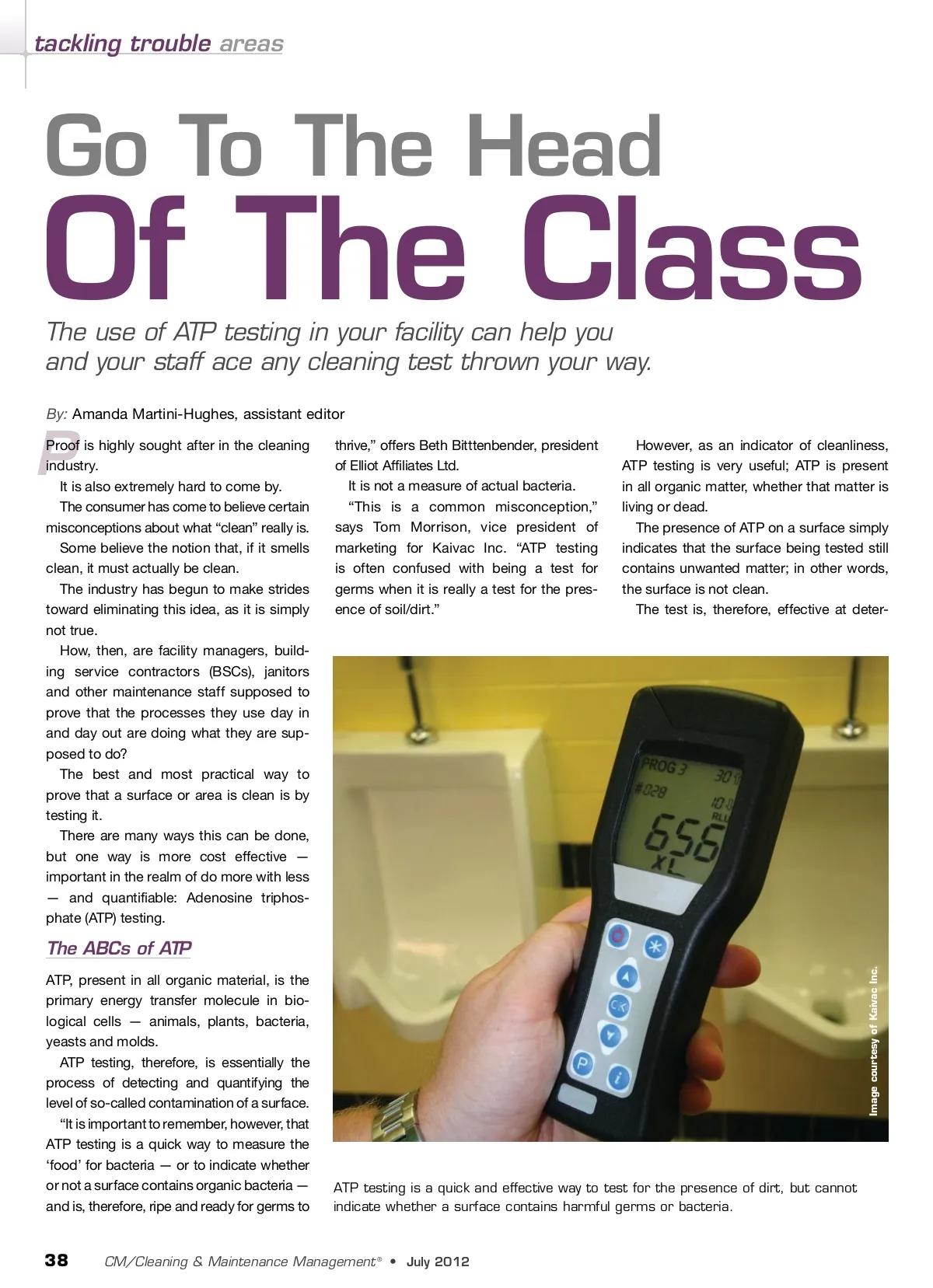
mining cleaning effectiveness and whether or not a cleaning process has effectively reduced the risk of contamination. The test does not, however, indicate the actual health of a surface and cannot tell you whether what is found is a living, dead or hazardous. What Can It Do? One of the biggest advantages of ATP test-ing is that it is a quick and easy way to deter-mine if your Cleaning process is working. It is also an effective way to educate employees on the simple fact that a certain process really does make a difference, rath-er than piling on more and more product. The lower the ATP level that is measured, the lower the level of bacteria that are pres-ent on a given surface. This is especially important for high-touch points, such as doorknobs, light switches and fixture handles. The testing process can show employees the effect of a specific cleaning process, whether that be the correct process or something not exactly up to par. The advantage of ATP testing is that this effect can be shown on-the-spot, rather than days later if using the Petri dish meth-od; ATP testing is also far more accurate and easy to understand than growing bac-teria in a Petri dish, selecting a portion of the growth to count and hoping you come up with something that resembles the amount of bacteria that was on the surface. The Best Use There are three instances when using the results from ATP testing is the most appro-priate: To show the effect of a cleaning pro-cess; to show the effect of an overloaded cloth; and for measuring and monitoring. 1. The effect of a cleaning process The cleaning industry is not one that is necessarily a proponent of change. It is not unheard of for a veteran of the industry, someone who has deep roots, to be adverse to any sort of chemical or pro-cess change. To this veteran, the tried and true meth-ods that have been employed for years have worked and, therefore, shouldn’t be messed with. ATP is an easy way to prove to this per-son, and any non-believer, that a new clean-ing process or technique is as effective, if not more so, than the old one. Through in-the-field testing, the efficacy of a new process can be proven. Because the ATP meter will give the user a quantifiable measurement of how much “food” is on a surface, it is easy to test before cleaning and to test again after the cleaning process is complete. 2. The effect of an overloaded cloth Many times, though it is certainly not the norm, cleaners will use and reuse their cleaning implement because it is easier or because they don’t want to seem wasteful. However, if a cleaning cloth or mop head had been used too often, it can actually be doing more harm than good. “Eventually, all you’re doing is transfer-ring dirt from one place to another,” notes Bittenbender. Even if an implement appears clean, that might not be the case. ATP testing is a way to show the effect an overused rag, cloth or mop head can have on a surface. Test the space before cleaning, and then proceed with the cleaning process, remem-bering to test again after completing the cleaning process. If the ATP count goes up, you have added food on which bacteria can then thrive. 3. Measuring and monitoring Monthly monitoring and measuring of touch point cleaning is made infinitely easier with ATP testing. The ease of data collection and interpre-tation of the results makes it a relatively sim-ple task to record inspections, compile data and compose a global perspective of the cleaning processes at work in your facility. If the data collected is inconsistent, it may be indicative of a problem with the clean-ing process, whether the employee using it has not been trained properly or there is a problem with the equipment or chemicals being used. The question is, what do you do with that data? Utilizing tools such as spreadsheets will allow you to categorize and sort your data easily. Sort by building for an overarching look at the efficacy of your cleaning process; further sort by room type in order to see where corners are being cut or attention to detail is not being paid. Be sure to keep in mind, however, that the data you collect cannot tell you why num-bers are high; you still need to investigate. Are your tools, whether they be hand tools or chemicals, not performing up to your expected standards; is an employee not fol-lowing the letter of the law, so to speak? “Data is the starting point, not the finish, and should never be used for disciplinary reasons,” cautions Bittenbender. The Name Of The Game Is Consistency All the proving, testing, measuring and mon-itoring in the world will not matter if how you use ATP testing in your facility is not consistent. Bittenbender recommends having a tem-plate for a surface that allows a specific size of a surface area to be tested: “Having a template, say a two-inch by two-inch cutout, will ensure that you swab the exact same surface area each time you test.” If the way in which you test is consistent, it will be easier to compare data and to deter-mine if your cleaning system is working. It is important to remember that every device is different and will have its own set of ranges. By the same token, each facility is differ-ent and will classify what is an acceptable range differently. Do not assume what is acceptable in one facility will be acceptable in an entirely dif-ferent setting. CM Amanda Martini-Hughes is the assistant editor of Cleaning & Maintenance Management maga-zine. A graduate from Siena College, she can be reached at [email protected]. Since joining the publication, Martini-Hughes has worked on numerous industry articles and is responsible for populating the industry’s only daily electronic newsletter, CM e-News Daily. Chat online: Facebook.com/CMMOnline and Twitter.com/CMeNewsDaily. Data Collection If you are testing your facility on a regular basis, chances are good that you’ve com-piled a nice bit of data from which you can learn a thing or two about your facility and how it is cleaned. www.cmmonline.com 39
CMM – Archives July2012: 39