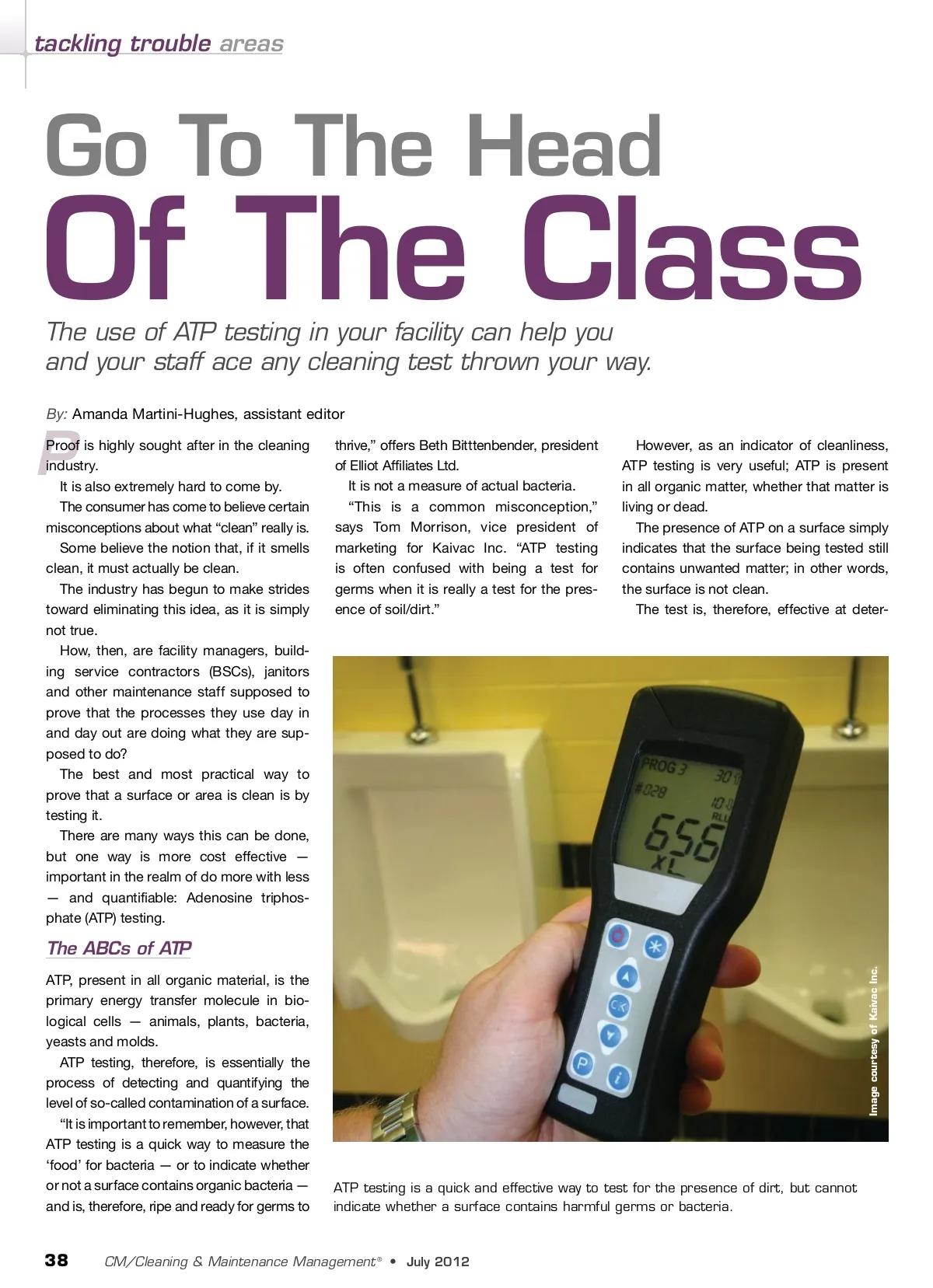
tackling trouble areas Of The Class The use of ATP testing in your facility can help you and your staff ace any cleaning test thrown your way. By: Amanda Martini-Hughes, assistant editor Proof is highly sought after in the cleaning industry. It is also extremely hard to come by. The consumer has come to believe certain misconceptions about what “clean” really is. Some believe the notion that, if it smells clean, it must actually be clean. The industry has begun to make strides toward eliminating this idea, as it is simply not true. How, then, are facility managers, build-ing service contractors (BSCs), janitors and other maintenance staff supposed to prove that the processes they use day in and day out are doing what they are sup-posed to do? The best and most practical way to prove that a surface or area is clean is by testing it. There are many ways this can be done, but one way is more cost effective — important in the realm of do more with less — and quantifiable: Adenosine triphos-phate (ATP) testing. thrive,” offers Beth Bitttenbender, president of Elliot Affiliates Ltd. It is not a measure of actual bacteria. “This is a common misconception,” says Tom Morrison, vice president of marketing for Kaivac Inc. “ATP testing is often confused with being a test for germs when it is really a test for the pres-ence of soil/dirt.” Go To The Head P However, as an indicator of cleanliness, ATP testing is very useful; ATP is present in all organic matter, whether that matter is living or dead. The presence of ATP on a surface simply indicates that the surface being tested still contains unwanted matter; in other words, the surface is not clean. The test is, therefore, effective at deter-The ABCs of ATP ATP, present in all organic material, is the primary energy transfer molecule in bio-logical cells — animals, plants, bacteria, yeasts and molds. ATP testing, therefore, is essentially the process of detecting and quantifying the level of so-called contamination of a surface. “It is important to remember, however, that ATP testing is a quick way to measure the ‘food’ for bacteria — or to indicate whether or not a surface contains organic bacteria — and is, therefore, ripe and ready for germs to Image courtesy of Kaivac Inc. ATP testing is a quick and effective way to test for the presence of dirt, but cannot indicate whether a surface contains harmful germs or bacteria. 38 CM/Cleaning & Maintenance Management ® • July 2012
CMM – Archives July2012: 38