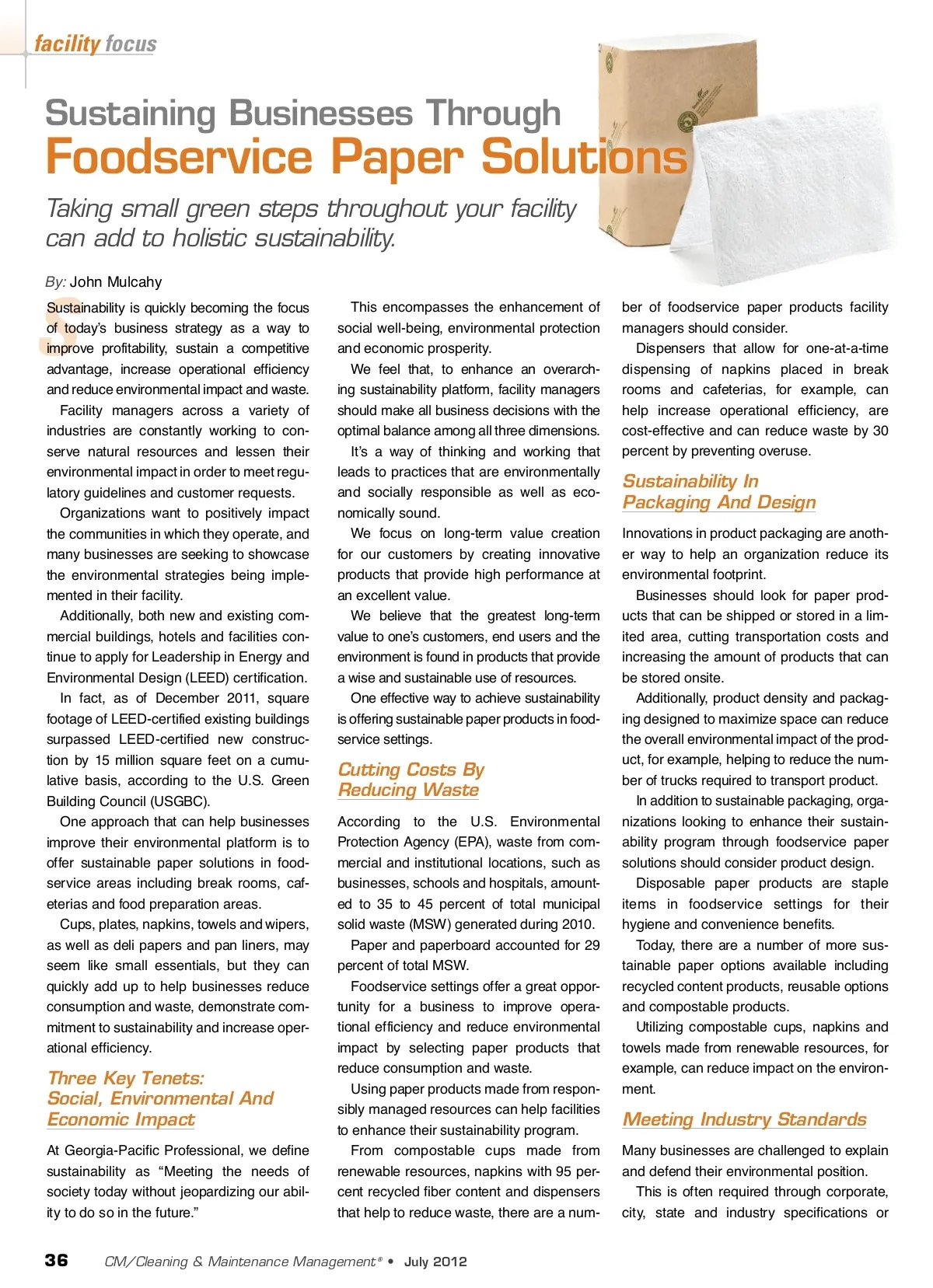
facility focus SustainingBusinessesThrough Taking small green steps throughout your facility can add to holistic sustainability. By: John Mulcahy FoodservicePaperSolu t ions S Sustainability is quickly becoming the focus of today’s business strategy as a way to improve profitability, sustain a competitive advantage, increase operational efficiency and reduce environmental impact and waste. Facility managers across a variety of industries are constantly working to con-serve natural resources and lessen their environmental impact in order to meet regu-latory guidelines and customer requests. Organizations want to positively impact the communities in which they operate, and many businesses are seeking to showcase the environmental strategies being imple-mented in their facility. Additionally, both new and existing com-mercial buildings, hotels and facilities con-tinue to apply for Leadership in Energy and Environmental Design (LEED) certification. In fact, as of December 2011, square footage of LEED-certified existing buildings surpassed LEED-certified new construc-tion by 15 million square feet on a cumu-lative basis, according to the U.S. Green Building Council (USGBC). One approach that can help businesses improve their environmental platform is to offer sustainable paper solutions in food-service areas including break rooms, caf-eterias and food preparation areas. Cups, plates, napkins, towels and wipers, as well as deli papers and pan liners, may seem like small essentials, but they can quickly add up to help businesses reduce consumption and waste, demonstrate com-mitment to sustainability and increase oper-ational efficiency. This encompasses the enhancement of social well-being, environmental protection and economic prosperity. We feel that, to enhance an overarch-ing sustainability platform, facility managers should make all business decisions with the optimal balance among all three dimensions. It’s a way of thinking and working that leads to practices that are environmentally and socially responsible as well as eco-nomically sound. We focus on long-term value creation for our customers by creating innovative products that provide high performance at an excellent value. We believe that the greatest long-term value to one’s customers, end users and the environment is found in products that provide a wise and sustainable use of resources. One effective way to achieve sustainability is offering sustainable paper products in food-service settings. ber of foodservice paper products facility managers should consider. Dispensers that allow for one-at-a-time dispensing of napkins placed in break rooms and cafeterias, for example, can help increase operational efficiency, are cost-effective and can reduce waste by 30 percent by preventing overuse. Sustainability In Packaging And Design Innovations in product packaging are anoth-er way to help an organization reduce its environmental footprint. Businesses should look for paper prod-ucts that can be shipped or stored in a lim-ited area, cutting transportation costs and increasing the amount of products that can be stored onsite. Additionally, product density and packag-ing designed to maximize space can reduce the overall environmental impact of the prod-uct, for example, helping to reduce the num-ber of trucks required to transport product. In addition to sustainable packaging, orga-nizations looking to enhance their sustain-ability program through foodservice paper solutions should consider product design. Disposable paper products are staple items in foodservice settings for their hygiene and convenience benefits. Today, there are a number of more sus-tainable paper options available including recycled content products, reusable options and compostable products. Utilizing compostable cups, napkins and towels made from renewable resources, for example, can reduce impact on the environ-ment. Cutting Costs By Reducing Waste According to the U.S. Environmental Protection Agency (EPA), waste from com-mercial and institutional locations, such as businesses, schools and hospitals, amount-ed to 35 to 45 percent of total municipal solid waste (MSW) generated during 2010. Paper and paperboard accounted for 29 percent of total MSW. Foodservice settings offer a great oppor-tunity for a business to improve opera-tional efficiency and reduce environmental impact by selecting paper products that reduce consumption and waste. Using paper products made from respon-sibly managed resources can help facilities to enhance their sustainability program. From compostable cups made from renewable resources, napkins with 95 per-cent recycled fiber content and dispensers that help to reduce waste, there are a num-Three Key Tenets: Social, Environmental And Economic Impact At Georgia-Pacific Professional, we define sustainability as “Meeting the needs of society today without jeopardizing our abil-ity to do so in the future.” Meeting Industry Standards Many businesses are challenged to explain and defend their environmental position. This is often required through corporate, city, state and industry specifications or 36 CM/Cleaning & Maintenance Management ® • July2012
CMM – Archives July2012: 36