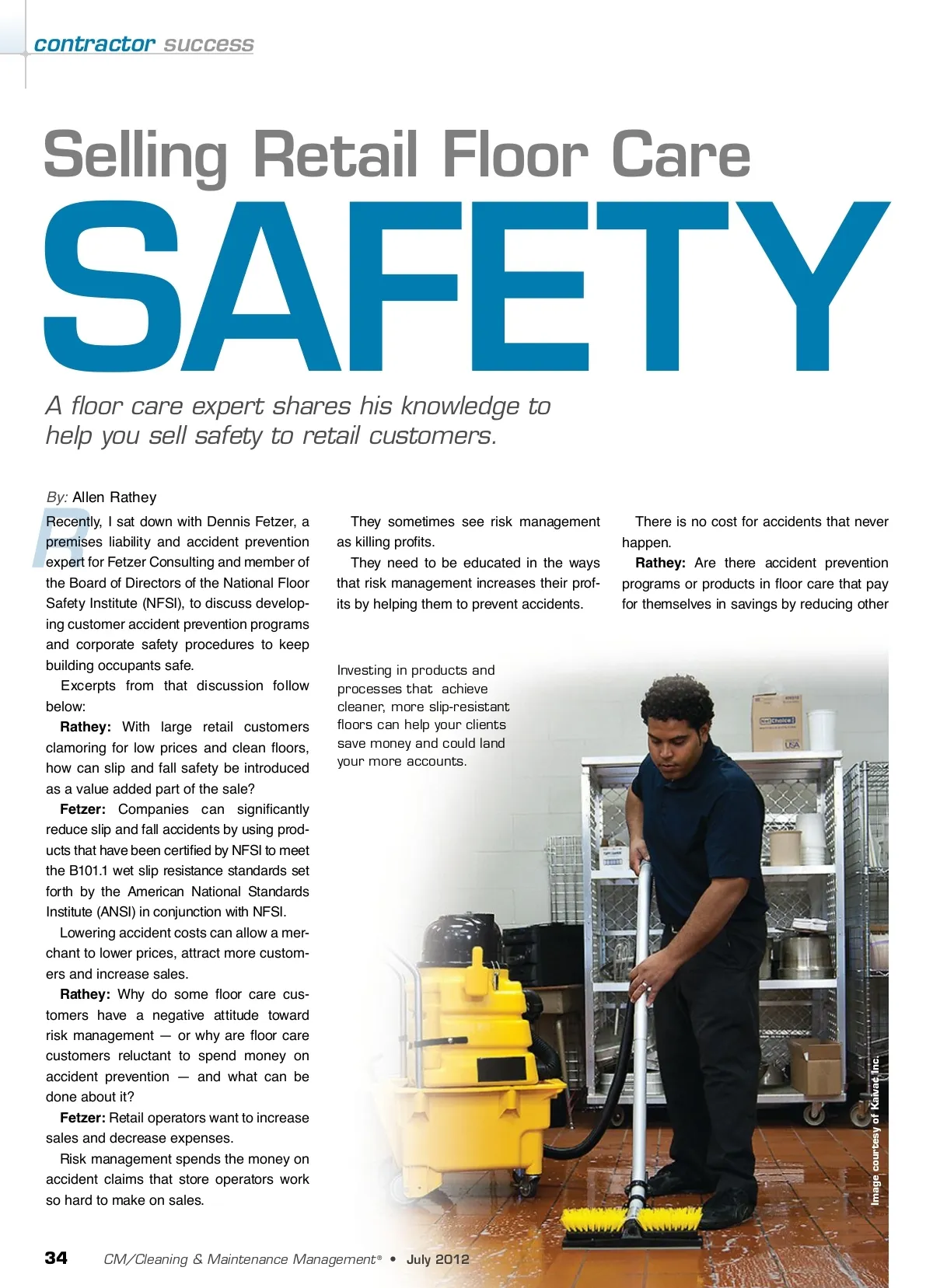
Better Cleaning Methods For Slip And Fall Prevention By: Rex Morrison, president of the nonprofit Process Cleaning for Healthy Schools (PCHS) Consortium Conventional mop and bucket floor cleaning inevitably recirculates soil and contaminants — including oils that build up over time to make floors slippery, especially in kitchens. Consider adopting floor cleaning methods that do not redistribute dirt and do prevent slip-pery buildup, thus optimize floor safety, labor and associated costs. Autoscrubbers are worth considering since these offer a self-contained solution and recov-ery tank — only clean water is applied to the floor, the floor is automatically scrubbed and the dirty solution is vacuumed off. However, the cost of an autoscrubber is often prohibitive — perhaps several thousand dollars per unit. In addition, the scrub pads can quickly become overloaded in a grease-soiled environ-ment like a kitchen, and autoscrubbers can be cumbersome in confined areas. Dispense-and-vacuum or spray-and-vacuum equipment are sound options since they offer the key benefits of autoscrubbers — applying fresh cleaning solution to the floor, agitating with a brush and/or pressurized spray and vacuuming the soiled water — at a fraction of the cost. Crossover equipment, as these technologies are being called, consists of a simple-to-use modified mop bucket platform, to which can be added spray/squeegee and vacuum functions via simple, modular components at a price point for a complete system well under $1,000 in many cases. Maneuverability and access to tight spots is also excellent using lightweight wands and tools. Before-and-after coefficient of friction (COF) traction measurements with a Binary Output Tribometer (BOT) indicate better cleaning and slip resistance outcomes using a crossover dispense-and-vacuum or spray-and-vacuum unit versus legacy mop-and-bucket systems — microfiber or otherwise. Productivity is also enhanced since floor cleaning is faster and more thorough. operating costs? Fetzer: Innovative advances in technol-ogy and equipment design have resulted in products that can pay for themselves by reducing labor costs. One company even has a savings cal-culator that shows the customer how much money the customer can save by using its products. Rathey: How can you respond to the typical reasons that customers give for not wanting to invest time and money on acci-dent prevention products and programs? Fetzer: Typical excuse: “I don’t need to prevent accidents; that’s what I carry insur-ance for.” Good response: Accident costs increase insurance premiums. Typical excuse: “Accident prevention expenses can add up in a hurry.” Good response: Jury verdicts can add up in a hurry, too. Typical excuse: “I just increase prices to pay for accidents.” Good response: Increased prices reduce sales. Typical excuse: “I don’t want to spend money, I want to save money.” Good response: Accident prevention saves money. Rathey: How can I convince customers that accident prevention proposals will work and will be cost effective? Fetzer: Case studies are available to show that products that meet the ANSI/NFSI B101.1 wet slip resistance standards can significantly reduce slip and fall accidents. Demo projects are also used to show a customer how a specific product can help them to reduce accident costs. CM Allen Rathey is president of InstructionLink/ JanTrain Inc. of Boise, Idaho. He also serves as president of the Housekeeping Channel (HC), the Healthy House Institute (HHI) and the Healthy Facilities Institute (HFI). Rathey promotes healthy indoor environments, and writes and speaks on healthy cleaning and facility topics. www.ultrachemlabs.com Product Information no. 208 on page 24 www.cmmonline.com 35
CMM – Archives July2012: 35