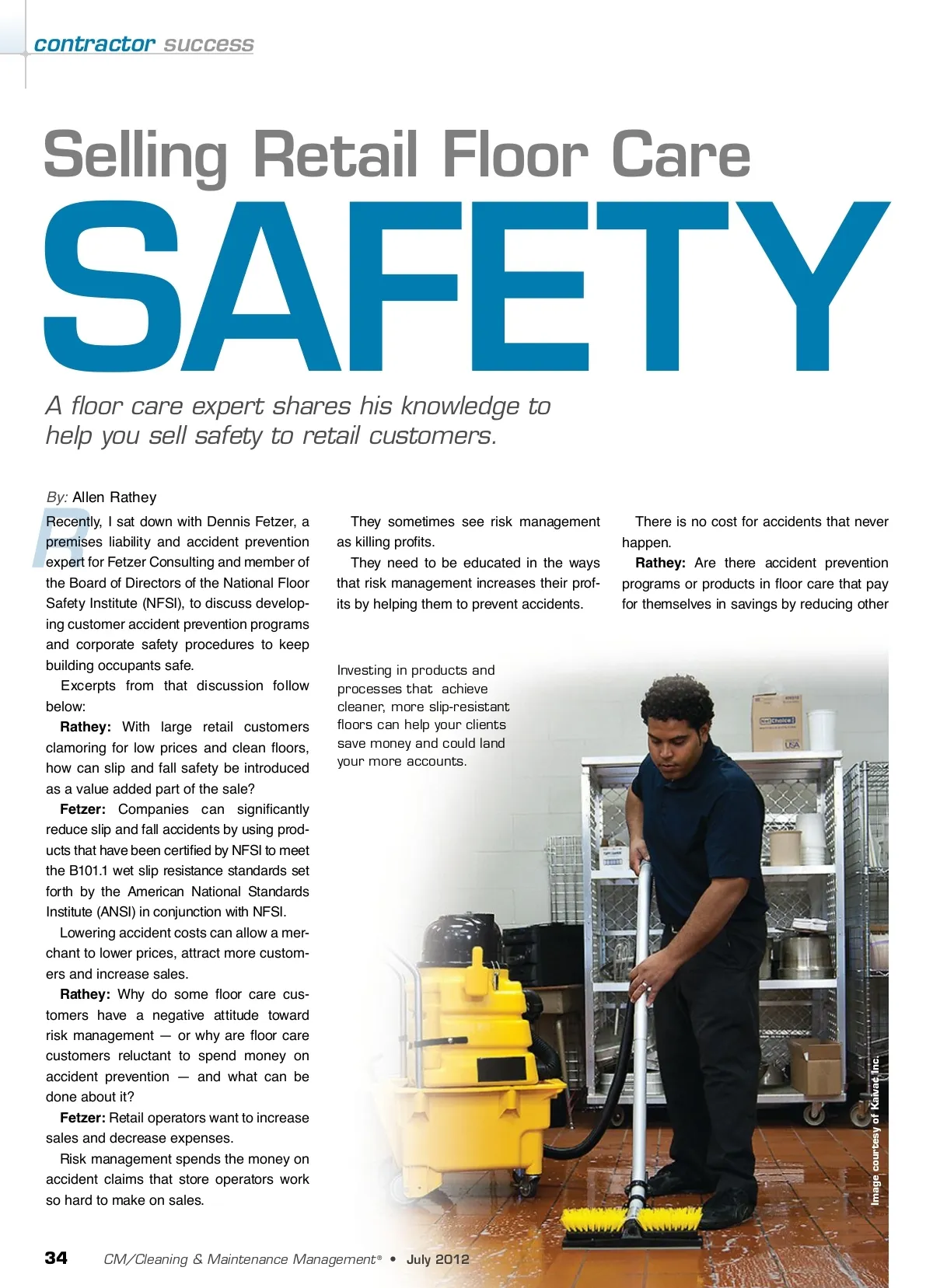
contractor success Selling Retail Floor Care SAFETY A floor care expert shares his knowledge to help you sell safety to retail customers. By: Allen Rathey R Recently, I sat down with Dennis Fetzer, a premises liability and accident prevention expert for Fetzer Consulting and member of the Board of Directors of the National Floor Safety Institute (NFSI), to discuss develop-ing customer accident prevention programs and corporate safety procedures to keep building occupants safe. Excerpts from that discussion follow below: Rathey: With large retail customers clamoring for low prices and clean floors, how can slip and fall safety be introduced as a value added part of the sale? Fetzer: Companies can significantly reduce slip and fall accidents by using prod-ucts that have been certified by NFSI to meet the B101.1 wet slip resistance standards set forth by the American National Standards Institute (ANSI) in conjunction with NFSI. Lowering accident costs can allow a mer-chant to lower prices, attract more custom-ers and increase sales. Rathey: Why do some floor care cus-tomers have a negative attitude toward risk management — or why are floor care customers reluctant to spend money on accident prevention — and what can be done about it? Fetzer: Retail operators want to increase sales and decrease expenses. Risk management spends the money on accident claims that store operators work so hard to make on sales. They sometimes see risk management as killing profits. They need to be educated in the ways that risk management increases their prof-its by helping them to prevent accidents. There is no cost for accidents that never happen. Rathey: Are there accident prevention programs or products in floor care that pay for themselves in savings by reducing other Investing in products and processes that achieve cleaner, more slip-resistant floors can help your clients save money and could land your more accounts. 34 CM/Cleaning & Maintenance Management ® • July 2012 Image courtesy of Kaivac Inc.
CMM – Archives July2012: 34