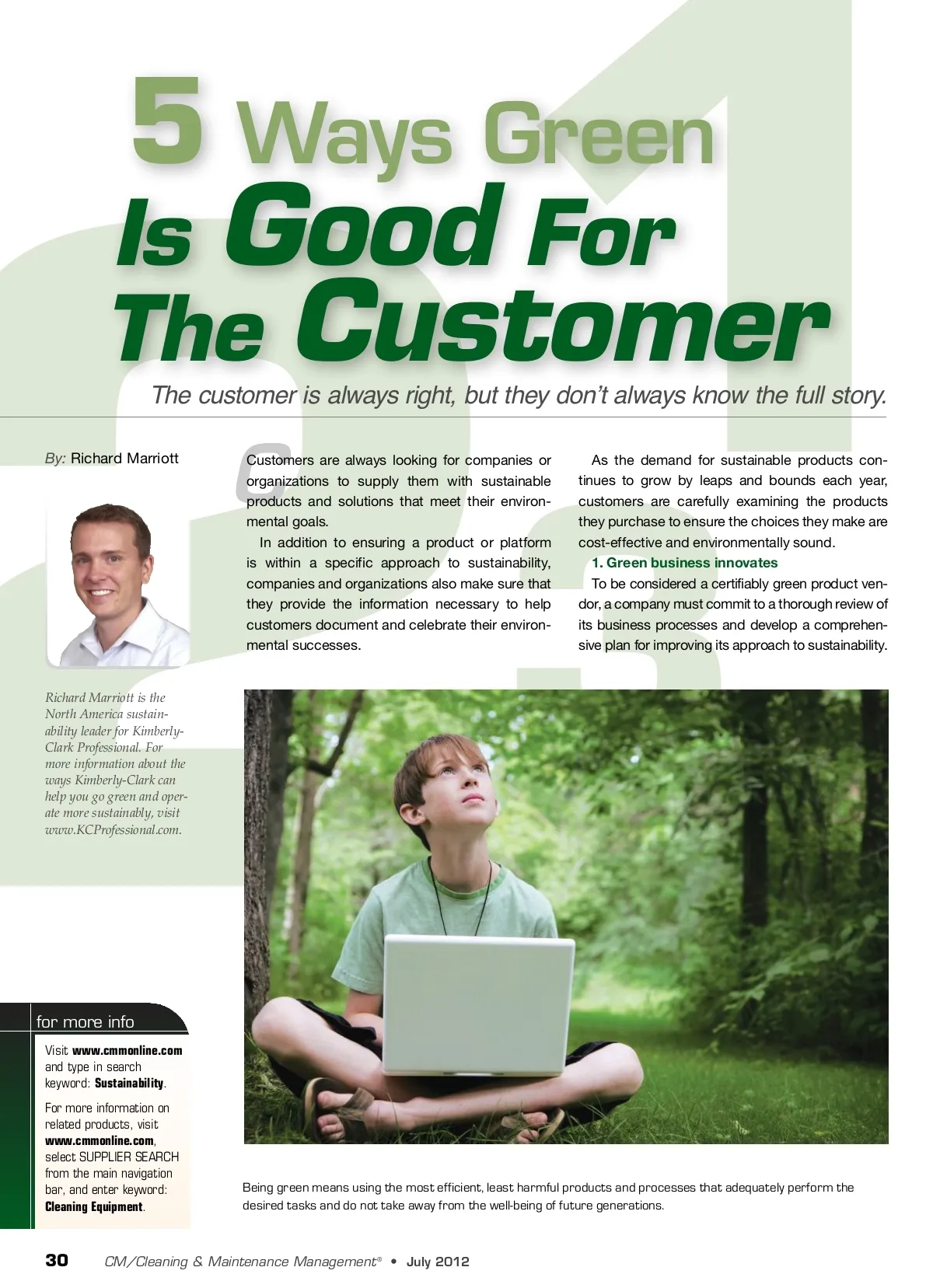
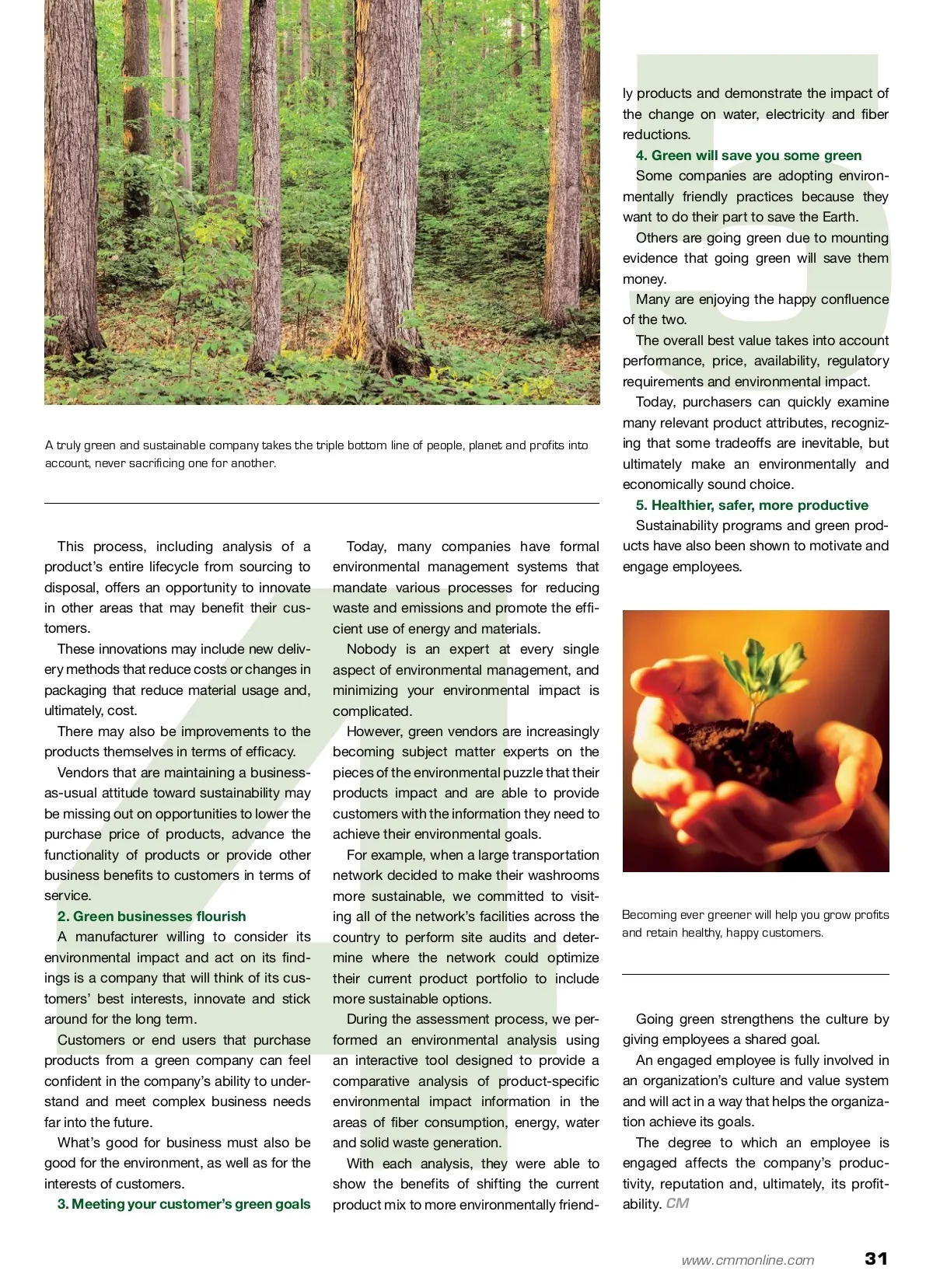
A truly green and sustainable company takes the triple bottom line of people, planet and profits into account, never sacrificing one for another. 4 This process, including analysis of a product’s entire lifecycle from sourcing to disposal, offers an opportunity to innovate in other areas that may benefit their cus-tomers. These innovations may include new deliv-ery methods that reduce costs or changes in packaging that reduce material usage and, ultimately, cost. There may also be improvements to the products themselves in terms of efficacy. Vendors that are maintaining a business-as-usual attitude toward sustainability may be missing out on opportunities to lower the purchase price of products, advance the functionality of products or provide other business benefits to customers in terms of service. 2. Green businesses flourish A manufacturer willing to consider its environmental impact and act on its find-ings is a company that will think of its cus-tomers’ best interests, innovate and stick around for the long term. Customers or end users that purchase products from a green company can feel confident in the company’s ability to under-stand and meet complex business needs far into the future. What’s good for business must also be good for the environment, as well as for the interests of customers. 3. Meeting your customer’s green goals Today, many companies have formal environmental management systems that mandate various processes for reducing waste and emissions and promote the effi-cient use of energy and materials. Nobody is an expert at every single aspect of environmental management, and minimizing your environmental impact is complicated. However, green vendors are increasingly becoming subject matter experts on the pieces of the environmental puzzle that their products impact and are able to provide customers with the information they need to achieve their environmental goals. For example, when a large transportation network decided to make their washrooms more sustainable, we committed to visit-ing all of the network’s facilities across the country to perform site audits and deter-mine where the network could optimize their current product portfolio to include more sustainable options. During the assessment process, we per-formed an environmental analysis using an interactive tool designed to provide a comparative analysis of product-specific environmental impact information in the areas of fiber consumption, energy, water and solid waste generation. With each analysis, they were able to show the benefits of shifting the current product mix to more environmentally friend-5 ly products and demonstrate the impact of the change on water, electricity and fiber reductions. 4. Green will save you some green Some companies are adopting environ-mentally friendly practices because they want to do their part to save the Earth. Others are going green due to mounting evidence that going green will save them money. Many are enjoying the happy confluence of the two. The overall best value takes into account performance, price, availability, regulatory requirements and environmental impact. Today, purchasers can quickly examine many relevant product attributes, recogniz-ing that some tradeoffs are inevitable, but ultimately make an environmentally and economically sound choice. 5. Healthier, safer, more productive Sustainability programs and green prod-ucts have also been shown to motivate and engage employees. Becoming ever greener will help you grow profits and retain healthy, happy customers. Going green strengthens the culture by giving employees a shared goal. An engaged employee is fully involved in an organization’s culture and value system and will act in a way that helps the organiza-tion achieve its goals. The degree to which an employee is engaged affects the company’s produc-tivity, reputation and, ultimately, its profit-ability. CM www.cmmonline.com 31
CMM – Archives July2012: 31