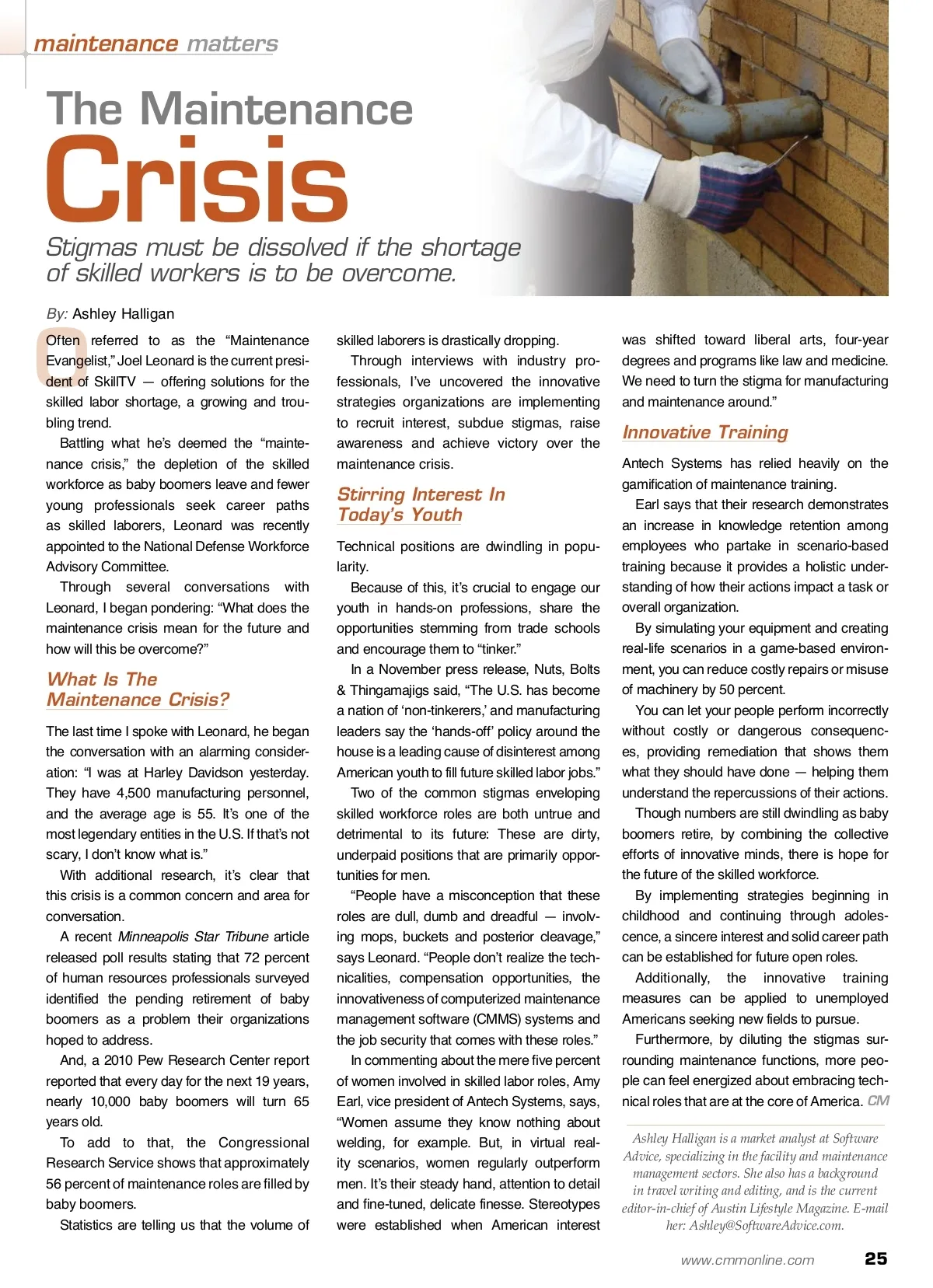
maintenance matters The Maintenance Crisis Stigmas must be dissolved if the shortage of skilled workers is to be overcome. By: Ashley Halligan O Often referred to as the “Maintenance Evangelist,” Joel Leonard is the current presi-dent of SkillTV — offering solutions for the skilled labor shortage, a growing and trou-bling trend. Battling what he’s deemed the “mainte-nance crisis,” the depletion of the skilled workforce as baby boomers leave and fewer young professionals seek career paths as skilled laborers, Leonard was recently appointed to the National Defense Workforce Advisory Committee. Through several conversations with Leonard, I began pondering: “What does the maintenance crisis mean for the future and how will this be overcome?” skilled laborers is drastically dropping. Through interviews with industry pro-fessionals, I’ve uncovered the innovative strategies organizations are implementing to recruit interest, subdue stigmas, raise awareness and achieve victory over the maintenance crisis. was shifted toward liberal arts, four-year degrees and programs like law and medicine. We need to turn the stigma for manufacturing and maintenance around.” Innovative Training Antech Systems has relied heavily on the gamification of maintenance training. Earl says that their research demonstrates an increase in knowledge retention among employees who partake in scenario-based training because it provides a holistic under-standing of how their actions impact a task or overall organization. By simulating your equipment and creating real-life scenarios in a game-based environ-ment, you can reduce costly repairs or misuse of machinery by 50 percent. You can let your people perform incorrectly without costly or dangerous consequenc-es, providing remediation that shows them what they should have done — helping them understand the repercussions of their actions. Though numbers are still dwindling as baby boomers retire, by combining the collective efforts of innovative minds, there is hope for the future of the skilled workforce. By implementing strategies beginning in childhood and continuing through adoles-cence, a sincere interest and solid career path can be established for future open roles. Additionally, the innovative training measures can be applied to unemployed Americans seeking new fields to pursue. Furthermore, by diluting the stigmas sur-rounding maintenance functions, more peo-ple can feel energized about embracing tech-nical roles that are at the core of America. CM Ashley Halligan is a market analyst at Software Advice, specializing in the facility and maintenance management sectors. She also has a background in travel writing and editing, and is the current editor-in-chief of Austin Lifestyle Magazine. E-mail her: [email protected]. www.cmmonline.com Stirring Interest In Today’s Youth Technical positions are dwindling in popu-larity. Because of this, it’s crucial to engage our youth in hands-on professions, share the opportunities stemming from trade schools and encourage them to “tinker.” In a November press release, Nuts, Bolts & Thingamajigs said, “The U.S. has become a nation of ‘non-tinkerers,’ and manufacturing leaders say the ‘hands-off’ policy around the house is a leading cause of disinterest among American youth to fill future skilled labor jobs.” Two of the common stigmas enveloping skilled workforce roles are both untrue and detrimental to its future: These are dirty, underpaid positions that are primarily oppor-tunities for men. “People have a misconception that these roles are dull, dumb and dreadful — involv-ing mops, buckets and posterior cleavage,” says Leonard. “People don’t realize the tech-nicalities, compensation opportunities, the innovativeness of computerized maintenance management software (CMMS) systems and the job security that comes with these roles.” In commenting about the mere five percent of women involved in skilled labor roles, Amy Earl, vice president of Antech Systems, says, “Women assume they know nothing about welding, for example. But, in virtual real-ity scenarios, women regularly outperform men. It’s their steady hand, attention to detail and fine-tuned, delicate finesse. Stereotypes were established when American interest What Is The Maintenance Crisis? The last time I spoke with Leonard, he began the conversation with an alarming consider-ation: “I was at Harley Davidson yesterday. They have 4,500 manufacturing personnel, and the average age is 55. It’s one of the most legendary entities in the U.S. If that’s not scary, I don’t know what is.” With additional research, it’s clear that this crisis is a common concern and area for conversation. A recent Minneapolis Star Tribune article released poll results stating that 72 percent of human resources professionals surveyed identified the pending retirement of baby boomers as a problem their organizations hoped to address. And, a 2010 Pew Research Center report reported that every day for the next 19 years, nearly 10,000 baby boomers will turn 65 years old. To add to that, the Congressional Research Service shows that approximately 56 percent of maintenance roles are filled by baby boomers. Statistics are telling us that the volume of 25
CMM – Archives July2012: 25