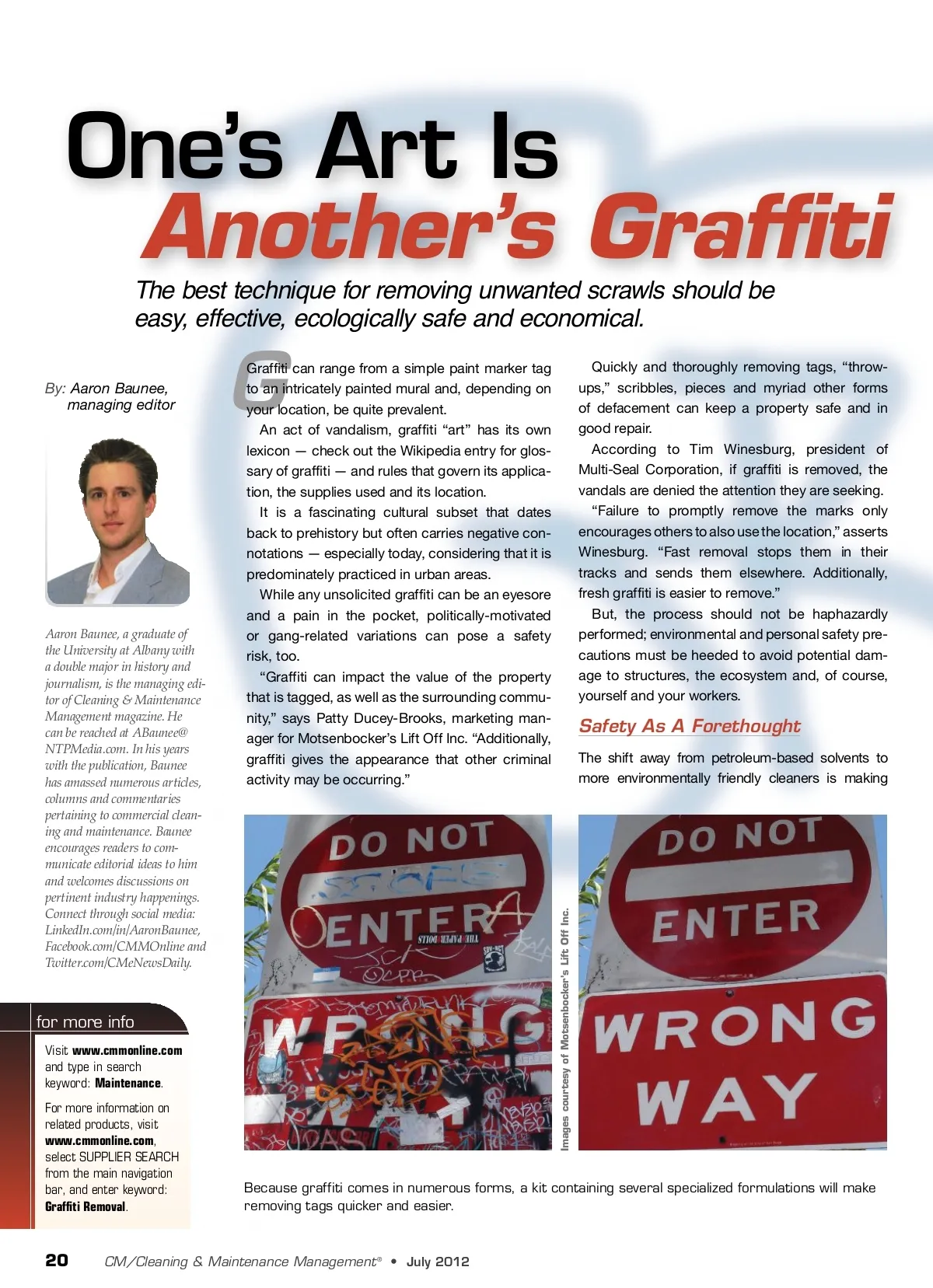
graffiti removal safer without sacrificing per-formance. While not applicable in every instance — sometimes, you need to break out the big guns — water-based formulations are able to remove markings without damaging sur-faces or harming users and the environment. “Some products are now going for the green,” notes Winesburg. “While the indus-try is trying to make products safer, graf-fiti removers will likely remain stronger than general cleaners, as effectiveness is still the bottom line requirement.” In accordance with the least harmful men-tality, the formulation administered should be the mildest product available that suffi-ciently removes markings without damaging the surface, the surrounding ecosystem or the user. Environmental precautions notwithstand-ing, users need to ensure that they are protected from dermal contact with a graffiti remover. Our skin is the largest organ in our body, and it is quite adept at absorbing potentially toxic chemicals. Not uncommon to other tasks performed by custodial and maintenance profession-als, personal protective equipment (PPE) should be used when attempting to remove any graffiti. At a minimum, goggles and rubber gloves should be worn to protect against splashes and unwanted contact. If high-pressure rinsing is utilized, a face shield and a rubber apron can be supple-mental PPE to provide an added layer of protection. While the goal is to always completely and quickly remove any graffiti, safety — both personal and environmental — should never be an afterthought. Grouping Graffiti Removal According to Ducey-Brooks, for each appli-cation of graffiti, there is a means to remove it. Removing unwanted matter is achieved by one or a combination of two processes: Chemical and physical. A third method, though not an actual removal process, is to apply a surface pro-tectant that makes it difficult for paint, ink or dye to adhere to a surface. Here is a breakdown of the graffiti removal methods and how they work: ■ Chemical removers Relying on a reaction between the product and the graffiti, chemical removers emulsify the marking and allow it to be removed from the surface. Chemical removers come in several forms, including concentrated liquids and gels that are applied directly onto a surface and wipes impregnated with any number of chemicals, each formulated to remove markings on specific surfaces. As with any cleaning chemicals, you should read the product label and follow directions accordingly to get the most out of a product without exacerbating an existing problem. After the graffiti is no longer adhered to the surface, it can be wiped away, rinsed with water or power washed to ensure com-plete removal. ■ Physical removers Rather than chemical means, physical graffiti removal relies on agitation to force a marking from the surface on which it was painted, sprayed or otherwise applied. This technique is employed with things such as sandblasting, dry ice blasting or even using high-pressure water to agitate a surface after a chemical remover has been used. According to Winesburg, some are mov-ing away from sandblasting and other similar physical processes because of the potential for damage to surfaces. Aside from potential damage, alterna-tive blasting media like walnut shells and sodium bicarbonate are limited in their effi-cacy, largely relegated for use in only the most environmentally sensitive areas or in instances where the price of removal is not a concern. Physical agitation is often employed in conjunction with a chemical remover to speed up the process and to ensure more thorough removal without the need for repeating the process multiple times. ■ Preventive coatings By creating a barrier between a surface and any potential markings, preventive coat-ings help protect surfaces from graffiti. Applied at the factory during manufactur-ing, during final construction of a structure or after graffiti removal has been performed, preventive coatings help protect your invest-ment. Preventive coatings are generally clas-sified as one of two types: Permanent and sacrificial. A permanent protective coating is one that is designed to withstand a series of cleanings, providing extended protection of a surface. But, warns Winesburg, a permanent coat-ing will not protect infinitely and may require reapplication over time, especially if harsh chemical removers or abrasive techniques are employed. Sacrificial coatings are designed to dete-riorate during cleanings, providing protec-tion only one time before they require reap-plication. While selecting a graffiti removal pro-cess or protective coating is a mainte-nance expenditure, it should not be done on upfront price alone. Other factors to consider are cost in use, ease of cleaning, durability and appearance — even a clear coating can alter the appear-ance of a surface. Also, because labor accounts for 90 per-cent of a cleaning and maintenance oper-ating budget, selecting a low-cost graffiti removal method that requires a significant investment in time can prove rather costly. “Anyone involved in graffiti removal needs to understand the importance of using prod-ucts that work, won’t damage property and aren’t dangerous to the user,” recommends Ducey-Brooks. Another thing to keep in mind is that not all graffiti can be fully removed, even after multiple cleanings using various removal processes. Sometimes, a shadow will remain where the prominent marking once was. In such a case, specific chemicals are made to delve deeply into pores and finish the removal. However, some markings could be per-manent, and the only solution may be replacement, painting, staining or otherwise refinishing the surface. As Winesburg points out, taggers use graf-fiti as a way to call attention to themselves or the group with whom they are affiliated. And, because they hold no regard for defacement or damage to property, it is wise to invest in a graffiti removal program that minimizes potential damage from the onset and discourages taggers altogether. CM www.cmmonline.com 21
CMM – Archives July2012: 21