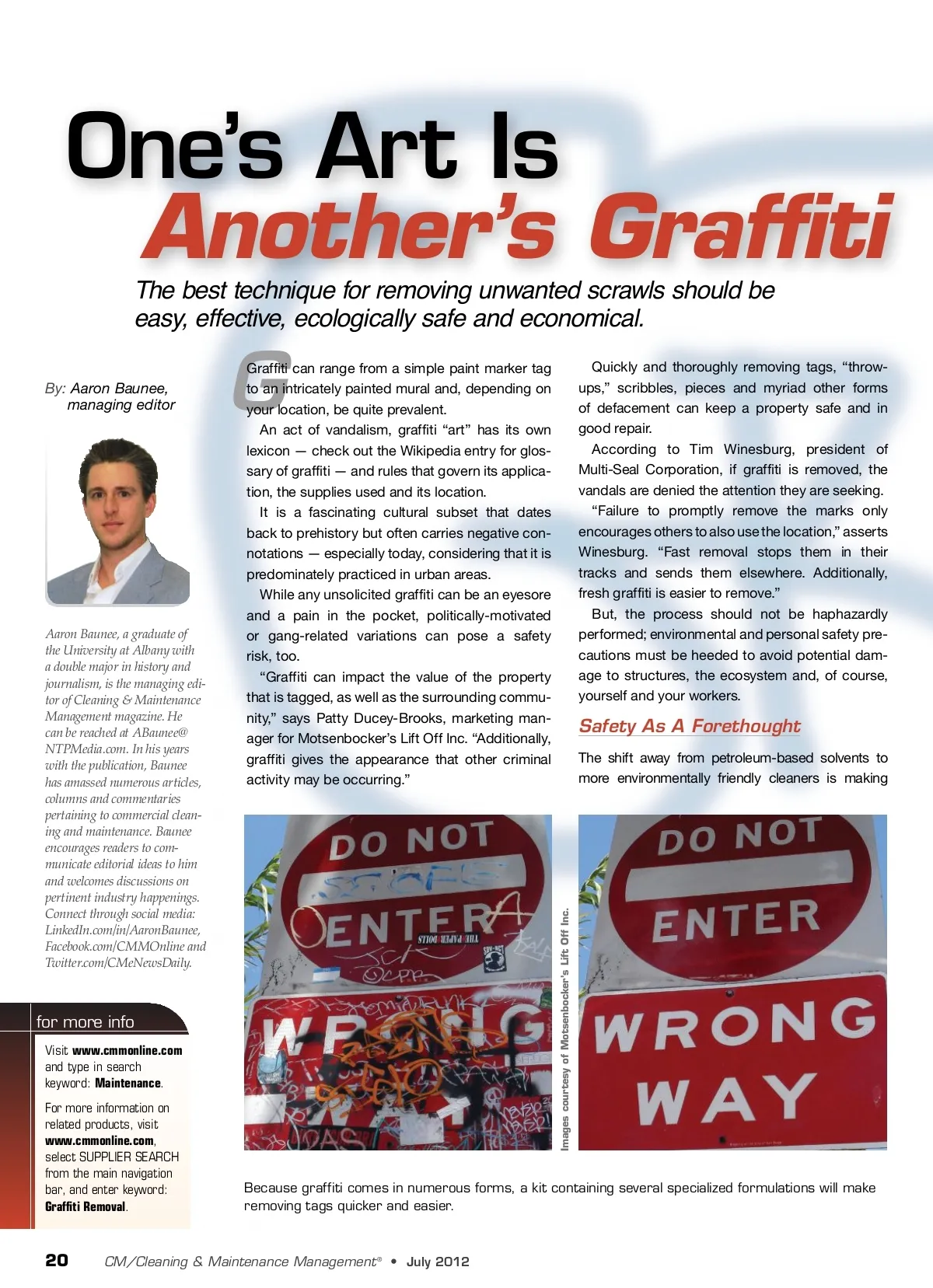
One’s Art Is Another’s Graffiti The best technique for removing unwanted scrawls should be easy, effective, ecologically safe and economical. By: Aaron Baunee, managing editor G for more info Visit www.cmmonline.com and type in search keyword: Maintenance . For more information on related products, visit www.cmmonline.com , select SUPPLIER SEARCH from the main navigation bar, and enter keyword: Graffiti Removal . Because graffiti comes in numerous forms, a kit containing several specialized formulations will make removing tags quicker and easier. 20 CM/Cleaning & Maintenance Management ® • July 2012 Images courtesy of Motsenbocker’s Lift Off Inc. Aaron Baunee, a graduate of the University at Albany with a double major in history and journalism, is the managing edi-tor of Cleaning & Maintenance Management magazine. He can be reached at ABaunee@ NTPMedia.com. In his years with the publication, Baunee has amassed numerous articles, columns and commentaries pertaining to commercial clean-ing and maintenance. Baunee encourages readers to com-municate editorial ideas to him and welcomes discussions on pertinent industry happenings. Connect through social media: LinkedIn.com/in/AaronBaunee, Facebook.com/CMMOnline and Twitter.com/CMeNewsDaily. Graffiti can range from a simple paint marker tag to an intricately painted mural and, depending on your location, be quite prevalent. An act of vandalism, graffiti “art” has its own lexicon — check out the Wikipedia entry for glos-sary of graffiti — and rules that govern its applica-tion, the supplies used and its location. It is a fascinating cultural subset that dates back to prehistory but often carries negative con-notations — especially today, considering that it is predominately practiced in urban areas. While any unsolicited graffiti can be an eyesore and a pain in the pocket, politically-motivated or gang-related variations can pose a safety risk, too. “Graffiti can impact the value of the property that is tagged, as well as the surrounding commu-nity,” says Patty Ducey-Brooks, marketing man-ager for Motsenbocker’s Lift Off Inc. “Additionally, graffiti gives the appearance that other criminal activity may be occurring.” Quickly and thoroughly removing tags, “throw-ups,” scribbles, pieces and myriad other forms of defacement can keep a property safe and in good repair. According to Tim Winesburg, president of Multi-Seal Corporation, if graffiti is removed, the vandals are denied the attention they are seeking. “Failure to promptly remove the marks only encourages others to also use the location,” asserts Winesburg. “Fast removal stops them in their tracks and sends them elsewhere. Additionally, fresh graffiti is easier to remove.” But, the process should not be haphazardly performed; environmental and personal safety pre-cautions must be heeded to avoid potential dam-age to structures, the ecosystem and, of course, yourself and your workers. Safety As A Forethought The shift away from petroleum-based solvents to more environmentally friendly cleaners is making
CMM – Archives July2012: 20