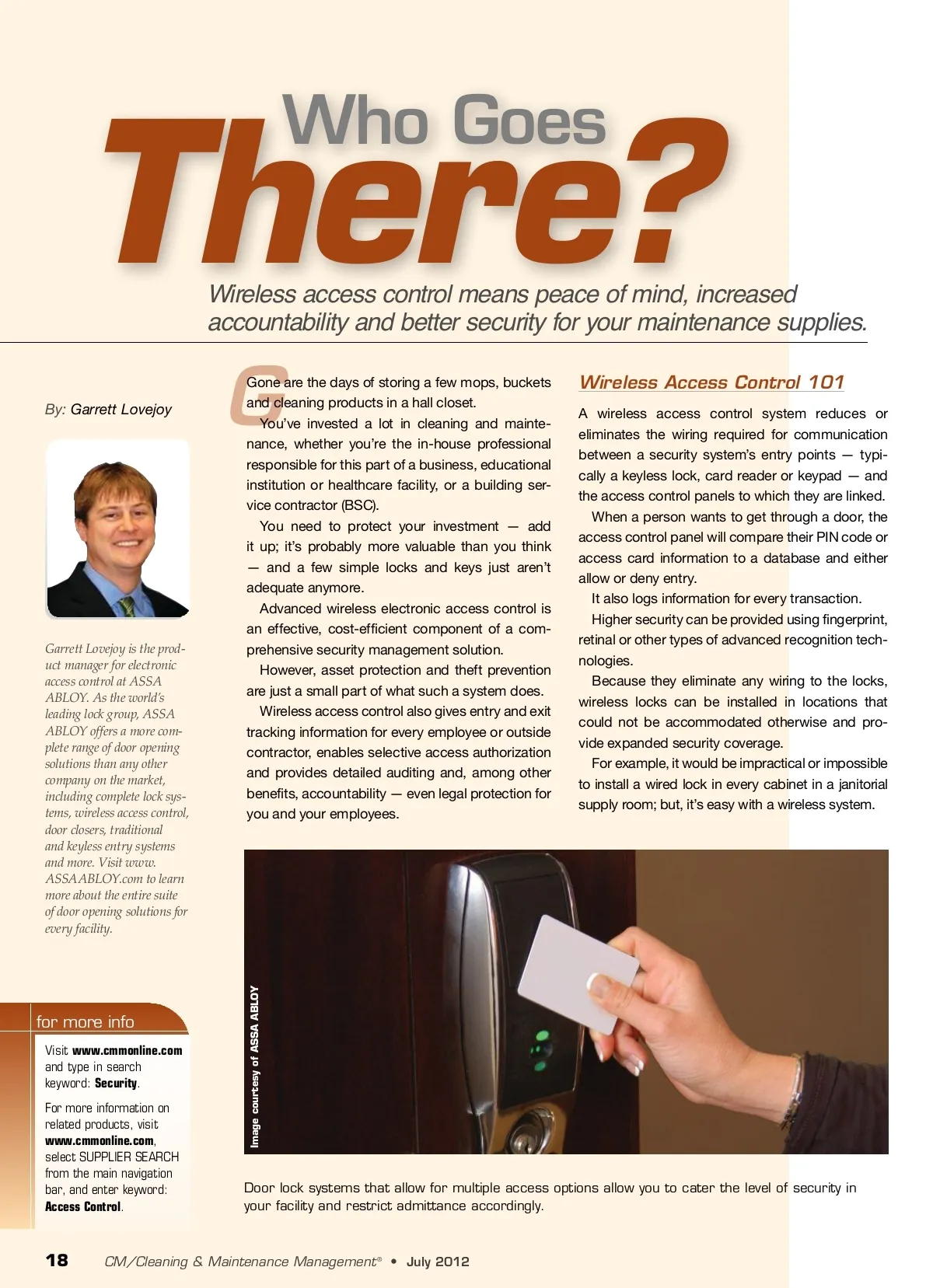
There are two basic types of wireless access control solutions: Wireless fidelity (WiFi) and transactional. WiFi-based systems use a facility’s exist-ing information technology (IT) infrastruc-ture, already in place for computers, print-ers, telecommunications and other devices. The WiFi standard is the 802.11 created and maintained by the Institute of Electrical and Electronics Engineers (IEEE). They typically maintain a local database and work offline, communicating with the host system only to report alarms or, at scheduled intervals, to receive updates or submit audit trails. The other type is what we will call transac-tional wireless systems, which communicate to the host system in real time at every entry request. Transactional systems use either a standards-based implementation such as ZigBee, Z-Wave, IEEE 802.15.4 or a wireless standard developed by the manufacturer. Both WiFi and transactional system hard-ware is easier to install than that of wired systems. Changing to a wireless lock requires drill-ing only a few additional holes and minimal configuration, typically about an hour or so of labor time. You might wonder, “What are the benefits and tradeoffs of each?” WiFi-based systems can offer the great-est infrastructure cost savings because they’re utilizing the already-in-place IT infra-structure — standard WiFi access points like IEEE 802.11b/g/n — and little or no additional hardware has to be installed other than the locks. While WiFi systems can take from 12 to 24 hours to update events, they still report alarm conditions in real time. In addition, local decision making ensures operation regardless of network status. Transactional wireless systems utilize the access control infrastructure already in place in a building, but require the deploy-ment and installation of wireless hubs or gateways. This adds to the installation cost of the solution, but still provides excellent cost savings over a traditionally wired opening. A major advantage of transactional sys-tems is that they provide immediate, real-time control of your facility — who entered what door at what time, access permissions and state of each opening such as open, closed, alarm, etc. Better Tracking And Accountability Tighter security over more of your facility is an undeniable advantage. Yet, there is another very important aspect of a higher security system: Tracking of your employees’ whereabouts or those of anyone who has authorization to enter a secure area, such as an outside cleaning contractor’s staff. Whenever anyone uses a lock, the identity of the user, the time of entry and the particu-lar lock used is stored in a central database. This information creates an airtight record of exactly who was where, when and gives you detailed snapshots of exactly what’s going on in your facility. You can track a person’s movements down to the minute and verify that they were where they were supposed to be, when they were supposed to be there. This can help greatly in verifying that a worker cleaned all the rooms they were assigned to in their allotted time, for exam-ple. With conventional standalone locks and keys, there is no ability to track anyone or anything. Should any theft occur in your facility, the audit trail can help greatly in narrowing down any possible suspects — and in eliminating others. With an electronic audit trail, you can prove who was and who was not present at the time of the theft. This can even save you legal fees should a case ever escalate to the point where legal action takes place. Wireless electronic access control sys-tems also allow tiered levels of access; only the people with the highest levels of authori-zation can get into high-security areas. For instance, a system can be configured so that all of the hospital maintenance staff can get into a general supply storeroom, but only authorized personnel will have access to areas where pharmaceuticals or other valuable equipment is stored. Or, as another example, only top corpo-rate management will have access to confi-dential company records. Different areas can also be made acces-sible or off limits to different people at dif-ferent times or days of the week, and any device in the system can be programmed instantly from a remote location. If an employee is terminated, their access can be removed immediately; there is no need to get an employee’s keys back or change any locks. Built To Last Wireless locks for use in commercial and institutional applications should be built to a high standard for durability and quality, specifically to the Grade 1 classification set forth by the American National Standards Institute (ANSI) and the Builders Hardware Manufacturers Association (BHMA). ANSI/BHMA product grades — Grade 1, 2 or 3, with Grade 1 being the highest — are defined by progressive levels of per-formance benchmarks in each applicable ANSI/BHMA standard. One key benchmark associated with the ANSI/BHMA product grades is cycle testing. The most robust locks, those that have achieved Grade 1 certification, must be tested to withstand a minimum of one million cycles without failure. Selecting high-quality, durable products ensures that they are vandal-resistant and extremely difficult to force open or break, are weather-resistant and will stand up well to most cleaning products. These are the luxury cars of the lock world. When looking at your initial cost outlay, it doesn’t pay to be pennywise and pound foolish. If you purchase less expensive locks, you’ll probably go through two or three of them as compared to a single lock of bet-ter quality that you won’t have to replace as often. When it comes to planning budgets, it’s often easier to get approval for that initial, one-time capital expense than to have to explain why you need an extra $2,000 to $10,000 or more every year to maintain and replace your locks. In fact, when you add up all the benefits, a wireless access control solution can be one of the smartest and most cost-effective facility upgrades you can make. CM www.cmmonline.com 19
CMM – Archives July2012: 19