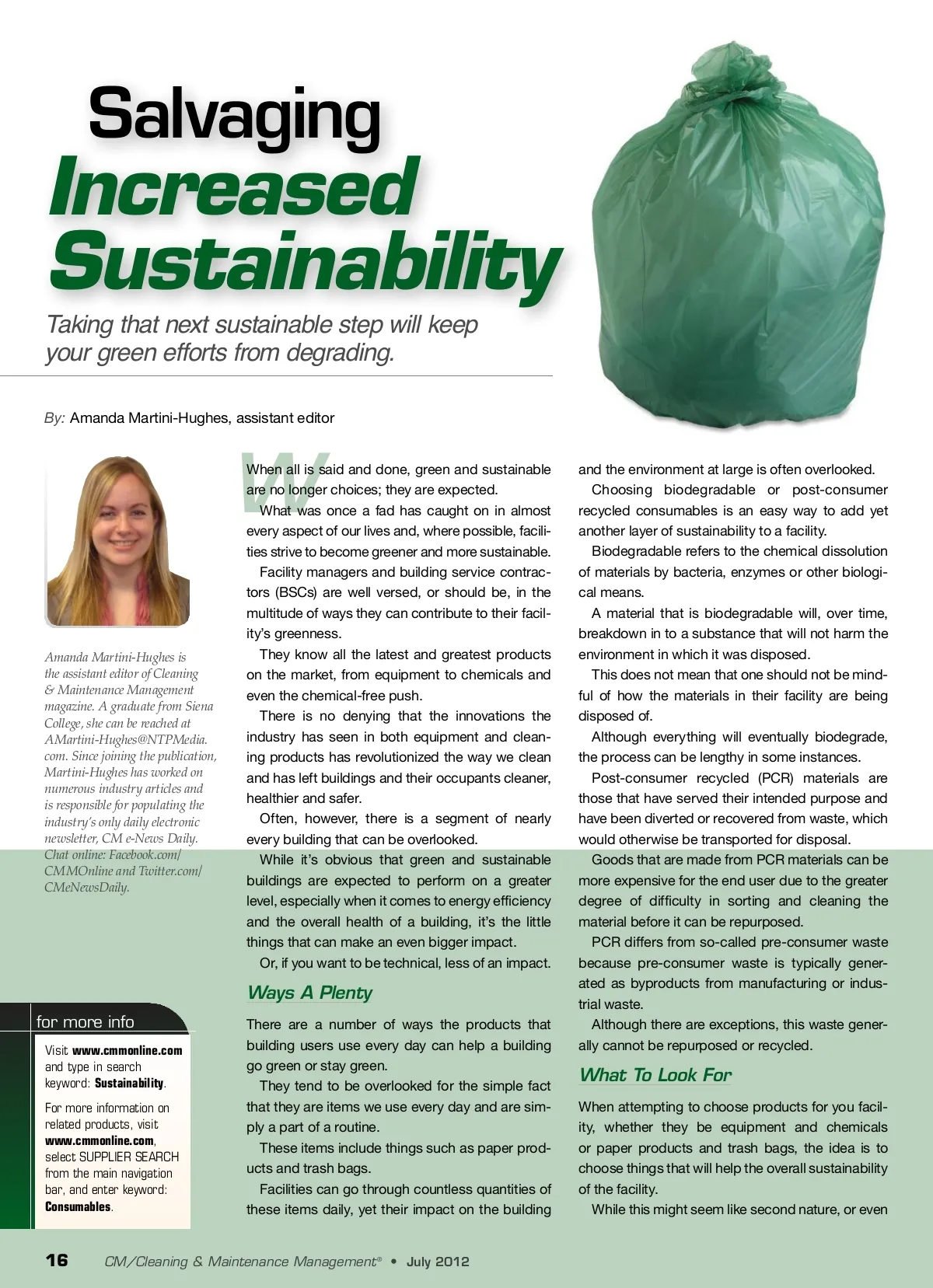
Salvaging Increased Sustainability Taking that next sustainable step will keep your green efforts from degrading. By: Amanda Martini-Hughes, assistant editor W Amanda Martini-Hughes is the assistant editor of Cleaning & Maintenance Management magazine. A graduate from Siena College, she can be reached at AMartini-Hughes@NTPMedia. com. Since joining the publication, Martini-Hughes has worked on numerous industry articles and is responsible for populating the industry’s only daily electronic newsletter, CM e-News Daily. Chat online: Facebook.com/ CMMOnline and Twitter.com/ CMeNewsDaily. When all is said and done, green and sustainable are no longer choices; they are expected. What was once a fad has caught on in almost every aspect of our lives and, where possible, facili-ties strive to become greener and more sustainable. Facility managers and building service contrac-tors (BSCs) are well versed, or should be, in the multitude of ways they can contribute to their facil-ity’s greenness. They know all the latest and greatest products on the market, from equipment to chemicals and even the chemical-free push. There is no denying that the innovations the industry has seen in both equipment and clean-ing products has revolutionized the way we clean and has left buildings and their occupants cleaner, healthier and safer. Often, however, there is a segment of nearly every building that can be overlooked. While it’s obvious that green and sustainable buildings are expected to perform on a greater level, especially when it comes to energy efficiency and the overall health of a building, it’s the little things that can make an even bigger impact. Or, if you want to be technical, less of an impact. Ways A Plenty for more info Visit www.cmmonline.com and type in search keyword: Sustainability . For more information on related products, visit www.cmmonline.com , select SUPPLIER SEARCH from the main navigation bar, and enter keyword: Consumables . There are a number of ways the products that building users use every day can help a building go green or stay green. They tend to be overlooked for the simple fact that they are items we use every day and are sim-ply a part of a routine. These items include things such as paper prod-ucts and trash bags. Facilities can go through countless quantities of these items daily, yet their impact on the building and the environment at large is often overlooked. Choosing biodegradable or post-consumer recycled consumables is an easy way to add yet another layer of sustainability to a facility. Biodegradable refers to the chemical dissolution of materials by bacteria, enzymes or other biologi-cal means. A material that is biodegradable will, over time, breakdown in to a substance that will not harm the environment in which it was disposed. This does not mean that one should not be mind-ful of how the materials in their facility are being disposed of. Although everything will eventually biodegrade, the process can be lengthy in some instances. Post-consumer recycled (PCR) materials are those that have served their intended purpose and have been diverted or recovered from waste, which would otherwise be transported for disposal. Goods that are made from PCR materials can be more expensive for the end user due to the greater degree of difficulty in sorting and cleaning the material before it can be repurposed. PCR differs from so-called pre-consumer waste because pre-consumer waste is typically gener-ated as byproducts from manufacturing or indus-trial waste. Although there are exceptions, this waste gener-ally cannot be repurposed or recycled. What To Look For When attempting to choose products for you facil-ity, whether they be equipment and chemicals or paper products and trash bags, the idea is to choose things that will help the overall sustainability of the facility. While this might seem like second nature, or even 16 CM/Cleaning & Maintenance Management ® • July 2012
CMM – Archives July2012: 16