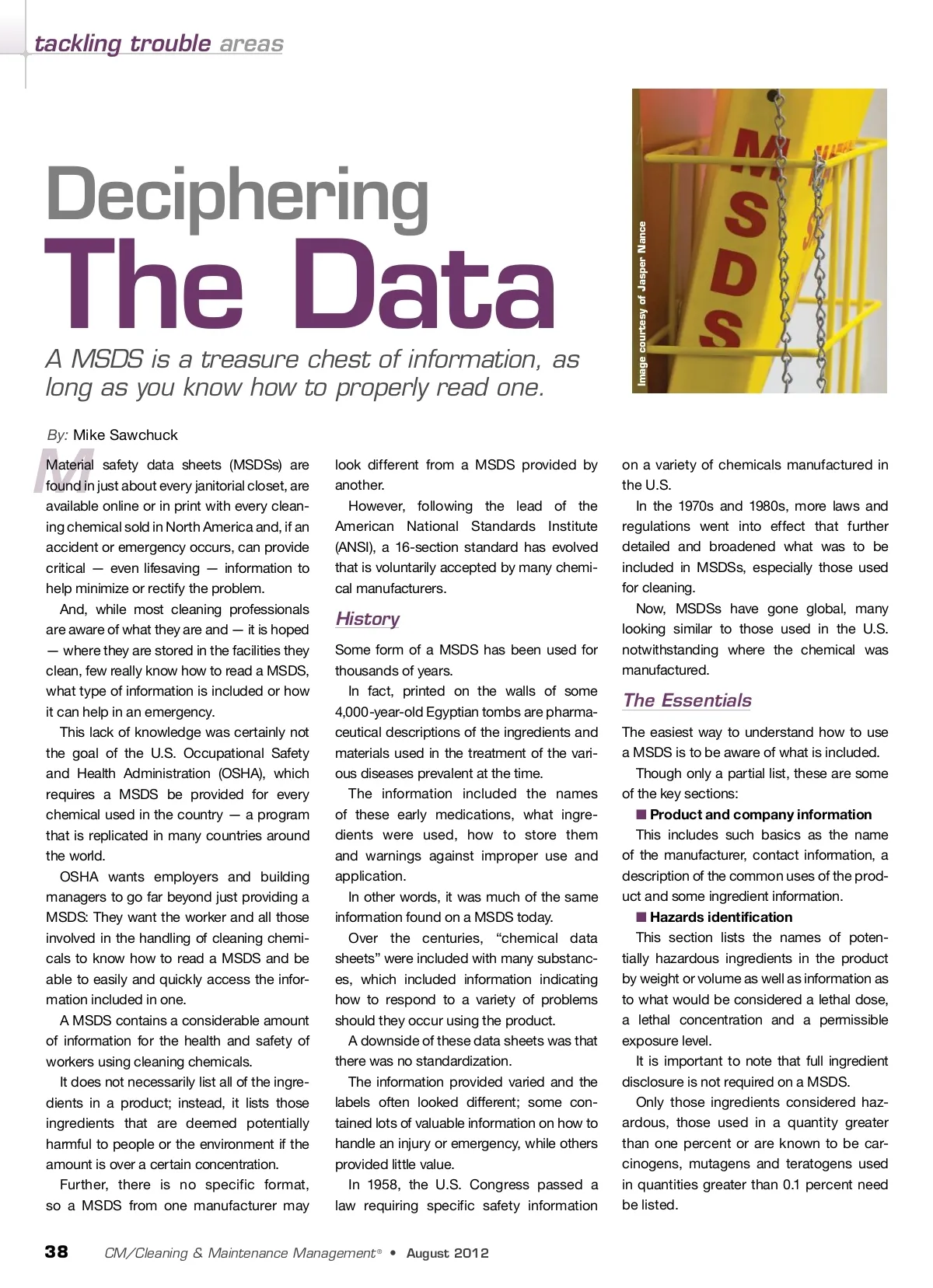
tackling trouble areas The Data By: Mike Sawchuck A MSDS is a treasure chest of information, as long as you know how to properly read one. M Material safety data sheets (MSDSs) are found in just about every janitorial closet, are available online or in print with every clean-ing chemical sold in North America and, if an accident or emergency occurs, can provide critical — even lifesaving — information to help minimize or rectify the problem. And, while most cleaning professionals are aware of what they are and — it is hoped — where they are stored in the facilities they clean, few really know how to read a MSDS, what type of information is included or how it can help in an emergency. This lack of knowledge was certainly not the goal of the U.S. Occupational Safety and Health Administration (OSHA), which requires a MSDS be provided for every chemical used in the country — a program that is replicated in many countries around the world. OSHA wants employers and building managers to go far beyond just providing a MSDS: They want the worker and all those involved in the handling of cleaning chemi-cals to know how to read a MSDS and be able to easily and quickly access the infor-mation included in one. A MSDS contains a considerable amount of information for the health and safety of workers using cleaning chemicals. It does not necessarily list all of the ingre-dients in a product; instead, it lists those ingredients that are deemed potentially harmful to people or the environment if the amount is over a certain concentration. Further, there is no specific format, so a MSDS from one manufacturer may look different from a MSDS provided by another. However, following the lead of the American National Standards Institute (ANSI), a 16-section standard has evolved that is voluntarily accepted by many chemi-cal manufacturers. History Some form of a MSDS has been used for thousands of years. In fact, printed on the walls of some 4,000-year-old Egyptian tombs are pharma-ceutical descriptions of the ingredients and materials used in the treatment of the vari-ous diseases prevalent at the time. The information included the names of these early medications, what ingre-dients were used, how to store them and warnings against improper use and application. In other words, it was much of the same information found on a MSDS today. Over the centuries, “chemical data sheets” were included with many substanc-es, which included information indicating how to respond to a variety of problems should they occur using the product. A downside of these data sheets was that there was no standardization. The information provided varied and the labels often looked different; some con-tained lots of valuable information on how to handle an injury or emergency, while others provided little value. In 1958, the U.S. Congress passed a law requiring specific safety information on a variety of chemicals manufactured in the U.S. In the 1970s and 1980s, more laws and regulations went into effect that further detailed and broadened what was to be included in MSDSs, especially those used for cleaning. Now, MSDSs have gone global, many looking similar to those used in the U.S. notwithstanding where the chemical was manufactured. The Essentials The easiest way to understand how to use a MSDS is to be aware of what is included. Though only a partial list, these are some of the key sections: ■ Product and company information This includes such basics as the name of the manufacturer, contact information, a description of the common uses of the prod-uct and some ingredient information. ■ Hazards identification This section lists the names of poten-tially hazardous ingredients in the product by weight or volume as well as information as to what would be considered a lethal dose, a lethal concentration and a permissible exposure level. It is important to note that full ingredient disclosure is not required on a MSDS. Only those ingredients considered haz-ardous, those used in a quantity greater than one percent or are known to be car-cinogens, mutagens and teratogens used in quantities greater than 0.1 percent need be listed. 38 CM/Cleaning & Maintenance Management ® • August 2012 Image courtesy of Jasper Nance Deciphering
CMM – Archives August 2012: 38