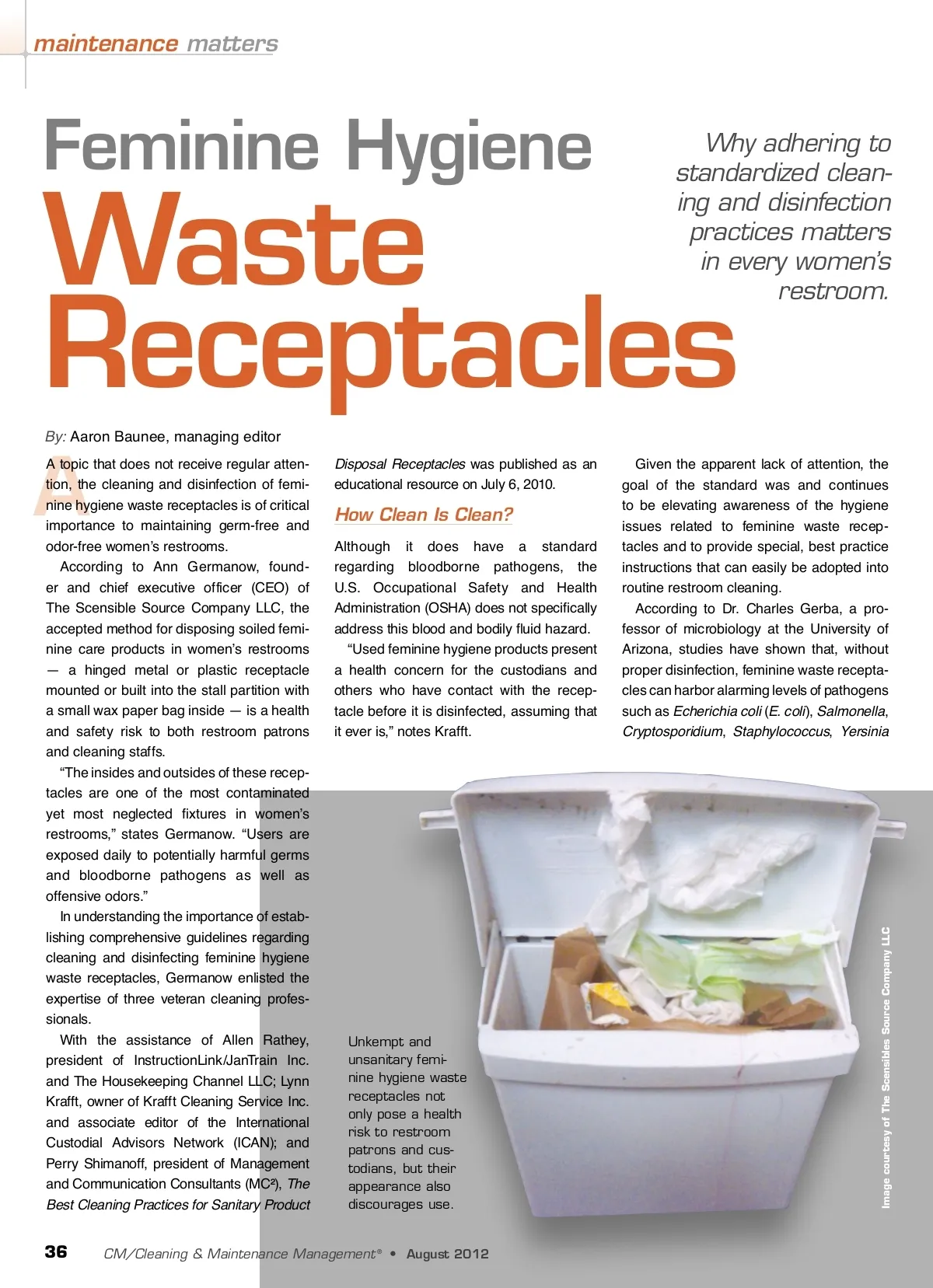
and many others that can cause anything from mild skin discomfort to death. Concurrent with studies performed by Gerba, the findings of a study conducted by Ethox International showed that the unlined interiors of these receptacles yield more than 10 times the biological contamination of the exterior surfaces. While custodial professionals don gloves and other personal protective equipment (PPE) when performing cleaning duties, restroom patrons do not. As such, and whether she is aware of it or not, a woman using a feminine hygiene waste receptacle could be unnecessarily exposed to any number of harmful pathogens. “The custodians did not like the sys-tem we had in place, as the brown bag would fall into the container and the feminine products disposed of would often need to be touched to be removed,” proclaims Donald Sullivan, manager of custodial services for the University of Massachusetts at Amherst. “They always wear gloves, but it’s still not the most sani-tary way of disposal.” Moreover, if receptacles are not cleaned and disinfected properly and frequently, restroom patrons may be discouraged to make use of them. And, as any weathered custodial or maintenance professional knows, femi-nine hygiene products can wreak havoc on plumbing systems when flushed. As Sullivan explains, before new units were installed that are easier to clean and disinfect, most women were flushing their feminine products down the toilet. “The units we had looked disgusting and patrons didn’t want to deal with them,” asserts Sullivan. “Our campus plumbers seem glad we installed these new units — fewer plugs in sewer lines to deal with.” Because our job as custodial profession-als is to provide safe and healthy indoor environments for building occupants, Germanow, Rathey, Krafft and Shimanoff provide the following guidelines in a step-by-step procedure to ensure the proper cleaning and disinfection of these often forgotten about receptacles. 2. 3. 4. 5. 6. 7. 8. can or lined trash pickup container Use extra caution when handling the liner, which may contain sharps such as needles Visually inspect the inside of the receptacle and carefully remove debris remaining in the bottom and discard it in the trash Use paper towels or other disposable wipes only To properly clean, apply — via dispos-able wipes and/or a spray bottle — a hospital-grade disinfectant cleaner registered by the U.S. Environmental Protection Agency (EPA) on the interior and exterior of the receptacle, includ-ing the lid and even when there is no visible soiling In order to be effective, always follow the recommended dwell time on the manufacturer’s product label To dry receptacle surfaces, use paper towels or other disposable wipes only and discard them when saturated To comply with the OSHA Bloodborne Pathogen standard, line the clean receptacle with one bag that will completely cover the inside surface and totally enclose discarded sani-tary products, which protects custodial staffs from coming into direct contact with materials containing blood or bodi-ly fluids ■ Check the dimensions of the receptacle to choose the correct size bag ■ The liner should reach all the way around the sides and to the bottom of the receptacle ■ Use one liner bag only; do not place multiple waxed paper bags in the receptacle 9. Handle the filled trashcan or trash pickup container carefully knowing that sharps and bloodborne pathogens may be present; do not sort through or com-press trash, even with gloved hands 10. Inspect your work to ensure visible and hygienic cleaning standards are met; adenosine triphosphate (ATP) mea-surement can help to verify organic soil removal. CM Ten Steps To Cleanliness 1. Empty the receptacle’s contents by removing the liner bag, sealing it and placing it in a lined cleaning cart trash-Product Information no. 208 on page 32 www.cmmonline.com 37
CMM – Archives August 2012: 37