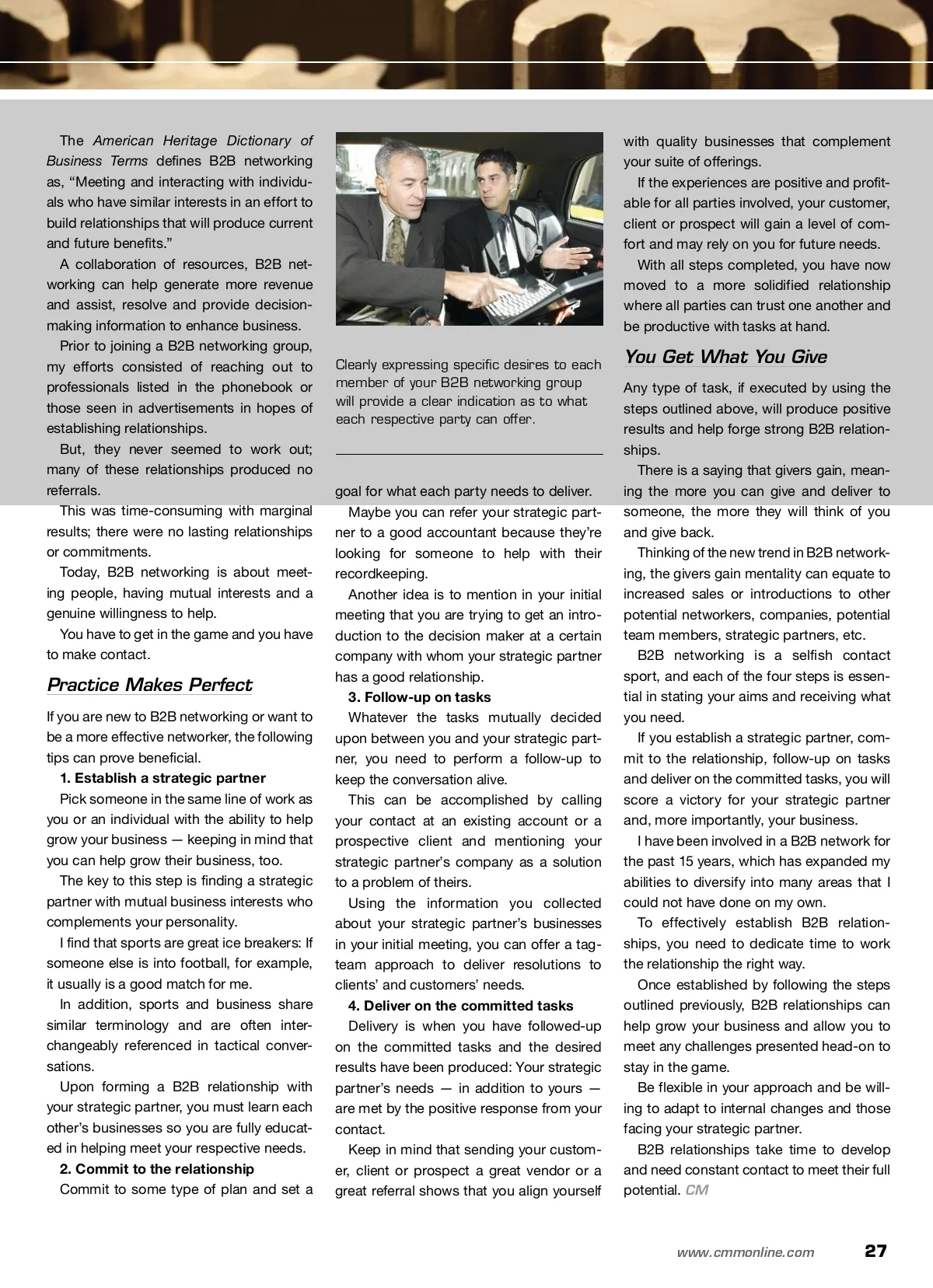
The American Heritage Dictionary of Business Terms defines B2B networking as, “Meeting and interacting with individu-als who have similar interests in an effort to build relationships that will produce current and future benefits.” A collaboration of resources, B2B net-working can help generate more revenue and assist, resolve and provide decision-making information to enhance business. Prior to joining a B2B networking group, my efforts consisted of reaching out to professionals listed in the phonebook or those seen in advertisements in hopes of establishing relationships. But, they never seemed to work out; many of these relationships produced no referrals. This was time-consuming with marginal results; there were no lasting relationships or commitments. Today, B2B networking is about meet-ing people, having mutual interests and a genuine willingness to help. You have to get in the game and you have to make contact. with quality businesses that complement your suite of offerings. If the experiences are positive and profit-able for all parties involved, your customer, client or prospect will gain a level of com-fort and may rely on you for future needs. With all steps completed, you have now moved to a more solidified relationship where all parties can trust one another and be productive with tasks at hand. Clearly expressing specific desires to each member of your B2B networking group will provide a clear indication as to what each respective party can offer. You Get What You Give Any type of task, if executed by using the steps outlined above, will produce positive results and help forge strong B2B relation-ships. There is a saying that givers gain, mean-ing the more you can give and deliver to someone, the more they will think of you and give back. Thinking of the new trend in B2B network-ing, the givers gain mentality can equate to increased sales or introductions to other potential networkers, companies, potential team members, strategic partners, etc. B2B networking is a selfish contact sport, and each of the four steps is essen-tial in stating your aims and receiving what you need. If you establish a strategic partner, com-mit to the relationship, follow-up on tasks and deliver on the committed tasks, you will score a victory for your strategic partner and, more importantly, your business. I have been involved in a B2B network for the past 15 years, which has expanded my abilities to diversify into many areas that I could not have done on my own. To effectively establish B2B relation-ships, you need to dedicate time to work the relationship the right way. Once established by following the steps outlined previously, B2B relationships can help grow your business and allow you to meet any challenges presented head-on to stay in the game. Be flexible in your approach and be will-ing to adapt to internal changes and those facing your strategic partner. B2B relationships take time to develop and need constant contact to meet their full potential. CM Practice Makes Perfect If you are new to B2B networking or want to be a more effective networker, the following tips can prove beneficial. 1. Establish a strategic partner Pick someone in the same line of work as you or an individual with the ability to help grow your business — keeping in mind that you can help grow their business, too. The key to this step is finding a strategic partner with mutual business interests who complements your personality. I find that sports are great ice breakers: If someone else is into football, for example, it usually is a good match for me. In addition, sports and business share similar terminology and are often inter-changeably referenced in tactical conver-sations. Upon forming a B2B relationship with your strategic partner, you must learn each other’s businesses so you are fully educat-ed in helping meet your respective needs. 2. Commit to the relationship Commit to some type of plan and set a goal for what each party needs to deliver. Maybe you can refer your strategic part-ner to a good accountant because they’re looking for someone to help with their recordkeeping. Another idea is to mention in your initial meeting that you are trying to get an intro-duction to the decision maker at a certain company with whom your strategic partner has a good relationship. 3. Follow-up on tasks Whatever the tasks mutually decided upon between you and your strategic part-ner, you need to perform a follow-up to keep the conversation alive. This can be accomplished by calling your contact at an existing account or a prospective client and mentioning your strategic partner’s company as a solution to a problem of theirs. Using the information you collected about your strategic partner’s businesses in your initial meeting, you can offer a tag-team approach to deliver resolutions to clients’ and customers’ needs. 4. Deliver on the committed tasks Delivery is when you have followed-up on the committed tasks and the desired results have been produced: Your strategic partner’s needs — in addition to yours — are met by the positive response from your contact. Keep in mind that sending your custom-er, client or prospect a great vendor or a great referral shows that you align yourself www.cmmonline.com 27
CMM – Archives August 2012: 27