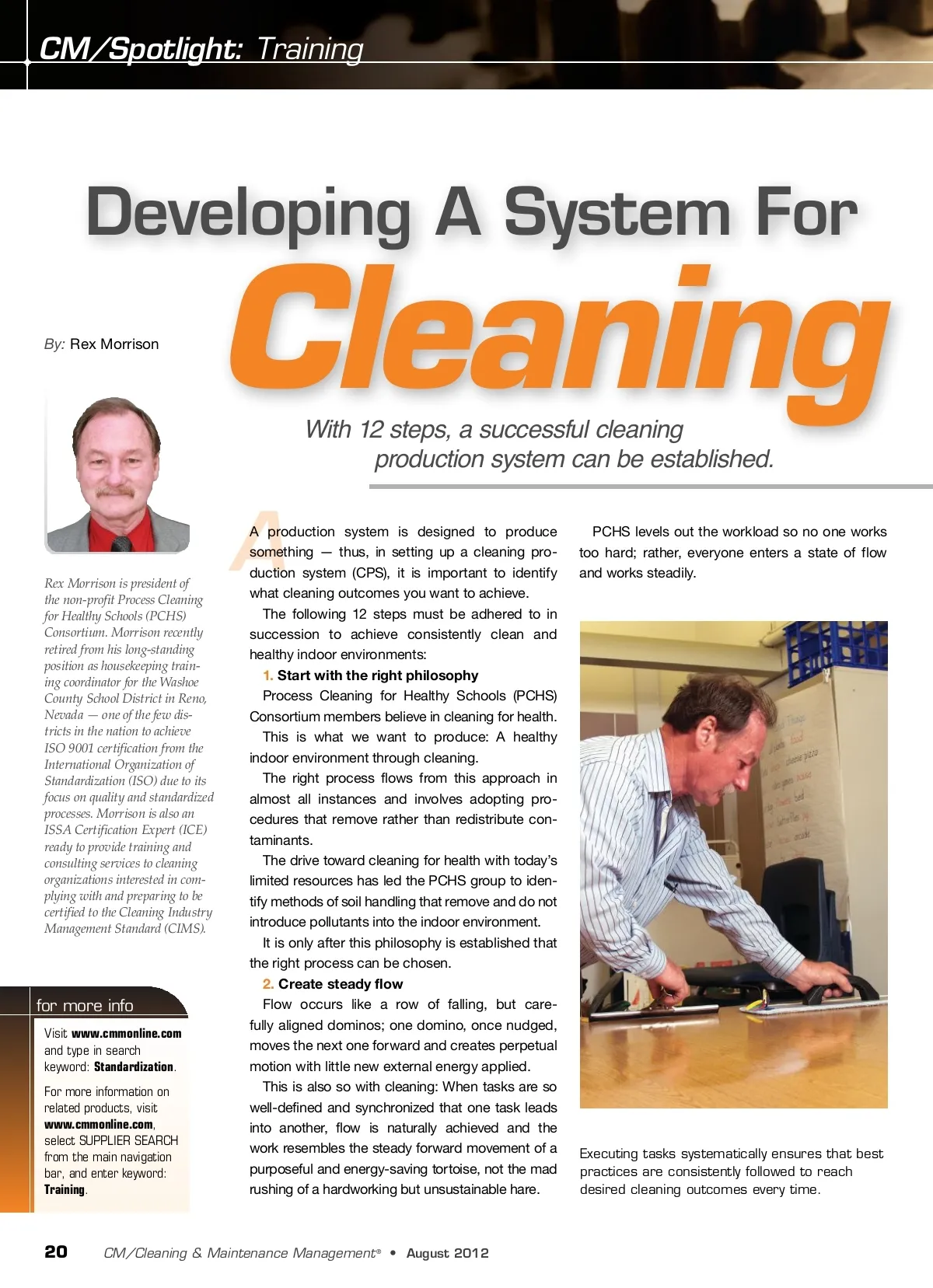
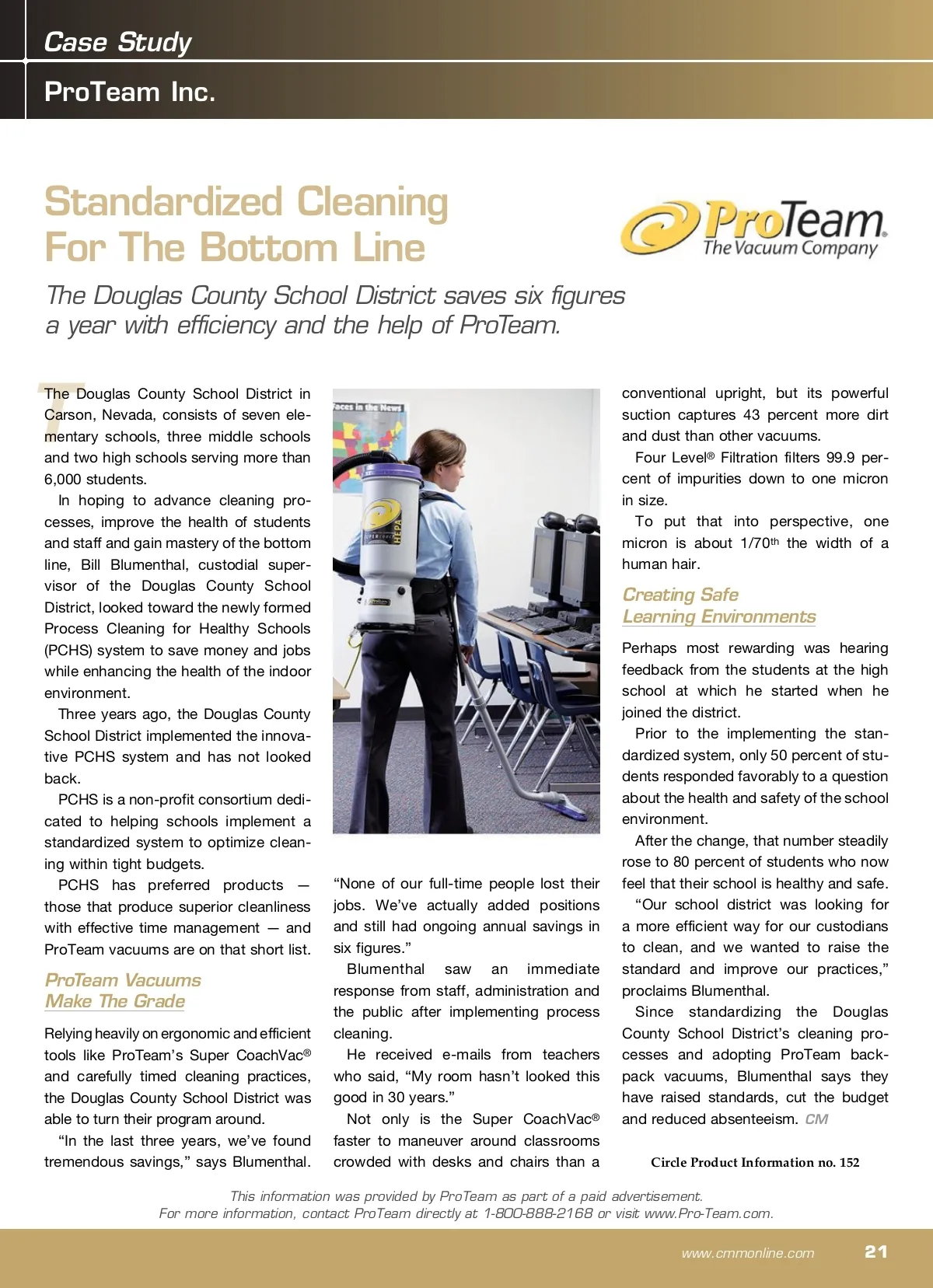
CM/Spotlight: Training Developing A System For By: Rex Morrison Cleaning With 12 steps, a successful cleaning production system can be established. Rex Morrison is president of the non-profit Process Cleaning for Healthy Schools (PCHS) Consortium. Morrison recently retired from his long-standing position as housekeeping train-ing coordinator for the Washoe County School District in Reno, Nevada — one of the few dis-tricts in the nation to achieve ISO 9001 certification from the International Organization of Standardization (ISO) due to its focus on quality and standardized processes. Morrison is also an ISSA Certification Expert (ICE) ready to provide training and consulting services to cleaning organizations interested in com-plying with and preparing to be certified to the Cleaning Industry Management Standard (CIMS). A for more info Visit www.cmmonline.com and type in search keyword: Standardization . For more information on related products, visit www.cmmonline.com , select SUPPLIER SEARCH from the main navigation bar, and enter keyword: Training . A production system is designed to produce something — thus, in setting up a cleaning pro-duction system (CPS), it is important to identify what cleaning outcomes you want to achieve. The following 12 steps must be adhered to in succession to achieve consistently clean and healthy indoor environments: 1. Start with the right philosophy Process Cleaning for Healthy Schools (PCHS) Consortium members believe in cleaning for health. This is what we want to produce: A healthy indoor environment through cleaning. The right process flows from this approach in almost all instances and involves adopting pro-cedures that remove rather than redistribute con-taminants. The drive toward cleaning for health with today’s limited resources has led the PCHS group to iden-tify methods of soil handling that remove and do not introduce pollutants into the indoor environment. It is only after this philosophy is established that the right process can be chosen. 2. Create steady flow Flow occurs like a row of falling, but care-fully aligned dominos; one domino, once nudged, moves the next one forward and creates perpetual motion with little new external energy applied. This is also so with cleaning: When tasks are so well-defined and synchronized that one task leads into another, flow is naturally achieved and the work resembles the steady forward movement of a purposeful and energy-saving tortoise, not the mad rushing of a hardworking but unsustainable hare. PCHS levels out the workload so no one works too hard; rather, everyone enters a state of flow and works steadily. Executing tasks systematically ensures that best practices are consistently followed to reach desired cleaning outcomes every time. 20 CM/Cleaning & Maintenance Management ® • August 2012
CMM – Archives August 2012: 20