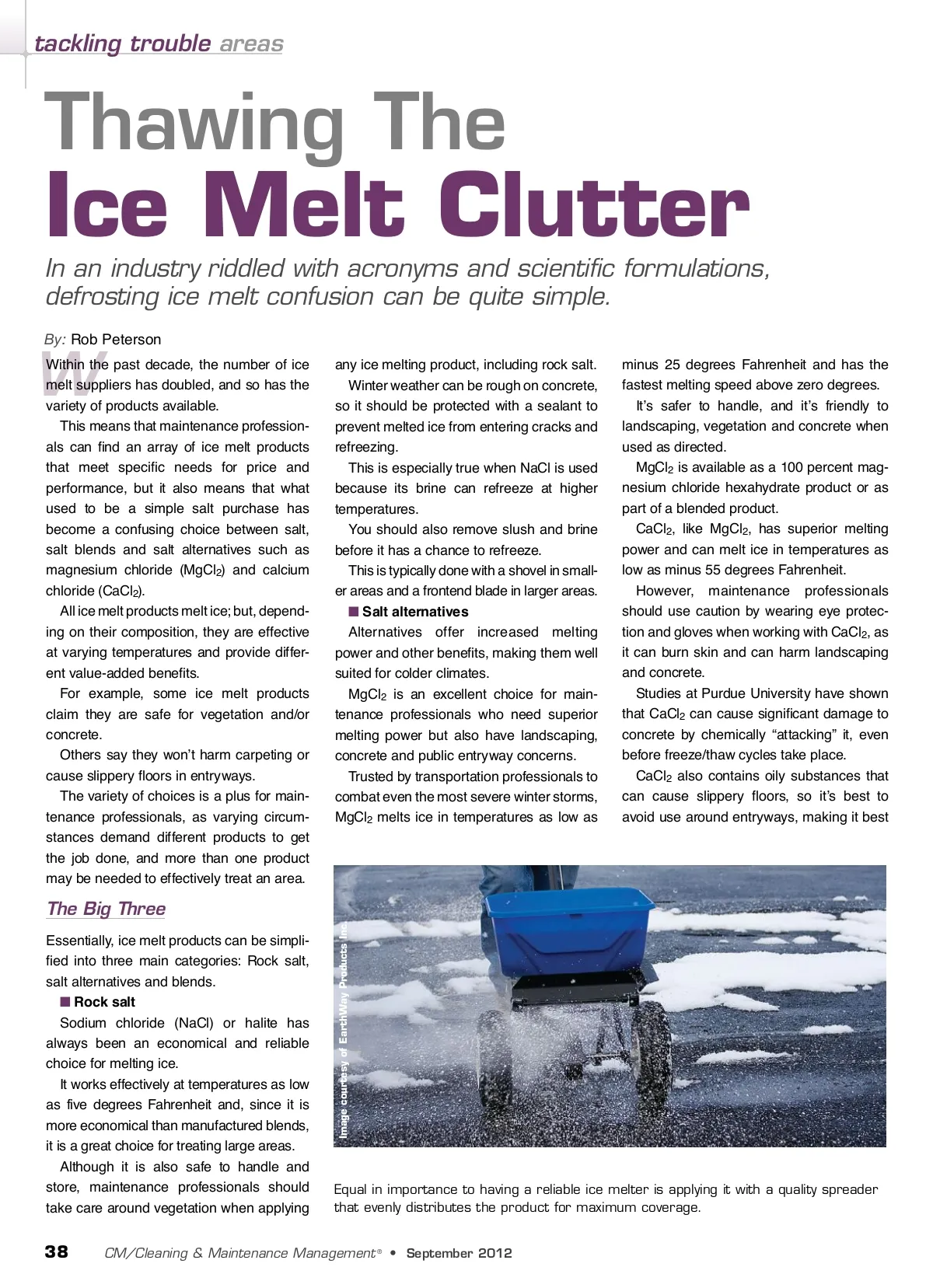
tackling trouble areas Thawing The Ice Melt Clutter In an industry riddled with acronyms and scientific formulations, defrosting ice melt confusion can be quite simple. By: Rob Peterson W Within the past decade, the number of ice melt suppliers has doubled, and so has the variety of products available. This means that maintenance profession-als can find an array of ice melt products that meet specific needs for price and performance, but it also means that what used to be a simple salt purchase has become a confusing choice between salt, salt blends and salt alternatives such as magnesium chloride (MgCl 2 ) and calcium chloride (CaCl 2 ). All ice melt products melt ice; but, depend-ing on their composition, they are effective at varying temperatures and provide differ-ent value-added benefits. For example, some ice melt products claim they are safe for vegetation and/or concrete. Others say they won’t harm carpeting or cause slippery floors in entryways. The variety of choices is a plus for main-tenance professionals, as varying circum-stances demand different products to get the job done, and more than one product may be needed to effectively treat an area. any ice melting product, including rock salt. Winter weather can be rough on concrete, so it should be protected with a sealant to prevent melted ice from entering cracks and refreezing. This is especially true when NaCl is used because its brine can refreeze at higher temperatures. You should also remove slush and brine before it has a chance to refreeze. This is typically done with a shovel in small-er areas and a frontend blade in larger areas. ■ Salt alternatives Alternatives offer increased melting power and other benefits, making them well suited for colder climates. MgCl 2 is an excellent choice for main-tenance professionals who need superior melting power but also have landscaping, concrete and public entryway concerns. Trusted by transportation professionals to combat even the most severe winter storms, MgCl 2 melts ice in temperatures as low as minus 25 degrees Fahrenheit and has the fastest melting speed above zero degrees. It’s safer to handle, and it’s friendly to landscaping, vegetation and concrete when used as directed. MgCl 2 is available as a 100 percent mag-nesium chloride hexahydrate product or as part of a blended product. CaCl 2 , like MgCl 2 , has superior melting power and can melt ice in temperatures as low as minus 55 degrees Fahrenheit. However, maintenance professionals should use caution by wearing eye protec-tion and gloves when working with CaCl 2 , as it can burn skin and can harm landscaping and concrete. Studies at Purdue University have shown that CaCl 2 can cause significant damage to concrete by chemically “attacking” it, even before freeze/thaw cycles take place. CaCl 2 also contains oily substances that can cause slippery floors, so it’s best to avoid use around entryways, making it best The Big Three Essentially, ice melt products can be simpli-fied into three main categories: Rock salt, salt alternatives and blends. ■ Rock salt Sodium chloride (NaCl) or halite has always been an economical and reliable choice for melting ice. It works effectively at temperatures as low as five degrees Fahrenheit and, since it is more economical than manufactured blends, it is a great choice for treating large areas. Although it is also safe to handle and store, maintenance professionals should take care around vegetation when applying Image courtesy of EarthWay Products Inc. Equal in importance to having a reliable ice melter is applying it with a quality spreader that evenly distributes the product for maximum coverage. 38 CM/Cleaning & Maintenance Management ® • September 2012
CMM – Archives Sept 2012: 38