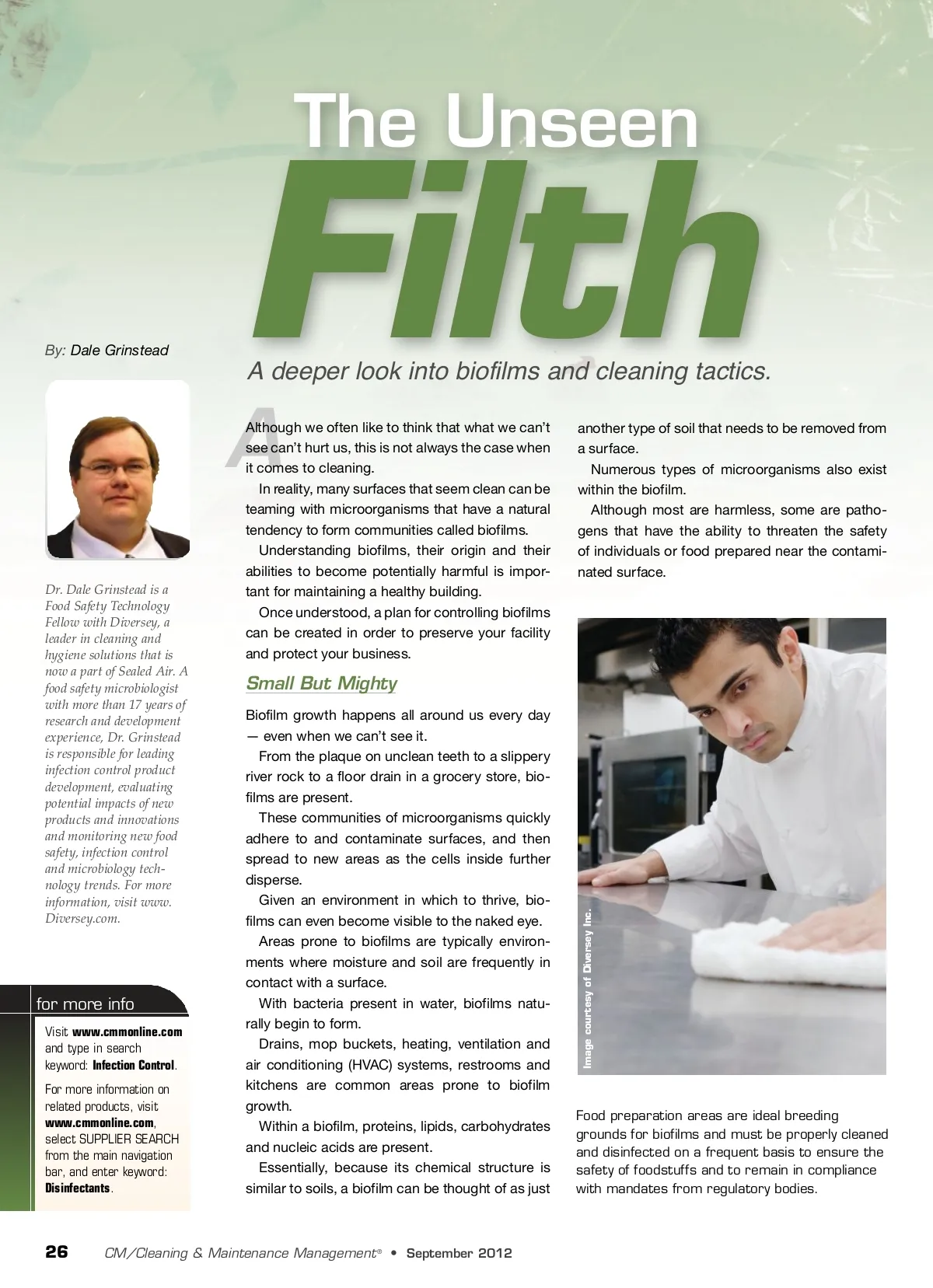
Filth By: Dale Grinstead The Unseen A deeper look into biofilms and cleaning tactics. A Dr. Dale Grinstead is a Food Safety Technology Fellow with Diversey, a leader in cleaning and hygiene solutions that is now a part of Sealed Air. A food safety microbiologist with more than 17 years of research and development experience, Dr. Grinstead is responsible for leading infection control product development, evaluating potential impacts of new products and innovations and monitoring new food safety, infection control and microbiology tech-nology trends. For more information, visit www. Diversey.com. Although we often like to think that what we can’t see can’t hurt us, this is not always the case when it comes to cleaning. In reality, many surfaces that seem clean can be teaming with microorganisms that have a natural tendency to form communities called biofilms. Understanding biofilms, their origin and their abilities to become potentially harmful is impor-tant for maintaining a healthy building. Once understood, a plan for controlling biofilms can be created in order to preserve your facility and protect your business. another type of soil that needs to be removed from a surface. Numerous types of microorganisms also exist within the biofilm. Although most are harmless, some are patho-gens that have the ability to threaten the safety of individuals or food prepared near the contami-nated surface. Small But Mighty Biofilm growth happens all around us every day — even when we can’t see it. From the plaque on unclean teeth to a slippery river rock to a floor drain in a grocery store, bio-films are present. These communities of microorganisms quickly adhere to and contaminate surfaces, and then spread to new areas as the cells inside further disperse. Given an environment in which to thrive, bio-films can even become visible to the naked eye. Areas prone to biofilms are typically environ-ments where moisture and soil are frequently in contact with a surface. With bacteria present in water, biofilms natu-rally begin to form. Drains, mop buckets, heating, ventilation and air conditioning (HVAC) systems, restrooms and kitchens are common areas prone to biofilm growth. Within a biofilm, proteins, lipids, carbohydrates and nucleic acids are present. Essentially, because its chemical structure is similar to soils, a biofilm can be thought of as just for more info Visit www.cmmonline.com and type in search keyword: Infection Control . For more information on related products, visit www.cmmonline.com , select SUPPLIER SEARCH from the main navigation bar, and enter keyword: Disinfectants . Food preparation areas are ideal breeding grounds for biofilms and must be properly cleaned and disinfected on a frequent basis to ensure the safety of foodstuffs and to remain in compliance with mandates from regulatory bodies. 26 CM/Cleaning & Maintenance Management ® • September 2012 Image courtesy of Diversey Inc.
CMM – Archives Sept 2012: 26