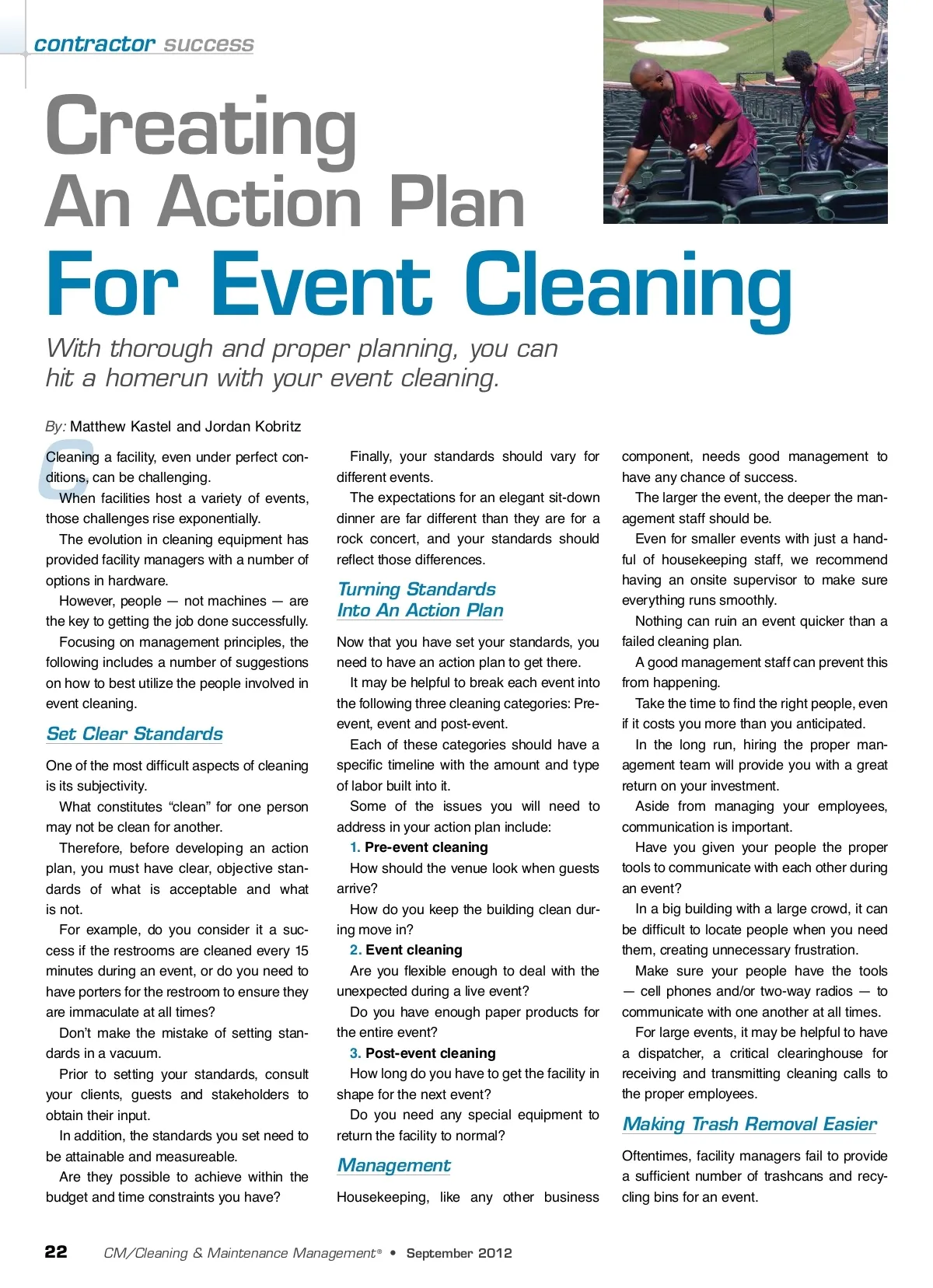
contractor success Creating An Action Plan For Event Cleaning With thorough and proper planning, you can hit a homerun with your event cleaning. By: Matthew Kastel and Jordan Kobritz C Cleaning a facility, even under perfect con-ditions, can be challenging. When facilities host a variety of events, those challenges rise exponentially. The evolution in cleaning equipment has provided facility managers with a number of options in hardware. However, people — not machines — are the key to getting the job done successfully. Focusing on management principles, the following includes a number of suggestions on how to best utilize the people involved in event cleaning. Finally, your standards should vary for different events. The expectations for an elegant sit-down dinner are far different than they are for a rock concert, and your standards should reflect those differences. Turning Standards Into An Action Plan Now that you have set your standards, you need to have an action plan to get there. It may be helpful to break each event into the following three cleaning categories: Pre-event, event and post-event. Each of these categories should have a specific timeline with the amount and type of labor built into it. Some of the issues you will need to address in your action plan include: 1. Pre-event cleaning How should the venue look when guests arrive? How do you keep the building clean dur-ing move in? 2. Event cleaning Are you flexible enough to deal with the unexpected during a live event? Do you have enough paper products for the entire event? 3. Post-event cleaning How long do you have to get the facility in shape for the next event? Do you need any special equipment to return the facility to normal? Set Clear Standards One of the most difficult aspects of cleaning is its subjectivity. What constitutes “clean” for one person may not be clean for another. Therefore, before developing an action plan, you must have clear, objective stan-dards of what is acceptable and what is not. For example, do you consider it a suc-cess if the restrooms are cleaned every 15 minutes during an event, or do you need to have porters for the restroom to ensure they are immaculate at all times? Don’t make the mistake of setting stan-dards in a vacuum. Prior to setting your standards, consult your clients, guests and stakeholders to obtain their input. In addition, the standards you set need to be attainable and measureable. Are they possible to achieve within the budget and time constraints you have? component, needs good management to have any chance of success. The larger the event, the deeper the man-agement staff should be. Even for smaller events with just a hand-ful of housekeeping staff, we recommend having an onsite supervisor to make sure everything runs smoothly. Nothing can ruin an event quicker than a failed cleaning plan. A good management staff can prevent this from happening. Take the time to find the right people, even if it costs you more than you anticipated. In the long run, hiring the proper man-agement team will provide you with a great return on your investment. Aside from managing your employees, communication is important. Have you given your people the proper tools to communicate with each other during an event? In a big building with a large crowd, it can be difficult to locate people when you need them, creating unnecessary frustration. Make sure your people have the tools — cell phones and/or two-way radios — to communicate with one another at all times. For large events, it may be helpful to have a dispatcher, a critical clearinghouse for receiving and transmitting cleaning calls to the proper employees. Making Trash Removal Easier Oftentimes, facility managers fail to provide a sufficient number of trashcans and recy-cling bins for an event. Management Housekeeping, like any other business 22 CM/Cleaning & Maintenance Management ® • September 2012
CMM – Archives Sept 2012: 22