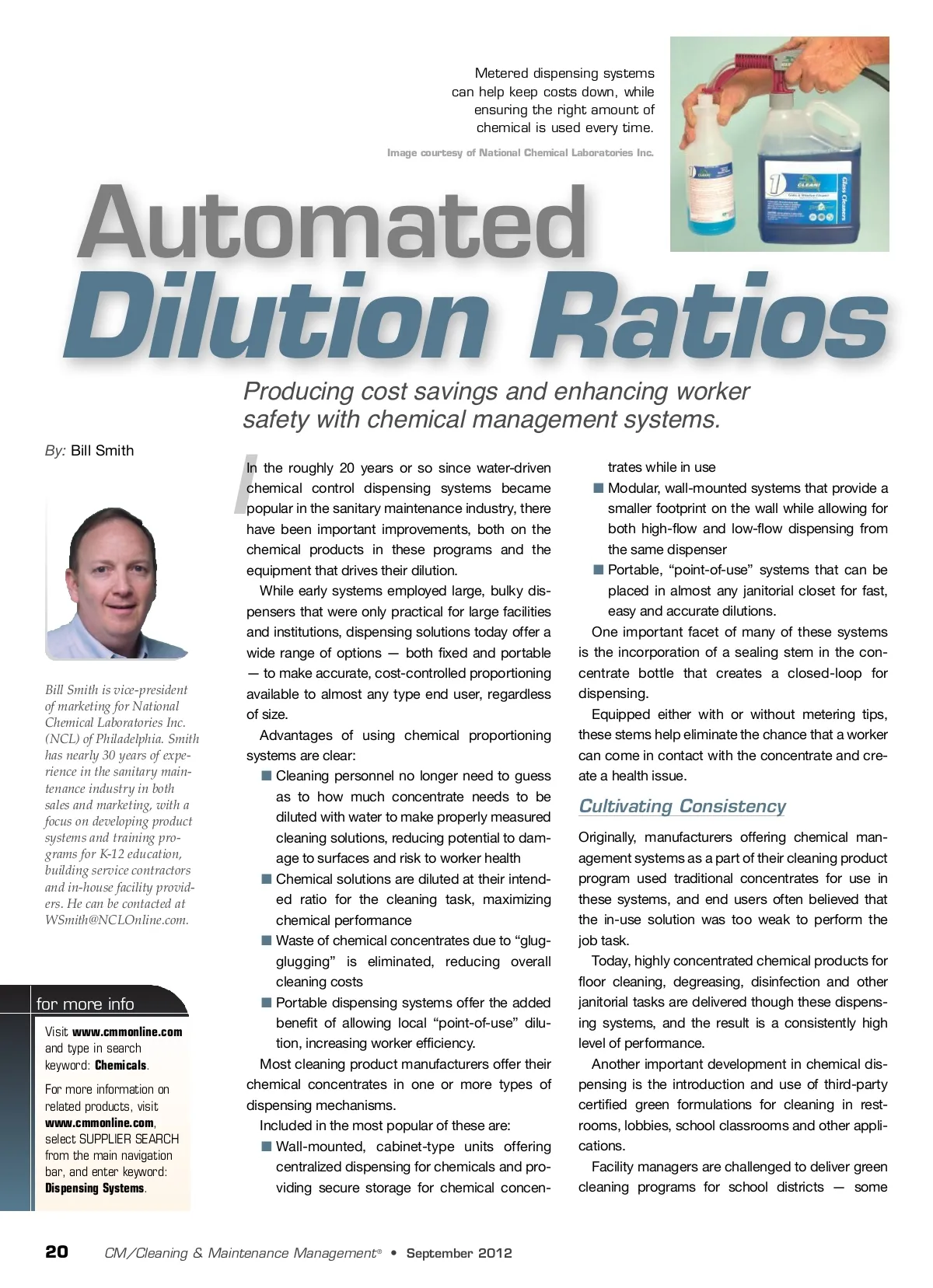
Metered dispensing systems can help keep costs down, while ensuring the right amount of chemical is used every time. Image courtesy of National Chemical Laboratories Inc. Dilution Ratios Producing cost savings and enhancing worker safety with chemical management systems. By: Bill Smith Automated I In the roughly 20 years or so since water-driven chemical control dispensing systems became popular in the sanitary maintenance industry, there have been important improvements, both on the chemical products in these programs and the equipment that drives their dilution. While early systems employed large, bulky dis-pensers that were only practical for large facilities and institutions, dispensing solutions today offer a wide range of options — both fixed and portable — to make accurate, cost-controlled proportioning available to almost any type end user, regardless of size. Advantages of using chemical proportioning systems are clear: ■ Cleaning personnel no longer need to guess as to how much concentrate needs to be diluted with water to make properly measured cleaning solutions, reducing potential to dam-age to surfaces and risk to worker health ■ Chemical solutions are diluted at their intend-ed ratio for the cleaning task, maximizing chemical performance ■ Waste of chemical concentrates due to “glug-glugging” is eliminated, reducing overall cleaning costs ■ Portable dispensing systems offer the added benefit of allowing local “point-of-use” dilu-tion, increasing worker efficiency. Most cleaning product manufacturers offer their chemical concentrates in one or more types of dispensing mechanisms. Included in the most popular of these are: ■ Wall-mounted, cabinet-type units offering centralized dispensing for chemicals and pro-viding secure storage for chemical concen-Bill Smith is vice-president of marketing for National Chemical Laboratories Inc. (NCL) of Philadelphia. Smith has nearly 30 years of expe-rience in the sanitary main-tenance industry in both sales and marketing, with a focus on developing product systems and training pro-grams for K-12 education, building service contractors and in-house facility provid-ers. He can be contacted at [email protected]. trates while in use ■ Modular, wall-mounted systems that provide a smaller footprint on the wall while allowing for both high-flow and low-flow dispensing from the same dispenser ■ Portable, “point-of-use” systems that can be placed in almost any janitorial closet for fast, easy and accurate dilutions. One important facet of many of these systems is the incorporation of a sealing stem in the con-centrate bottle that creates a closed-loop for dispensing. Equipped either with or without metering tips, these stems help eliminate the chance that a worker can come in contact with the concentrate and cre-ate a health issue. Cultivating Consistency Originally, manufacturers offering chemical man-agement systems as a part of their cleaning product program used traditional concentrates for use in these systems, and end users often believed that the in-use solution was too weak to perform the job task. Today, highly concentrated chemical products for floor cleaning, degreasing, disinfection and other janitorial tasks are delivered though these dispens-ing systems, and the result is a consistently high level of performance. Another important development in chemical dis-pensing is the introduction and use of third-party certified green formulations for cleaning in rest-rooms, lobbies, school classrooms and other appli-cations. Facility managers are challenged to deliver green cleaning programs for school districts — some for more info Visit www.cmmonline.com and type in search keyword: Chemicals . For more information on related products, visit www.cmmonline.com , select SUPPLIER SEARCH from the main navigation bar, and enter keyword: Dispensing Systems . 20 CM/Cleaning & Maintenance Management ® • September 2012
CMM – Archives Sept 2012: 20