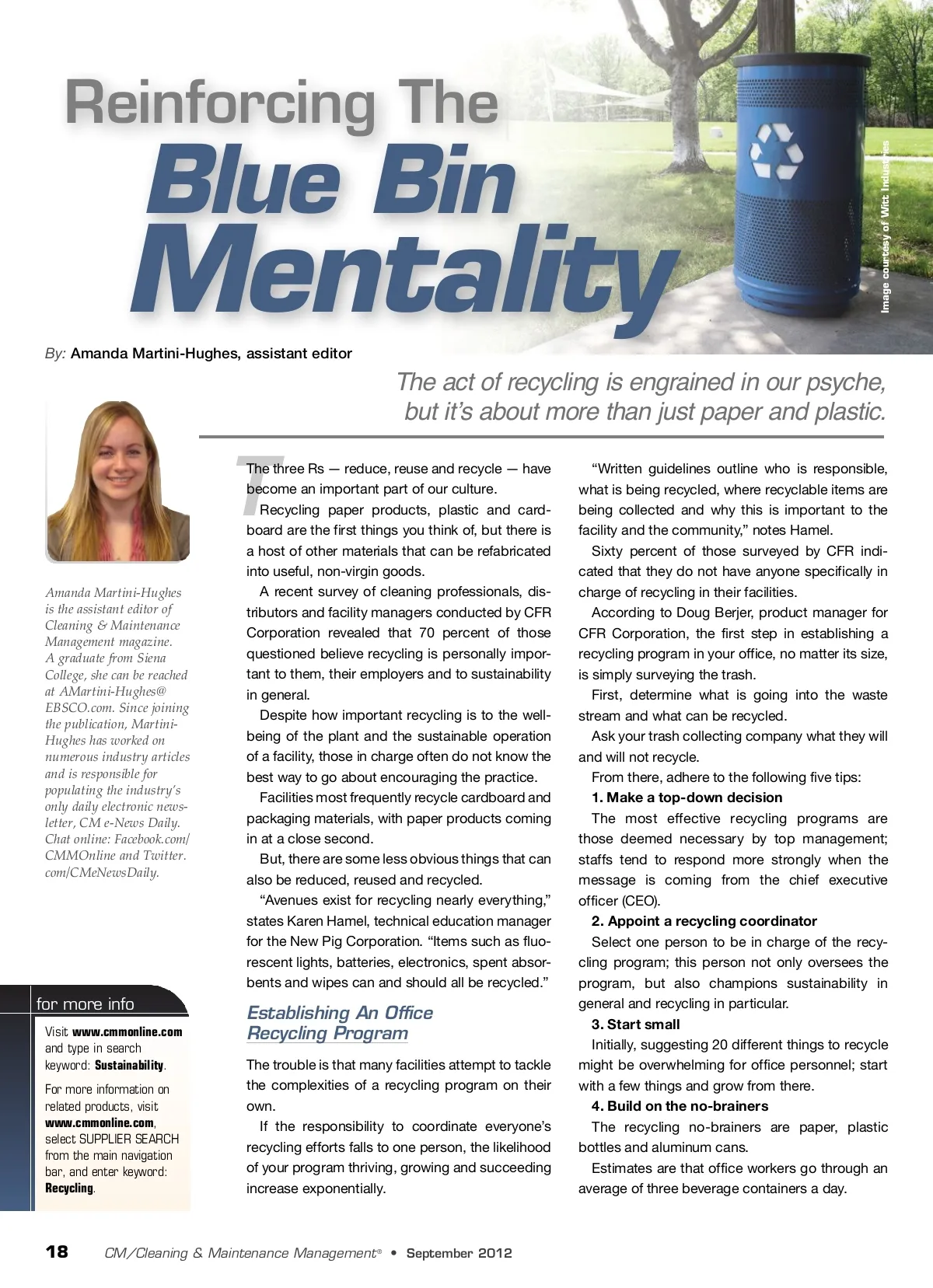
Reinforcing The Mentality By: Amanda Martini-Hughes, assistant editor Blue Bin T The act of recycling is engrained in our psyche, but it’s about more than just paper and plastic. The three Rs — reduce, reuse and recycle — have become an important part of our culture. Recycling paper products, plastic and card-board are the first things you think of, but there is a host of other materials that can be refabricated into useful, non-virgin goods. A recent survey of cleaning professionals, dis-tributors and facility managers conducted by CFR Corporation revealed that 70 percent of those questioned believe recycling is personally impor-tant to them, their employers and to sustainability in general. Despite how important recycling is to the well-being of the plant and the sustainable operation of a facility, those in charge often do not know the best way to go about encouraging the practice. Facilities most frequently recycle cardboard and packaging materials, with paper products coming in at a close second. But, there are some less obvious things that can also be reduced, reused and recycled. “Avenues exist for recycling nearly everything,” states Karen Hamel, technical education manager for the New Pig Corporation. “Items such as fluo-rescent lights, batteries, electronics, spent absor-bents and wipes can and should all be recycled.” “Written guidelines outline who is responsible, what is being recycled, where recyclable items are being collected and why this is important to the facility and the community,” notes Hamel. Sixty percent of those surveyed by CFR indi-cated that they do not have anyone specifically in charge of recycling in their facilities. According to Doug Berjer, product manager for CFR Corporation, the first step in establishing a recycling program in your office, no matter its size, is simply surveying the trash. First, determine what is going into the waste stream and what can be recycled. Ask your trash collecting company what they will and will not recycle. From there, adhere to the following five tips: 1. Make a top-down decision The most effective recycling programs are those deemed necessary by top management; staffs tend to respond more strongly when the message is coming from the chief executive officer (CEO). 2. Appoint a recycling coordinator Select one person to be in charge of the recy-cling program; this person not only oversees the program, but also champions sustainability in general and recycling in particular. 3. Start small Initially, suggesting 20 different things to recycle might be overwhelming for office personnel; start with a few things and grow from there. 4. Build on the no-brainers The recycling no-brainers are paper, plastic bottles and aluminum cans. Estimates are that office workers go through an average of three beverage containers a day. Amanda Martini-Hughes is the assistant editor of Cleaning & Maintenance Management magazine. A graduate from Siena College, she can be reached at AMartini-Hughes@ EBSCO.com. Since joining the publication, Martini-Hughes has worked on numerous industry articles and is responsible for populating the industry’s only daily electronic news-letter, CM e-News Daily. Chat online: Facebook.com/ CMMOnline and Twitter. com/CMeNewsDaily. for more info Visit www.cmmonline.com and type in search keyword: Sustainability . For more information on related products, visit www.cmmonline.com , select SUPPLIER SEARCH from the main navigation bar, and enter keyword: Recycling . Establishing An Office Recycling Program The trouble is that many facilities attempt to tackle the complexities of a recycling program on their own. If the responsibility to coordinate everyone’s recycling efforts falls to one person, the likelihood of your program thriving, growing and succeeding increase exponentially. 18 CM/Cleaning & Maintenance Management ® • September 2012 Image courtesy of Witt Industries
CMM – Archives Sept 2012: 18