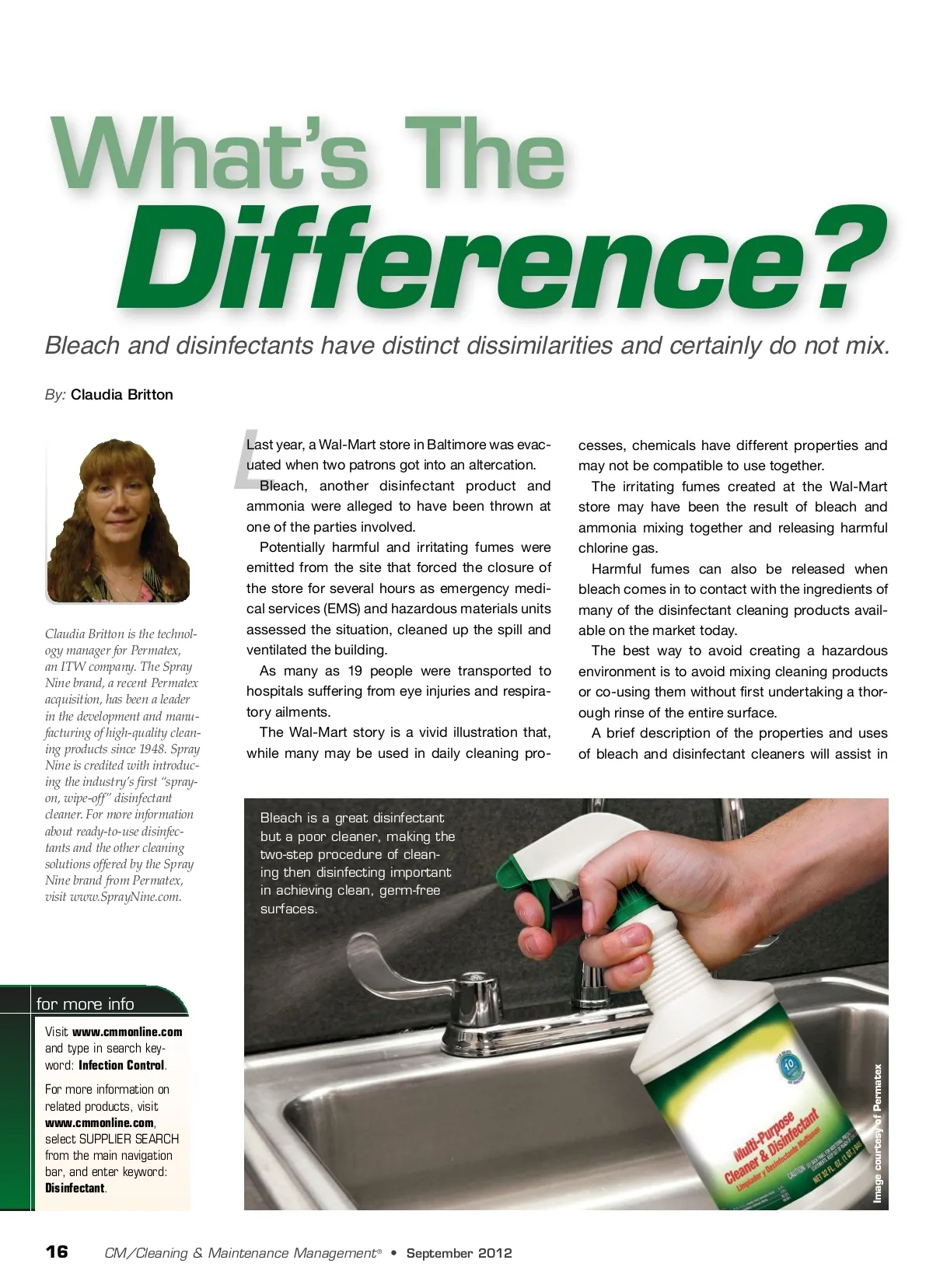
making the best product choice for the task at hand. When To Use Bleach Bleach has been around for more than 50 years and, when it is not being utilized as a weapon, it is both tried and true for many common tasks. In fact, bleach is an appropriate chemi-cal for removing or “bleaching” stains on many surfaces such as grout, shower cur-tains and, of course, our laundry whites. Bleach is recommended for use as a sanitizing agent for direct food contact surfaces such as dishes and utensils prior to putting them into service. It can also be used to disinfect fab-rics and other “soft and porous” surfaces that have been contaminated with harmful germs, a task which ready-to-use disin-fectant (RTU) cleaning products are not designed to perform. Although bleach can be used effectively as a disinfectant for many tasks, it has some attributes that can make it less desir-able than a RTU disinfecting product for some applications. Household bleach is made up of about five percent active sodium hypochlorite. At this concentration, bleach can be damaging to and/or cause discoloration of surfaces, clothing and other materials with which it comes in contact. It also emits a strong odor that can become unpleasant or irritating in areas that do not provide sufficient ventilation. Bleach must be diluted according to the label instructions to prepare the appropri-ate solution strength for the various clean-ing and disinfecting tasks it can perform. The contact time required for bleach to disinfect a surface is 10 minutes. In some circumstances, it is recom-mended that the contaminated surface be pre-cleaned prior to the disinfection step. Therefore, while it can be used effec-tively as a disinfectant, bleach has some inherent limitations, and a general purpose RTU disinfectant product may be the more appropriate choice. alkaline base with a quaternary ammonium compound (quat) as the active disinfecting ingredient. In addition to disinfecting, many of these products contain detergents for use in cleaning heavily soiled surfaces prior to the disinfection step. These disinfectant products will not “bleach” or discolor surfaces when they are used according to the label instruc-tions. RTU disinfectants are generally not cor-rosive or damaging to eyes, skin or contact surfaces in their final concentration. Most of these products have added fra-grances to impart a pleasant scent when they are used. As RTU products, they do not require any diluting and, in fact, they must be maintained in their original concentration to ensure adequate disinfection of treated surfaces. The required dwell time for many RTU disinfectant products is far less than the 10 minutes required for bleach to disinfect surfaces; it may be under one minute for some common germs. The main limitation in using RTU disin-fectant products is that they are designed to kill germs on hard and non-porous sur-faces, and they are not proven to be suf-ficiently effective in killing germs on fabrics and porous surfaces such as concrete. But, for cleaning staffs and facilities maintenance personnel, the ability to apply a disinfectant product in a RTU spray applicator to most hard, non-porous sur-faces to both clean and disinfect them can be a major benefit compared to the time and effort required to dilute and apply an appropriate solution of bleach. With a RTU disinfectant product, as long as you do not dilute or contaminate the contents inside the bottle, you are ready to go. Registration Requirements For Disinfectants The U.S. Environmental Protection Agency (EPA) is the regulating body for all disinfec-tant products. Efficacy claims and required product dwell times must be substantiated by a third-party laboratory using Association of Official Analytical Chemists’ (AOAC) germs When To Choose A Disinfectant The formula common to most RTU disin-fectants on the market today is an aqueous and test protocols and submitted to the EPA for review and acceptance. Only then can a germ kill claim be placed on the label of a disinfectant product. To be labeled as a hospital-grade dis-infectant product by the EPA, a prod-uct must pass the AOAC effectiveness tests against three specific organisms: Salmonella choleraesuis , for effective-ness against gram-negative bacteria; Staphylococcus aureus , for effective-ness against gram-positive bacteria; and Pseudomonas aeruginosa , for effective-ness against primarily nosocomial patho-gens — those favored for growth in a healthcare environment. Both bleach and many RTU disinfectant products carry hospital-grade disinfection claims. Consult the product label to determine if a disinfectant product meets your require-ments and the dwell time it requires to kill specific germs. Disinfectant manufacturers may also test products for effectiveness against specific organisms of known concern in healthcare facilities or to public health such as the human immunodeficiency virus (HIV), the hepatitis C and the herpes virus. It is the generally accepted belief of experts that a product satisfying the AOAC tests for a hospital-grade disinfec-tant designation would also be consid-ered effective against other relatively frag-ile microorganisms providing it is used according to the manufacturer’s label instructions. But, validation of a specific germ is nec-essary to claim it on the product label. The EPA allows both bleach and RTU disinfectant products to be used in health-care facilities and other industrial and institutional environments to both clean and kill germs. When used according to label instruc-tions, both categories of products can be effective. Cleaning and maintenance staffs in industrial and institutional facilities should consider ease of use, the speed of disin-fection, surface type and appropriateness in making their determination of whether bleach or a RTU disinfectant product is the more appropriate choice for a given application. CM www.cmmonline.com 17
CMM – Archives Sept 2012: 17