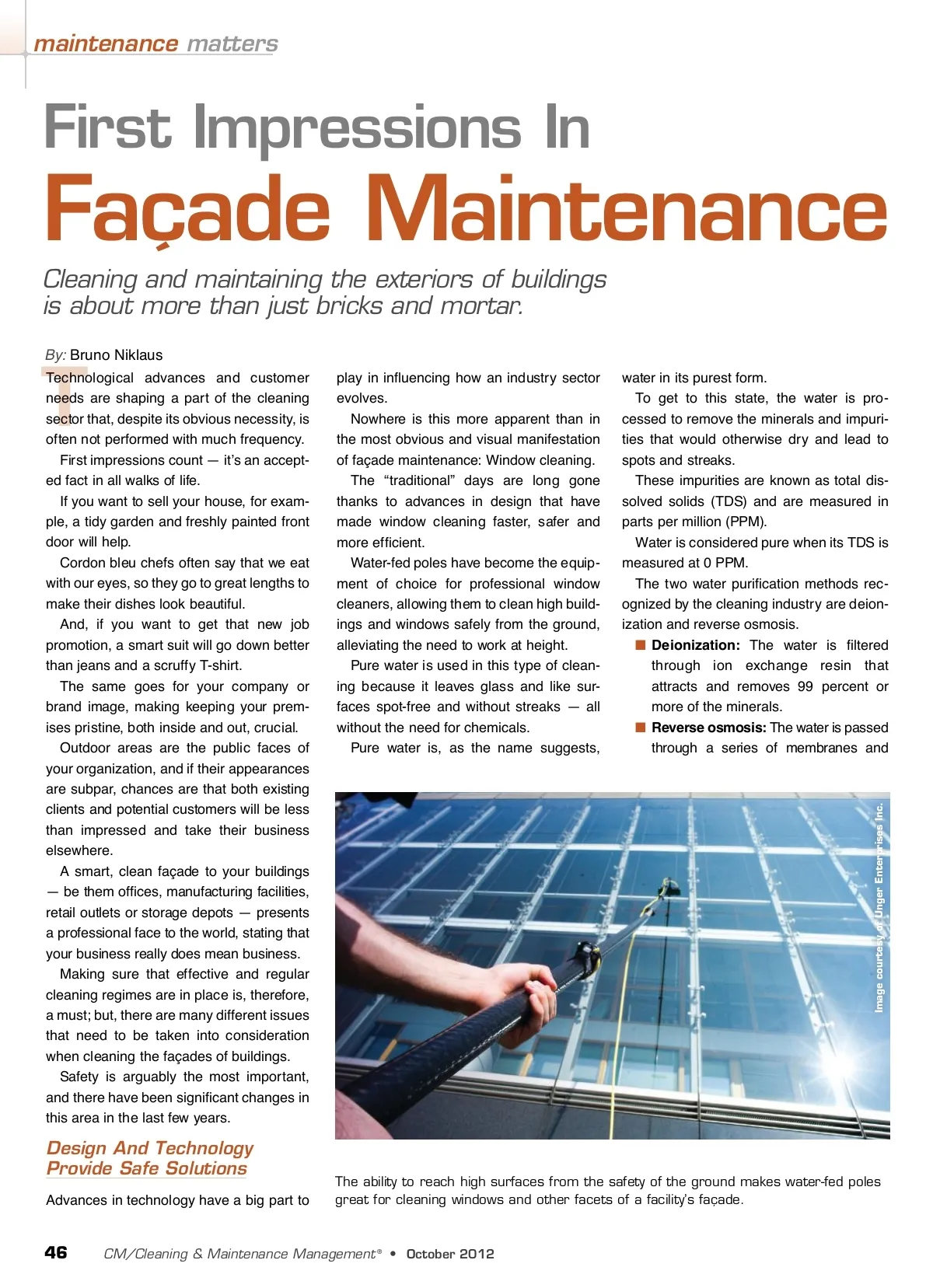
filters that retain and flush away most of the minerals and impurities. Water-fed poles continue to evolve, incor-porating new design features and materials that make these systems even easier to use, with the added bonus that they deliver even better quality results in a fraction of the time, which also saves companies money. The “next generation” water-fed poles provide a better balance between weight and rigidity than those of the past. Because the poles are lighter, it makes the cleaning worker’s job easier and more comfortable. But, this reduction in weight does not com-promise rigidity, meaning that the poles are still responsive and easy to control, allowing brushes to get right into every corner. Advances in brush head design, water delivery via multiple jets, angled adapters and pole extensions that allow workers to clean to heights of up to 65 feet while keep-ing their feet firmly on the ground all make this sector of the industry a fast-changing and exciting place. Water-fed pole technology is now step-ping up to the mark to provide solutions to this particular problem by developing larger brushes with soft bristles specifically designed to clean and prevent damage to solar panels. With further developments in technology and training in response to market forces and customer needs, façade maintenance and cleaning can only continue to become easier, quicker and more professional. CM Bruno Niklaus, vice president of global marketing for Unger Enterprises Inc., has 20 years of sales and marketing experience. He oversees the develop-ment and execution of Unger’s global marketing and branding strategies, as well as leading new product innovation initiatives for the professional business. In this capacity, Niklaus directs market research, market development and the launches of all Unger professional products. This year, he has been heavily involved in the launch of the new, groundbreaking Unger nLite water-fed pole system. More informa-tion can be found at www.UngerGlobal.com. Assess The Risks As with any cleaning job, site surveys and risk assessments will help to establish the best equipment to deliver the results you require. It can also identify gaps in knowledge or training and how frequently your façade needs to be cleaned. The different materials that need to be cleaned must also be taken into consider-ation. For instance, is it primarily glass windows that need to be cleaned, or are there other materials on the exterior of your building that will also need attention, such as metal signage? With an increasing awareness of environ-mental issues, companies are also think-ing about incorporating energy-efficiency upgrades into their business activities, and energy creation is a hot topic. Solar panels are becoming more and more popular — for residential and com-mercial applications — but they need regular cleaning. Exposure to rainwater does help to wash off some dirt, but it also adds new dirt par-ticles to the panel. A buildup of dirt and other soils can reduce the light absorption of solar panels, making them less efficient and effective. Product Information no. 222 on page 24 www.cmmonline.com 47
CMM – Archives Oct 2012: 47