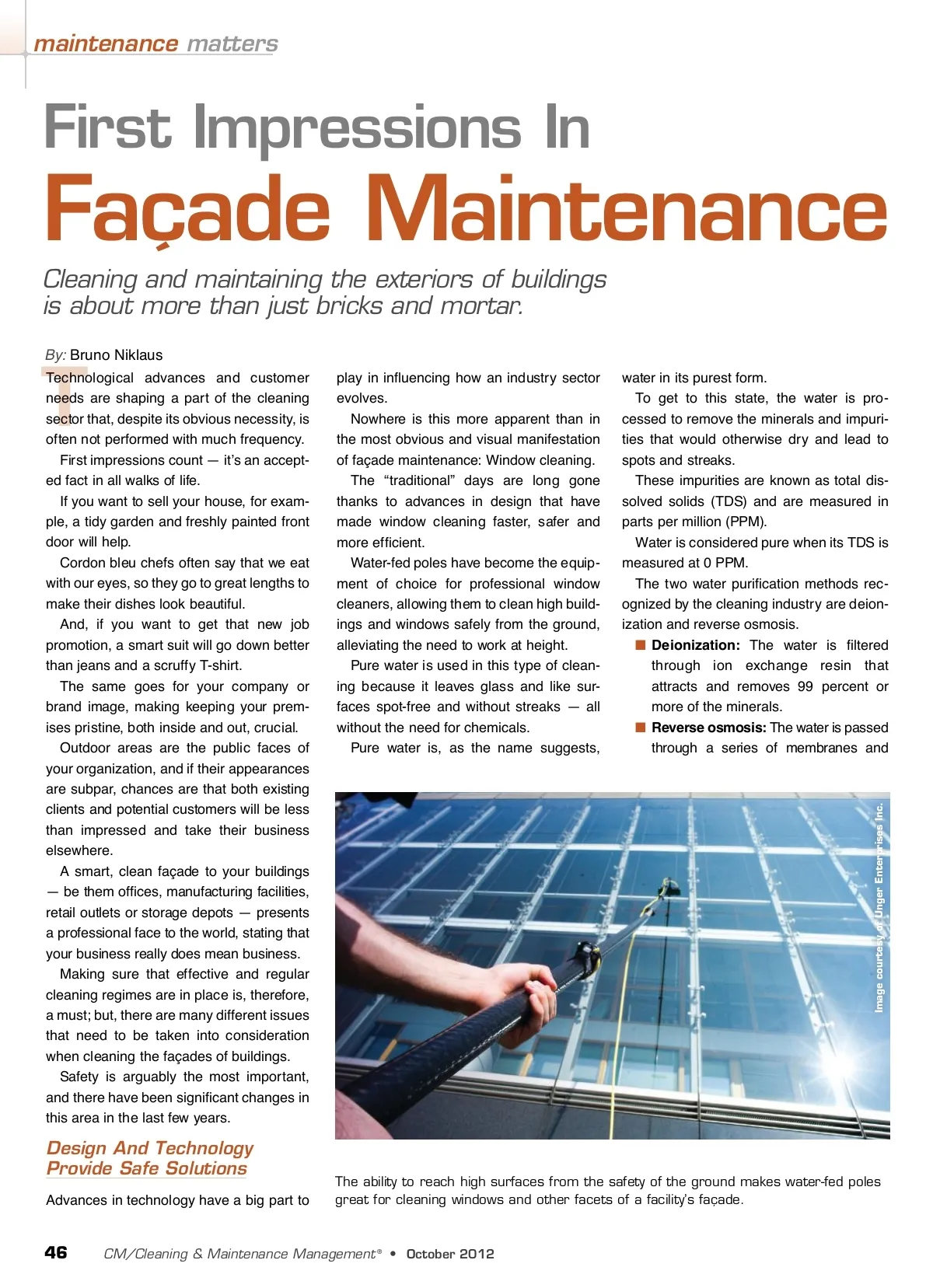
maintenance matters First Impressions In Façade Maintenance Cleaning and maintaining the exteriors of buildings is about more than just bricks and mortar. By: Bruno Niklaus T Technological advances and customer needs are shaping a part of the cleaning sector that, despite its obvious necessity, is often not performed with much frequency. First impressions count — it’s an accept-ed fact in all walks of life. If you want to sell your house, for exam-ple, a tidy garden and freshly painted front door will help. Cordon bleu chefs often say that we eat with our eyes, so they go to great lengths to make their dishes look beautiful. And, if you want to get that new job promotion, a smart suit will go down better than jeans and a scruffy T-shirt. The same goes for your company or brand image, making keeping your prem-ises pristine, both inside and out, crucial. Outdoor areas are the public faces of your organization, and if their appearances are subpar, chances are that both existing clients and potential customers will be less than impressed and take their business elsewhere. A smart, clean façade to your buildings — be them offices, manufacturing facilities, retail outlets or storage depots — presents a professional face to the world, stating that your business really does mean business. Making sure that effective and regular cleaning regimes are in place is, therefore, a must; but, there are many different issues that need to be taken into consideration when cleaning the façades of buildings. Safety is arguably the most important, and there have been significant changes in this area in the last few years. play in influencing how an industry sector evolves. Nowhere is this more apparent than in the most obvious and visual manifestation of façade maintenance: Window cleaning. The “traditional” days are long gone thanks to advances in design that have made window cleaning faster, safer and more efficient. Water-fed poles have become the equip-ment of choice for professional window cleaners, allowing them to clean high build-ings and windows safely from the ground, alleviating the need to work at height. Pure water is used in this type of clean-ing because it leaves glass and like sur-faces spot-free and without streaks — all without the need for chemicals. Pure water is, as the name suggests, water in its purest form. To get to this state, the water is pro-cessed to remove the minerals and impuri-ties that would otherwise dry and lead to spots and streaks. These impurities are known as total dis-solved solids (TDS) and are measured in parts per million (PPM). Water is considered pure when its TDS is measured at 0 PPM. The two water purification methods rec-ognized by the cleaning industry are deion-ization and reverse osmosis. ■ Deionization: The water is filtered through ion exchange resin that attracts and removes 99 percent or more of the minerals. ■ Reverse osmosis: The water is passed through a series of membranes and Design And Technology Provide Safe Solutions Advances in technology have a big part to The ability to reach high surfaces from the safety of the ground makes water-fed poles great for cleaning windows and other facets of a facility’s façade. 46 CM/Cleaning & Maintenance Management ® • October 2012 Image courtesy of Unger Enterprises Inc.
CMM – Archives Oct 2012: 46